
Class 7 Adjective Clauses Worksheet: Grammar Worksheet
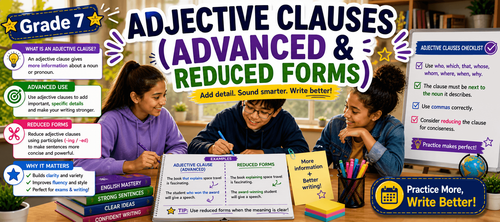

Master Advanced Sentences with This English Grammar Worksheet Grade 7 Adjective Clauses (Advanced & Reduced Forms)
Learning how to describe people, places, and things in a more detailed way makes writing stronger and more meaningful. This English grammar worksheet is specially designed for Grade 7 students who are learning Adjective Clauses (Advanced & Reduced Forms). Through sentence identification, multiple choice practice, rewriting tasks, fill in the blanks, and paragraph writing, students get many chances to understand how descriptive clauses work inside real sentences. The worksheet moves from simple recognition to advanced usage, helping learners become more confident in sentence building and grammar application.
Download these English grammar worksheets and practice regularly to strengthen your language skills and build a strong foundation. You can also book a free trial to get expert guidance and improve your reading, writing, and comprehension abilities. The worksheets are designed in a simple and structured way to help K–8 students learn grammar concepts easily and use them confidently in everyday communication.
What Is the Topic?
Adjective Clauses (Advanced & Reduced Forms) are sentence parts that give more information about a noun. In this Grade 7 worksheet, students learn to spot clauses such as who won the chess match or that sells kites and also reduced forms such as planted near the school bus or wearing a raincoat. These structures help sentences sound more connected and descriptive. Students are expected to understand where the adjective clause appears, how relative words like who and that are used, and how some clauses can be shortened into reduced forms.
What’s in This Worksheet?
1. The worksheet begins with underlining tasks where students identify the adjective clause or reduced form in each sentence.
2. It then provides multiple choice questions where learners choose the sentence with the correct adjective clause usage.
3. Students also complete rewriting practice by correcting wrong relative pronouns, adding helping verbs, and fixing sentence agreement.
4. A passage-based fill in the blanks section helps students use adjective clauses in connected paragraph context.
5. The worksheet ends with a paragraph writing task on a memorable visit using adjective clauses.
6. This full structure helps students prepare for grammar tests, school assignments, editing tasks, and writing improvement.
Definitions, Examples, Techniques, and Tips
An adjective clause is a group of words that describes a noun. In the worksheet, examples include who won the chess match, that sells kites, and who knew every lane.
A reduced adjective form is a shortened descriptive phrase that also tells more about the noun. Examples from the worksheet include planted near the school bus, arranged in blue folders, and wearing a raincoat.
Students also practice choosing the correct relative clause through MCQs. For example, they learn that The player who scored was absent is the correct construction.
Sentence rewriting gives a technique for improvement. Students notice errors like using which for people or missing helping verbs and then rewrite the sentence correctly.
A useful tip is to look at the noun first and then decide which describing clause fits naturally after it.
Why Is It Important to Learn This?
Learning adjective clauses is important because it helps Grade 7 students avoid very short and repetitive sentences. Instead of writing many simple lines, students can combine ideas in one meaningful sentence. This makes writing richer and more advanced. It also helps learners understand grammar used in textbooks, comprehension passages, and formal writing. Since adjective clauses are common in English communication, mastering them improves both grammar confidence and sentence fluency.
Where Will This Knowledge Help You?
This knowledge helps in school grammar exams where students must identify clauses, correct sentence errors, and complete blanks accurately.
It also helps in paragraph writing because students can add more details to nouns while writing about people, places, or experiences.
During class participation, students can understand teacher explanations about sentence combination and descriptive writing more clearly.
In editing and proofreading tasks, learners can quickly notice incorrect relative pronouns or missing verbs.
How to Use This Worksheet?
1. Start by reading each sentence independently and try to identify or complete the adjective clause without looking at help.
2. Attempt every section in the same order given in the worksheet, from underlining to paragraph writing.
3. After solving, compare your responses with the complete solutions carefully because the solutions follow the exact worksheet order.
4. Check whether you used the correct descriptive clause, correct relative pronoun, and proper helping verb.
5. Rewrite any wrong answers once again for stronger retention.
6. Practice similar sentence patterns regularly to gain fluency in adjective clause usage.
Important Tips and Tricks
1. Always check whether the noun refers to a person or thing before choosing who, that, or which.
2. Do not leave out helping verbs in reduced or full adjective clause corrections when the sentence needs them.
3. Read the full sentence aloud to see whether the descriptive part sounds complete and natural.
4. In exams, underline the noun first and then locate the words that describe it.
5. For rewriting tasks, correct only the grammar mistake mentioned in the prompt and keep the sentence meaning the same.
6. In writing tasks, include descriptive clauses naturally instead of forcing too many into one line.
Complete Answer Key
Exercise No. 1
1. who won the chess match
2. that sells kites
3. planted near the school bus
4. that leads to Pune
5. selected for cricket practice
6. kept on Meera's desk
7. arranged in blue folders
8. who knew every lane
9. who teaches music
10. wearing a raincoat
Exercise No. 2
1. b
2. c
3. b
4. a
5. b
6. c
7. b
8. a
9. a
10. b
Exercise No. 3
1. The boy who won the race thanked us.
2. The girl wearing blue is Riya.
3. The road that leads to school is muddy.
4. The file that is on my desk is missing.
5. The man that called was busy.
6. The books which were arranged neatly are new.
7. The lady who teaches dance is kind.
8. The snacks sold in canteen were stale.
9. The player who chosen for cricket smiled.
10. The bus that is going to Delhi is late.
Exercise No. 4
1. that
2. who
3. clicking
4. that
5. who
6. who
7. decorated
8. that
9. who
10. that
Exercise No. 5
Last month, I visited a park that was full of flowers. I saw children who were playing on the swings. There was a pond that had many ducks. A man selling balloons stood near the gate. I clicked pictures that looked very beautiful. It was a visit that I will always remember.
With regular practice using this English grammar worksheet, Grade 7 students can become more confident in using Adjective Clauses (Advanced & Reduced Forms) correctly in both grammar exercises and real writing. Step by step, these sentence-building activities help learners write in a more descriptive, mature, and polished way.