
Class 7 Adverbs Worksheet Covering All Major Types
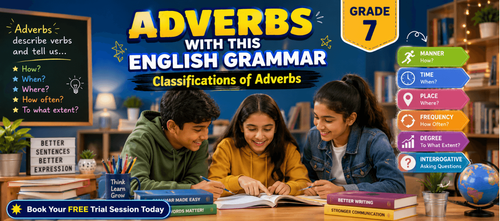

Adverbs with This English Grammar Worksheet for Grade 7 | Classifications of Adverbs
Adverbs help make sentences more meaningful and expressive. They tell us how, when, where, how often, and to what extent something happens. This Class 7 Adverbs Worksheet Covering All Major Types helps students understand the different classifications of adverbs through engaging grammar activities and sentence practice. Students will learn to identify adverbs, classify them correctly, complete sentences, rewrite incorrect sentences, and use adverbs naturally in paragraph writing.
This English grammar worksheet for Grade 7 gives students structured practice with adverbs of manner, time, place, frequency, degree, and interrogative adverbs. The exercises are designed in a simple and student-friendly way so learners can strengthen grammar concepts and improve sentence-building skills confidently.
Download these English grammar worksheets and practice regularly to strengthen your language skills and build a strong foundation. You can also book a free trial to get expert guidance and improve your reading, writing, and comprehension abilities. The worksheets are designed in a simple and structured way to help K–8 students learn grammar concepts easily and use them confidently in everyday communication.

What Is the Topic?
This worksheet focuses on the classifications of adverbs. Adverbs are words that describe verbs and provide extra information about actions. They help explain how something happens, when it happens, where it happens, how often it happens, and to what extent it happens.
Students will practice:
• Identifying adverbs in sentences
• Labeling the type of adverb
• Sorting adverbs into categories
• Completing sentences using suitable adverbs
• Correcting adverb errors
• Writing a paragraph using different kinds of adverbs
The worksheet helps students understand how adverbs improve communication and sentence clarity.
What’s in This Worksheet?
1. Underline the adverb and identify its type.
2. Sort adverbs into the correct categories.
3. Complete sentences using suitable adverbs.
4. Rewrite incorrect sentences correctly.
5. Practice adverbs of manner, time, place, frequency, degree, and interrogative adverbs.
6. Improve grammar correction and sentence formation skills.
7. Strengthen paragraph writing using adverbs naturally.
8. Build confidence in grammar usage and written communication.
Definitions, Examples, Techniques, and Tips
Adverbs of manner describe how an action happens.
Examples:
• beautifully
• softly
• gently
• loudly
• carefully
Adverbs of time describe when an action happens.
Examples:
• tomorrow
• yesterday
• today
• tonight
• soon
Adverbs of place describe where an action happens.
Examples:
• outside
• upstairs
• here
• there
Adverbs of frequency describe how often an action happens.
Examples:
• often
• always
• rarely
• never
• sometimes
Adverbs of degree describe the intensity or extent of an action.
Examples:
• nearly
• almost
• fully
• just
Interrogative adverbs are used to ask questions.
Examples:
• when
• where
Helpful techniques for solving the worksheet:
• Read the sentence carefully before choosing the adverb.
• Identify what the adverb is describing.
• Check whether the word answers how, when, where, how often, or to what extent.
• Use proper adverb forms while rewriting sentences.
• Practice using adverbs naturally in speaking and writing.
Quick tips:
• Many adverbs of manner end in “-ly.”
• Frequency adverbs usually come before the main verb.
• Interrogative adverbs are commonly used at the beginning of questions.
• Degree adverbs show intensity or extent.
Why Is It Important to Learn This?
Learning classifications of adverbs is important because adverbs improve sentence meaning and communication. They help students express actions clearly and accurately. Using adverbs correctly also improves grammar, writing, and speaking confidence.
This topic helps students:
• Write detailed sentences
• Improve grammar accuracy
• Build better communication skills
• Avoid common grammar mistakes
• Perform better in school assignments and exams
Where Will This Knowledge Help You?
Students can use this grammar knowledge in:
• School examinations
• Creative writing
• Story writing
• Paragraph writing
• English speaking activities
• Reading comprehension
• Daily conversations
• Classroom participation
Correct adverb usage makes both writing and speaking more effective and interesting.
How to Use This Worksheet?
1. Read each question carefully before answering.
2. Attempt all exercises independently first.
3. Underline or complete the adverbs according to the instructions.
4. Follow the exact order of the worksheet while checking answers.
5. Compare your answers carefully with the solutions.
6. Correct mistakes neatly and rewrite sentences properly.
7. Practice similar sentence patterns regularly.
8. Use paragraph writing practice to improve practical grammar usage.
Important Tips and Tricks
1. Do not confuse adjectives with adverbs.
2. Remember that adverbs usually describe actions.
3. Identify whether the adverb tells how, when, where, how often, or to what extent.
4. Use proper adverb forms such as “beautifully” instead of “beautiful.”
5. While rewriting sentences, check grammar and sentence structure carefully.
6. Read sentences aloud to check whether they sound correct.
7. Use suitable adverbs according to the clue given in brackets.
8. In paragraph writing, include all required types of adverbs naturally.
Complete Answer Key
Exercise 1
1. She sings __beautifully__.
Manner
2. We __often__ go for a walk in the evening.
Frequency
3. He is __always__ late for school.
Frequency
4. The child is playing __outside__.
Place
5. __When__ will you return?
Time
6. He __nearly__ missed the train.
Degree
7. They will arrive __tomorrow__.
Time
8. The boy jumped __high__ to catch the ball.
Manner
9. She spoke very __softly__.
Manner
10. __Where__ are your shoes?
Place
Exercise 2
MANNER
quickly
suddenly
gently
loudly
carefully
happily
TIME
yesterday
already
soon
today
tonight
PLACE
upstairs
here
outside
there
FREQUENCY
never
often
rarely
always
sometimes
DEGREE
almost
nearly
just
fully
Exercise 3
1. He answered the question politely. (manner)
2. We go to the park often. (frequency)
3. She will return tomorrow. (time)
4. The cat sat under the mat. (place)
5. He almost completely missed the bus. (degree)
6. When did they leave? (interrogative)
7. She always visits her grandmother. (frequency)
8. They played happily in the rain. (manner)
9. We reached home yesterday. (time)
10. Where are you going? (interrogative)
Exercise 4
1. She sings beautifully on stage.
2. They arrived late for the morning meeting.
3. He completed the test faster than I did.
4. Please speak politely to your teacher.
5. The children are playing happily outside.
6. I am always forgetting my homework.
7. She almost perfectly cooked the rice.
8. He explained the topic clearly so everyone could understand.
9. The baby cried loudly in the room upstairs.
10. We will soon finish the project.
Exercise 5
Every morning, I wake up early and quickly get ready for school. I always brush my teeth carefully and happily eat my breakfast downstairs. I sometimes walk outside with my friends before class. Today, I reached school very early because the roads were almost empty. During class, I listened carefully and answered questions confidently. After school, I usually play outside and gently help my younger brother with homework. Tonight, I will complete my assignments fully and sleep peacefully.
This Grade 7 English grammar worksheet on classifications of adverbs gives students meaningful practice with all major types of adverbs. Regular practice with these exercises can improve grammar understanding, writing confidence, and communication skills. Continue practicing to become more confident in using adverbs correctly in both spoken and written English.