
Class 7 Assertive to Interrogative Worksheet: Grammar Worksheet
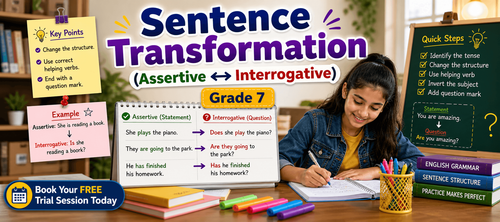

Master Sentence Transformation with This English Grammar Worksheet for Grade 7 on Assertive to Interrogative
Have you ever wondered how a simple statement can turn into a question? This is exactly what students explore in this Grade 7 English grammar worksheet on Assertive to Interrogative sentences. Learning how to transform sentences helps students understand how language works in real life. Whether asking questions in class, writing answers in exams, or having everyday conversations, this skill plays an important role.
This worksheet introduces students to sentence transformation in a structured and engaging way. It includes activities like rewriting sentences, choosing correct options, filling in blanks, and writing short paragraphs. Each task is designed to help learners recognize patterns and apply rules confidently.
Download these English grammar worksheets and practice regularly to strengthen your language skills and build a strong foundation. You can also book a free trial to get expert guidance and improve your reading, writing, and comprehension abilities. The worksheets are designed in a simple and structured way to help K–8 students learn grammar concepts easily and use them confidently in everyday communication.
What Is the Topic?
Sentence Transformation (Assertive ↔ Interrogative) is a grammar concept where students learn how to change a statement into a question. An assertive sentence gives information, while an interrogative sentence asks something. In this Grade 7 worksheet, students practice identifying sentence structure and converting it correctly without changing the meaning.
Students are expected to understand how words move in a sentence and how helping verbs are used to form questions. This helps them improve both written and spoken communication skills.
What’s in This Worksheet?
1. The worksheet begins with sentence rewriting tasks where students change assertive sentences into interrogative ones.
2. It includes multiple choice questions where students select the correct interrogative form from given options.
3. There are transformation exercises that require students to apply rules to negative sentences.
4. A fill in the blanks passage helps students practice grammar in context.
5. A paragraph writing task encourages students to use language creatively.
These activities help students practice different formats commonly seen in exams and improve their grammar accuracy.
Definitions, Examples, Techniques, and Tips
Definition:
An assertive sentence is a statement that gives information. An interrogative sentence is a question that asks something.
Examples from the worksheet:
She is very happy.
Is she very happy?
He finished his homework.
Did he finish his homework?
Technique:
Students learn to identify the helping verb and bring it to the beginning of the sentence while forming a question.
Tip:
Always ensure the sentence ends with a question mark when converting it into an interrogative form.
Why Is It Important to Learn This?
Learning sentence transformation is important because it helps students understand how different sentence types work. It improves their ability to ask questions clearly and correctly. This skill is useful in exams, writing tasks, and everyday communication. It also strengthens grammar basics, which are essential for higher-level learning.
Where Will This Knowledge Help You?
This knowledge helps students in school exams where sentence transformation questions are common. It also helps in writing assignments where correct sentence structure is important. In class discussions, students can ask better questions and participate more actively. It also supports better communication in daily life.
How to Use This Worksheet?
1. Attempt all questions on your own before checking answers.
2. Read each sentence carefully and understand its structure.
3. Compare your answers with the answer key provided.
4. Correct your mistakes and rewrite the correct answers.
5. Practice regularly to improve speed and accuracy.
The solutions follow the exact worksheet order, so students should compare their answers carefully.
Important Tips and Tricks
1. Always identify the helping verb before forming a question.
2. Make sure the meaning of the sentence does not change.
3. Use correct word order while forming interrogative sentences.
4. Pay attention to tense while rewriting sentences.
5. Read all options carefully in multiple choice questions before selecting an answer.
6. For writing tasks, focus on clarity and proper sentence structure.
7. Avoid skipping any question while practicing.
Complete Answer Key
Exercise 1 – Interrogative Sentences
1. Is she very happy?
2. Did he finish his homework?
3. Will he attend the meeting?
4. Does the train arrive on time?
5. Do you like mangoes?
6. Are they playing outside?
7. Did we go to Delhi yesterday?
8. Have they completed the work?
9. Can she solve the problem?
10. Was she reading a novel?
Exercise 2 – MCQs
1. b
2. a
3. b
4. a
5. b
6. b
7. a
8. b
9. a
10. b
Exercise 3 – Interrogative Sentences
1. Is she not happy?
2. Does he not like tea?
3. Did we not finish work?
4. Are they not ready?
5. Can she not swim well?
6. Have they not arrived yet?
7. Will you not join us?
8. Had she not seen it?
9. Was he not sleeping?
10. Were they not playing?
Exercise 4 – Fill in the Blanks (Sample Answers)
1. market
2. bought
3. greeted
4. kept
5. met
6. reached
7. placed
8. made
9. ate
Exercise 5 – Paragraph Writing (Sample Answer)
I visited the market with my mother yesterday. We bought fresh fruits and vegetables. The market was crowded and full of people. I saw many shops and vendors selling different things. It was a fun and learning experience for me.
With regular practice using this English grammar worksheet for Grade 7 on Assertive to Interrogative, students can confidently transform sentences and improve their communication skills. Keep practicing and stay consistent to build strong grammar foundations.