
Class 7 Clause Reduction Worksheet: English Grammar Worksheet
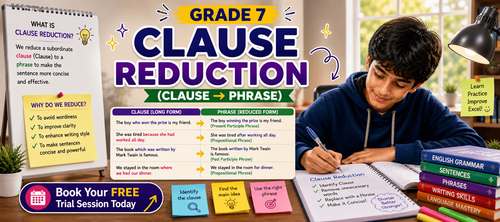

Master Clause Practice: English Grammar Worksheet Grade 7 on Clause Reduction
Long sentences can often feel heavy, repetitive, or difficult to manage while writing. This is why learning how to shorten sentence parts without losing meaning becomes an important grammar skill for middle school learners. This English grammar worksheet for Grade 7 on Clause Reduction gives students a guided way to notice clauses, understand reduced phrase patterns, and practise rewriting sentences in a smoother form. With a mix of recognition, multiple choice, rewriting, fill in the blanks, and paragraph writing, students get repeated exposure to the same grammar concept in practical contexts. The worksheet is structured in a gradual way so that learners first identify, then choose, then rewrite, and finally create their own examples using reduced clauses and phrases.
Download these English grammar worksheets and practice regularly to strengthen your language skills and build a strong foundation. You can also book a free trial to get expert guidance and improve your reading, writing, and comprehension abilities. The worksheets are designed in a simple and structured way to help K–8 students learn grammar concepts easily and use them confidently in everyday communication.
What Is the Topic?
Clause Reduction is the process of changing a longer clause into a shorter phrase while keeping the meaning connected to the main sentence. In this Grade 7 worksheet, students are expected to notice sentence parts like when he was tired, because he was late, and after she finished work, and then convert them into shorter forms such as being tired, being late, and finishing work. The worksheet helps students understand that long dependent ideas can often be reduced to make writing more direct and fluent. Students learn to identify these parts, compare correct and incorrect sentence forms, and practise using reduced structures in their own writing.
What’s in This Worksheet?
1. The worksheet begins with an underlining task where students identify the clause or phrase in each sentence.
2. It then includes multiple choice questions where students choose the correct reduced phrase form from three options.
3. After this, learners complete sentence rewriting by changing full clauses into reduced forms.
4. A fill in the blanks passage gives students a contextual language task connected with sentence reading and word use.
5. The worksheet ends with paragraph writing where students must write using clauses and reduced phrases.
6. This structure supports grammar recognition, sentence transformation, and written application, which are useful for classroom grammar tests and school writing practice.
Definitions, Examples, Techniques, and Tips
A clause is a part of a sentence that gives extra information around the main action. In this worksheet, examples include:
when he felt very tired
because he was late for school
after she finished her homework
A reduced phrase is the shorter form of the same supporting idea. In the worksheet, students repeatedly practise choosing forms like:
Being tired, Ravi slept.
Being late, Raj ran.
Having cooked, Asha rested.
One useful technique shown through the worksheet is comparison. Students do not only read one sentence form; they compare three sentence options and choose the one that best fits the rule. This helps them understand the difference between a full clause, a reduced phrase, and a simple joined sentence.
Another technique is direct rewriting. Instead of only spotting answers, learners actively convert:
Because he was late, Raj ran fast.
into
Being late, Raj ran fast.
A quick tip from this worksheet pattern is to first locate the extra information part of the sentence before changing it into a shorter phrase.
Why Is It Important to Learn This?
Clause Reduction is important because it helps students avoid repeating long sentence patterns again and again. When learners know how to shorten clauses, their writing becomes smoother and more mature. This also helps in descriptive writing, story writing, paragraph writing, and grammar transformation tasks. For Grade 7 students, this topic strengthens sentence handling and builds confidence in changing sentence structures without changing meaning. It also supports better reading understanding because students become more aware of how sentence parts connect.
Where Will This Knowledge Help You?
Students will use this knowledge in many practical areas:
1. In grammar exams, sentence transformation questions often ask students to rewrite while keeping the meaning.
2. In paragraph writing, reduced phrases help avoid repetitive sentence openings.
3. In classwork, students become faster at identifying dependent parts of a sentence.
4. In comprehension and editing tasks, they understand sentence relationships more clearly.
5. In general writing, they can make sentences shorter and neater.
How to Use This Worksheet?
1. Attempt each section independently before checking the solutions.
2. In the first section, underline carefully and identify the exact clause or phrase.
3. In the multiple choice section, compare all three options before selecting the correct reduced form.
4. In the rewriting section, make sure the full clause is shortened without changing meaning.
5. In the fill in the blanks and paragraph writing tasks, complete the language practice using suitable words and sentence forms.
6. The solutions below follow the exact worksheet order, so students should compare each answer carefully line by line.
7. Correct mistakes and rewrite wrong answers again for stronger retention.
8. Practise similar reductions regularly to improve sentence fluency.
Important Tips and Tricks
1. Do not simply join two actions with and when the worksheet asks for reduction.
2. Look for clue words such as when, because, and after. These usually show the part that needs shortening.
3. Make sure the reduced phrase still connects clearly to the subject in the sentence.
4. In MCQs, one option may keep the full clause, one may wrongly join actions, and one may show the proper reduced phrase. Compare carefully.
5. In writing tasks, use reduced phrases naturally instead of forcing them into every line.
6. Examiners usually expect meaning to remain the same after rewriting.
7. In paragraph writing tasks, include both full clauses and reduced phrases because the worksheet instruction specifically asks for both.
Complete Answer Key
Exercise No. 1
1. when he felt very tired.
2. because he was late for school.
3. when she was running.
4. when the program ended.
5. when she saw her friend.
6. after she finished her homework.
7. after she completed her work.
8. because he worked hard.
9. when their team won the match.
10. after he harvested the crops.
Exercise No. 2
1. b
2. a
3. b
4. c
5. a
6. c
7. b
8. b
9. a
10. a
Exercise No. 3
1. Being tired, Ravi slept.
2. Being late, Raj ran fast.
3. Playing outside, it rained.
4. Finishing work, Meera left.
5. Having cooked food, Asha rested.
6. Being tired, Ravi sleeps.
7. Having reached school, they ate.
8. Being hungry, Raj ate quickly.
9. Walking home, it rained.
10. Finishing homework, she smiled.
Exercise No. 4
1. history
2. knowledgeable
3. statues
4. notes
5. lunch
6. fountain
7. souvenirs
8. memorable
9. teacher
10. moment
Exercise No. 5
When we reached the picnic spot, everyone cheered loudly. Carrying baskets of food, we sat under a big tree. After eating sandwiches and fruits, we played cricket happily. Some children sang songs while others danced near the lake. Feeling excited, we clicked many pictures together. When the sun began to set, we packed our bags and returned home smiling. It was a joyful picnic with friends.
This English grammar worksheet Grade 7 on Clause Reduction gives learners repeated sentence practice in a focused and manageable way. By identifying clauses, selecting correct reduced forms, rewriting sentences, and using the pattern in paragraph writing, students gradually become more confident in handling longer sentence structures. Regular practice with this topic can make school grammar writing clearer, shorter, and more effective.