
Class 7 Clauses and Sentence Structure Grammar Practice Sheet
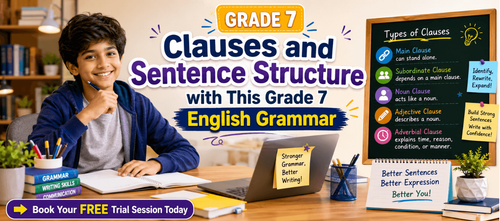

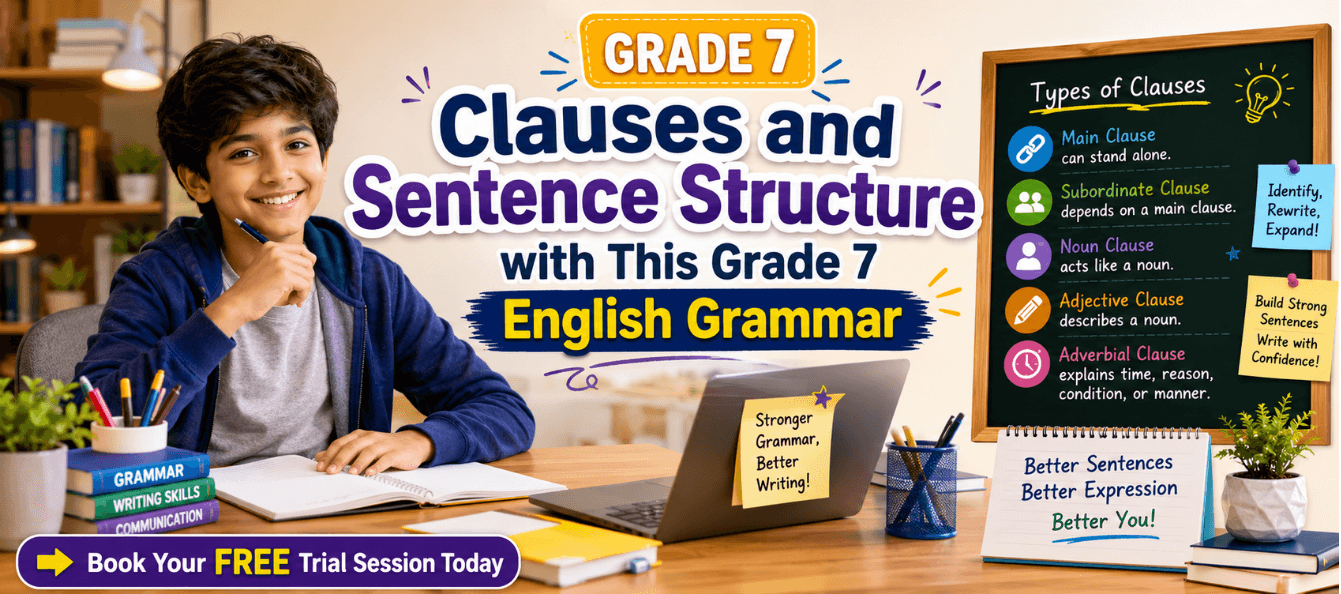
Clauses and Sentence Structure with This Grade 7 English Grammar Worksheet
Understanding clauses and sentence structure helps students create meaningful and grammatically correct sentences. In Grade 7, students learn how clauses work together to improve writing, speaking, and comprehension skills. This worksheet gives students detailed practice in identifying clauses, rewriting incorrect sentences, completing sentence structures, and forming complex sentences confidently.
This Grade 7 English grammar worksheet on clauses and sentence structure includes fun and engaging exercises such as underlining clauses, sorting clauses into categories, sentence completion, sentence correction, and paragraph writing. These exercises help students understand sentence formation in a practical and simple way while improving grammar accuracy.
Download these English grammar worksheets and practice regularly to strengthen your language skills and build a strong foundation. You can also book a free trial to get expert guidance and improve your reading, writing, and comprehension abilities. The worksheets are designed in a simple and structured way to help K–8 students learn grammar concepts easily and use them confidently in everyday communication.
What Is the Topic?
Clauses and sentence structure explain how sentences are built using groups of words that contain subjects and verbs. Some clauses can stand independently, while others depend on another clause to complete their meaning.
This worksheet focuses on:
• Main clauses
• Subordinate clauses
• Noun clauses
• Adjective clauses
• Adverbial clauses
• Complex sentence formation
Students learn how to identify different types of clauses and use them correctly while writing and speaking.
What’s in This Worksheet?
1. Exercises to underline main clauses and identify subordinate clauses.
2. Clause sorting activities using noun, adjective, and adverbial clauses.
3. Fill-in-the-blank sentence completion practice.
4. Sentence rewriting activities to correct grammar errors.
5. Sentence expansion exercises using different clause types.
6. Complex sentence writing practice.
7. Paragraph writing using multiple clause structures.
8. Grammar-based activities that improve sentence formation skills.
9. Structured exercises that help improve exam preparation.
10. Practice activities that strengthen writing fluency and grammar accuracy.
Definitions, Examples, Techniques, and Tips
A main clause can stand alone as a complete sentence.
Example:
Ramesh went to bed early.
A subordinate clause depends on a main clause.
Example:
Because he was tired
A noun clause acts like a noun in the sentence.
Example:
what she wants
An adjective clause describes a noun.
Example:
who won the award
An adverbial clause explains time, reason, condition, or manner.
Example:
when he saw the puppy
Helpful techniques for students:
• Find the subject and verb first.
• Look for joining words such as because, when, although, after, and whoever.
• Read the complete sentence carefully before identifying clauses.
• Practice sentence correction regularly.
• Check whether the sentence makes complete sense independently.
Why Is It Important to Learn This?
Learning clauses and sentence structure helps students write complete and meaningful sentences. It improves grammar understanding and helps students express ideas clearly in both speaking and writing.
Students who understand clauses can:
• Write better paragraphs
• Improve sentence variety
• Avoid grammar mistakes
• Build strong writing skills
• Perform better in grammar tests
This topic is important because clauses are used in almost every type of communication.
Where Will This Knowledge Help You?
Students can use clause and sentence structure skills in:
• School grammar tests
• Writing assignments
• Paragraph writing
• Story writing
• Reading comprehension
• Speaking activities
• Classroom discussions
• English examinations
Good sentence structure also improves confidence while writing and speaking English.
How to Use This Worksheet?
1. Read each sentence carefully before answering.
2. Identify the subject and verb in every sentence.
3. Attempt the worksheet independently first.
4. Underline or circle the correct parts according to the instructions.
5. Compare your answers carefully with the completed solutions.
6. Follow the exact worksheet order while checking answers.
7. Correct mistakes neatly after reviewing the answers.
8. Practice sentence writing regularly to improve grammar accuracy.
Important Tips and Tricks
1. A main clause gives complete meaning by itself.
2. A subordinate clause depends on another clause.
3. Words like because, after, when, although, and whoever often begin subordinate clauses.
4. Adjective clauses usually describe nouns.
5. Noun clauses often act as subjects or objects.
6. Read the complete sentence before deciding the clause type.
7. Avoid joining sentences incorrectly without conjunctions.
8. Check punctuation carefully while rewriting sentences.
9. Use proper verb forms in every sentence.
10. Practice writing complex sentences to improve fluency.
Complete Answer Key
Exercise 1
Underline the main clause and circle the subordinate clause in each sentence.
1. (Because he was tired), _Ramesh went to bed early._
2. _I don’t know_ (what she wants).
3. _The movie was fantastic_ (that we watched last night).
4. _He smiled_ (when he saw the puppy).
5. (That she lied) _surprised everyone._
6. _I cleaned the room and my brother did the dishes._
7. (Whoever said that) _is wrong._
8. _We left_ (after the show ended).
9. _The teacher praised the student_ (who won the award).
10. _You may sit_ (wherever you like).
Exercise 2
Sort the clauses from the sentences in the box into the correct categories.
MAIN CLAUSE
1. the match continued
2. is amazing
3. He can’t believe
4. you will succeed
5. The teacher entered the room
6. is still unknown
7. was very happy
8. They rested
9. The birds flew away
10. I smile
SUBORDINATE CLAUSE
1. Although the rain poured
2. that you gave me
3. what he just saw
4. If you study hard
5. Why she left early
6. who scored the goal
7. after the hike ended
8. Whenever I see her
NOUN CLAUSE
1. what he just saw
2. Why she left early
ADJECTIVE CLAUSE
1. that you gave me
2. who scored the goal
ADVERBIAL CLAUSE
1. Although the rain poured
2. If you study hard
3. after the hike ended
4. Whenever I see her
Exercise 3
Complete each sentence by adding the appropriate clause (main, subordinate, noun, adjective, or adverbial).
1. We cancelled the trip because it started to rain.
2. He acts as if he were the leader.
3. The story that she told us was very emotional.
4. She doesn’t know where her notebook is.
5. They danced until the lights went off.
6. Although he apologized, she remained upset.
7. Whoever wins the contest will get a trophy.
8. This is the book that I borrowed yesterday.
9. We will leave when the train arrives.
10. What she said shocked everyone.
Exercise 4
Each sentence contains an error in clause usage or sentence structure. Identify the incorrect part and rewrite the sentence correctly.
1. He went to the market because he wanted some fruits.
2. The boy who lost his bag is crying.
3. I don’t know if she is coming.
4. Though it was raining, we played outside.
5. She eats quickly because she is always in a hurry.
6. That he was angry was obvious to all.
7. He was happy because he won the prize.
8. Where she lives is a secret that nobody knows.
9. The car that is red is mine.
10. They slept because the show was boring.
Exercise 5
Rewrite or expand each sentence using the required clause (main, subordinate, noun, adjective, or adverbial).
1. She opened the window because it was hot inside.
2. The dog barked when the stranger entered the gate.
3. I wonder what she is doing.
4. The house that stood near the lake was quiet.
5. He ran fast because he wanted to win the race.
6. She cried because she lost her favorite book.
7. We left after the movie ended.
8. I stayed home because I was feeling sick.
9. If they finish their work, they will help.
10. I met the boy who won the award.
Exercise 6
Write a paragraph combining at least two main clauses and two subordinate clauses. Include one noun clause, one adverbial clause, and one adjective clause.
Although the weather was very cold, we went to the park because we wanted to play football. The boy who brought the football was very excited, and everyone thanked him for coming early. What surprised us most was that the match continued even after it started raining. We returned home after the game ended, and we talked about the exciting moments during dinner.
Practicing clauses and sentence structure regularly helps students improve grammar, writing, and communication skills. This Grade 7 English grammar worksheet gives students useful practice with sentence formation, clause identification, and sentence correction in an easy and engaging way. With regular practice, students can become more confident while writing and speaking English.