
Class 7 Common Word Pairings in English | Printable Worksheet
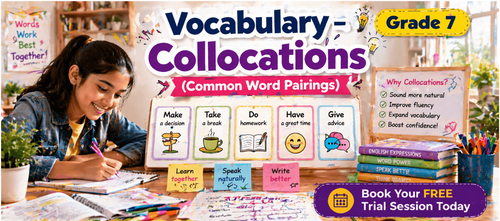

Vocabulary - Collocations (Common Word Pairings): English Grammar Worksheet for Grade 7
Learning how words naturally pair together—known as collocations—is an essential part of mastering vocabulary. This Grade 7 English grammar worksheet on common word pairings will help students identify and use common collocations in their writing and speaking. Understanding these word pairings allows for more natural and fluent communication, which is crucial for academic and everyday conversations.
Download these English grammar worksheets and practice regularly to strengthen your language skills and build a strong foundation. You can also book a free trial to get expert guidance and improve your reading, writing, and comprehension abilities. The worksheets are designed in a simple and structured way to help K–8 students learn grammar concepts easily and use them confidently in everyday communication. Book a free trial!
## What is the topic?
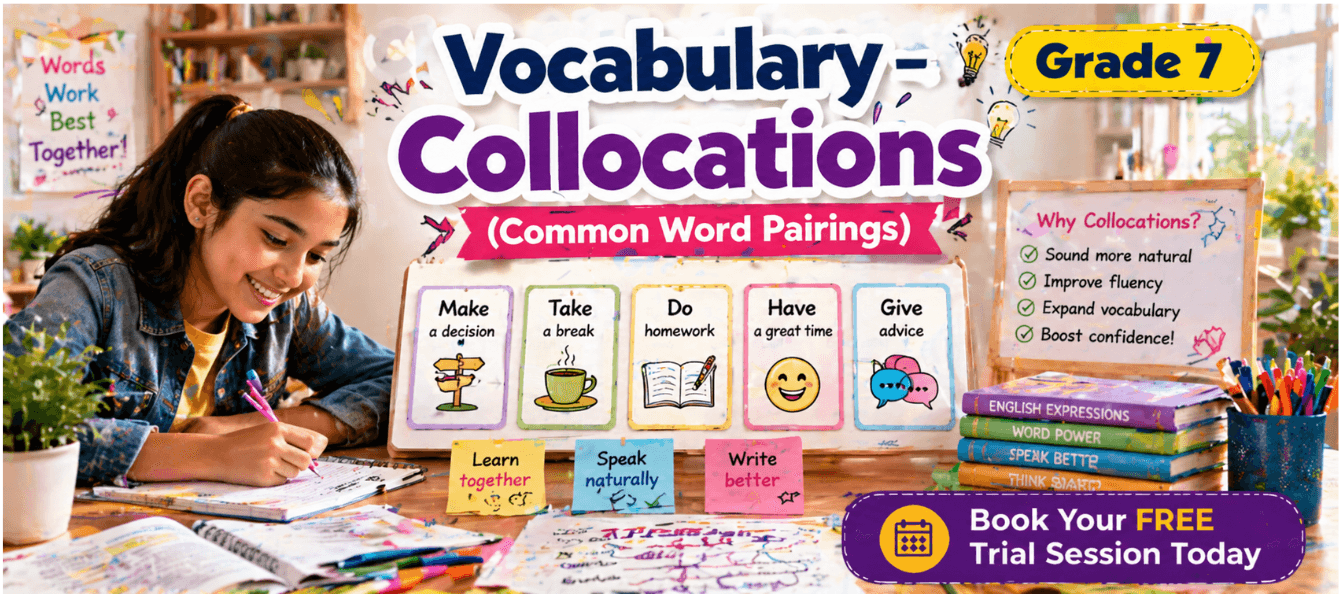
The topic of this worksheet focuses on **collocations**, which are natural combinations of words that frequently occur together. These common word pairings enhance fluency and make speech or writing sound more natural. Students will learn which word pairs are correct and which ones should be avoided, improving their understanding of English vocabulary usage.
In this worksheet, students will work on identifying correct collocations and avoiding incorrect ones. They'll also practice using these collocations in context through various exercises designed to strengthen their grammar skills.
## What’s in this worksheet?
This worksheet contains different types of activities that help students practice common word pairings. The activities aim to reinforce collocation knowledge and improve overall vocabulary usage. The worksheet includes:
1. **True or False:** Determine if certain collocations are correct or incorrect.
2. **Sort the Words:** Sort word pairs into correct and incorrect collocations.
3. **Fill in the Blanks:** Choose the appropriate collocation to complete the sentence.
4. **Multiple Choice Questions:** Select the correct collocation from a pair of options.
5. **Sentence Rewriting:** Rewrite sentences using the correct collocations.
These activities will not only test students' knowledge of common collocations but also prepare them for their exams and real-world usage of the language.
## Definitions, examples, techniques, and tips
- **Collocation:** A collocation is a combination of words that sound natural together. For example, "make a decision" or "take a break." These pairs of words are often used together in the English language.
- **Example:**
- **Correct collocation:** "Make a phone call"
- **Incorrect collocation:** "Do a phone call"
- **Technique:** To remember collocations, try to associate the word pairs with real-life scenarios. For instance, if you're talking about taking a break, use the collocation "take a break" instead of the incorrect "make a break."
- **Quick learning tip:** Read English texts such as articles, books, or listen to podcasts to see how native speakers use collocations in context. This will help reinforce correct usage.
## Why is it important to learn this?
Understanding collocations is essential for sounding natural and fluent in English. Knowing which word combinations are commonly used together helps students:
- **Write more naturally:** Using correct collocations makes your writing sound smoother and more native-like.
- **Speak more fluently:** Collocations are crucial for everyday communication, whether you're making small talk or delivering a presentation.
- **Improve reading and listening comprehension:** Recognizing collocations in written and spoken English enhances understanding and response time.
This skill is especially important for exams, where clear, correct language usage is essential for high scores.
## Where will this knowledge help you?
This knowledge will help you in various academic and practical areas:
- **Exams:** Collocations are often tested in vocabulary and writing sections of English exams. Knowing them will help you perform better in reading comprehension and composition tasks.
- **Writing tasks:** Whether it's writing an essay, a report, or even creative work, using the right collocations will make your writing more polished.
- **Class participation:** Understanding and using collocations correctly will allow you to engage in discussions, participate in group activities, and express yourself more clearly in the classroom.
## How to use this worksheet?
Follow these steps to make the most of this worksheet:
1. **Attempt independently first:** Try to solve each exercise without looking at the answer key to test your understanding.
2. **Review answers carefully:** Once you complete the exercises, check your answers against the answer key to understand any mistakes.
3. **Correct mistakes:** If you made an error, figure out why the correct collocation fits better in the context.
4. **Practice regularly:** Revisit the worksheet and practice more exercises to improve your understanding of common word pairings.
The solutions follow the exact worksheet order, so make sure to compare your answers carefully for better learning.
## Important tips and tricks
Here are some tips to master collocations:
1. **Common mistakes:** Many learners use "do a homework" instead of "do homework." Similarly, "take a decision" is incorrect; the right collocation is "make a decision."
2. **What examiners expect:** In exams, examiners expect students to use natural, correct word pairings. Avoid using awkward combinations like "do a photo" or "take a holiday."
3. **How to score full marks:** Pay attention to context in each exercise. Make sure the word pairs you choose make sense in the sentence.
4. **Approaching activity-based tasks:** When rewriting sentences or filling in the blanks, focus on using the correct collocation that fits the meaning of the sentence.
## Complete Answer Key
**Exercise No. 1 - True or False**
1. True
2. False
3. True
4. False
5. True
6. True
7. True
8. True
9. False
10. False
**Exercise No. 2 - Sort the word pairs into correct collocations and incorrect collocations**
- **Correct:**
- Make a phone call
- Make a decision
- Have a lunch
- Take a break
- Catch a cold
- **Incorrect:**
- Do a favor
- Do a homework
- Do a photo
- Take a holiday
- Give a break
**Exercise No. 3 - Choose the correct word from the pair**
1. Make
2. Take
3. Make
4. Do
5. Take
6. Make
7. Take
8. Make
9. Take
10. Handle
**Exercise No. 4 - Choose the correct option to complete the sentence**
1. Take
2. Take
3. Make
4. Do
5. Make
6. Take
7. Take
8. Make
9. Make
10. Take
**Exercise No. 5 - Rewrite each sentence using the correct collocation**
1. He made a mistake during the meeting.
2. She took a photo of the landscape.
3. He took a break after the presentation.
4. They did a favor for their friend.
5. He made a decision quickly.
6. She had a holiday in December.
7. They made a decision quickly.
8. He did a homework assignment.
9. She took a call during the lunch break.
10. They made a phone call after the meeting.
Book a free trial!