
Comparing Themes Worksheet for Grade 7: Skills & Examples

Comparing Themes Worksheet for Grade 7: Skills & Examples
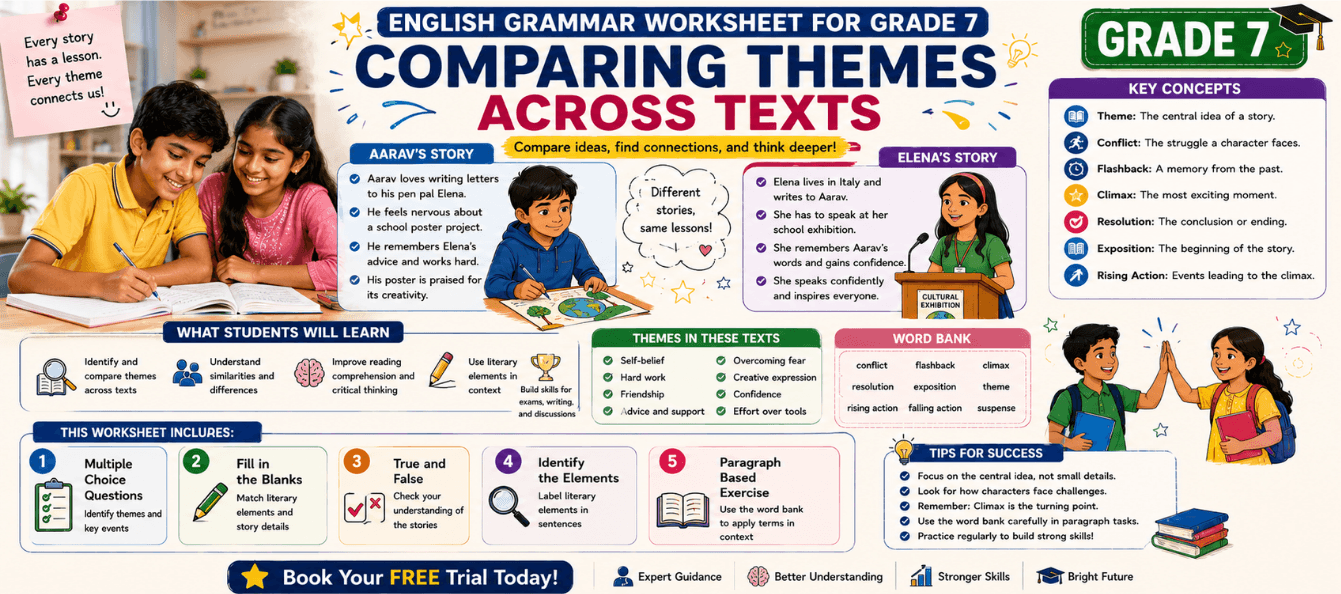
Themes are the heart of every story. They tell us what the story is really about and help us connect ideas across different texts. For Grade 7 students, learning to compare themes across texts is an important skill that strengthens reading comprehension and critical thinking. This English grammar worksheet on Comparing Themes Across Texts gives students the chance to explore how two different characters—Aarav and Elena—face challenges, overcome fears, and discover the power of self-belief.
Download these English grammar worksheets and practice regularly to strengthen your language skills and build a strong foundation. You can also book a free trial to get expert guidance and improve your reading, writing, and comprehension abilities. The worksheets are designed in a simple and structured way to help K–8 students learn grammar concepts easily and use them confidently in everyday communication.
What Is the Topic?
Comparing themes across texts means looking at two different stories and identifying what they have in common and how they differ. Students learn to recognize the central ideas, such as self-belief, effort, or friendship, and compare how these ideas are presented in each text. This worksheet helps students practice identifying themes and analyzing similarities and differences.
What’s in This Worksheet?
1. Multiple choice questions to identify themes and key events.
2. Fill in the blanks to match literary elements with story details.
3. True and false questions to check understanding.
4. Identification tasks to label literary elements in sentences.
5. Paragraph-based exercises to apply terms in context.
Definitions, Examples, Techniques, and Tips
- ‘‘Theme’’: The central idea of a story. Example: Aarav’s story shows self-belief, Elena’s story shows hard work.
- ‘‘Conflict’’: The struggle faced by characters. Example: Aarav’s nervousness about the sketchbook.
- ‘‘Flashback’’: A memory that interrupts the present. Example: Elena recalling Aarav’s words.
- ‘‘Climax’’: The most intense moment. Example: Aarav’s poster being praised, Elena’s confident speech.
- ‘‘Resolution’’: The conclusion. Example: Both realizing effort matters more than objects.
- ‘‘Exposition’’: The beginning of the story. Example: Aarav’s practice and preparation.
- ‘‘Rising action’’: The series of events leading to success.
Why Is It Important to Learn This?
Comparing themes helps students see how different authors explore similar ideas. It strengthens writing by teaching how to connect ideas across texts and improves reading comprehension. Academically, it prepares students for exams where theme comparison is often tested.
Where Will This Knowledge Help You?
- In exams, where comparing themes is a common question.
- In writing tasks, where students must analyze multiple texts.
- In class discussions, where comparing ideas builds deeper understanding.
How to Use This Worksheet?
1. Read both stories carefully.
2. Attempt each question independently.
3. Review the answer key in the exact worksheet order.
4. Correct mistakes and practice regularly.
Important Tips and Tricks
1. Always identify the theme as the central idea, not just a detail.
2. Look for flashbacks to understand how past advice influences present actions.
3. Remember that climax is the turning point, not the preparation.
4. Examiners expect clear identification of literary elements.
5. For paragraph tasks, use the exact terms provided in the word bank.
Complete Answer Key
Exercise No. 1
1. b) self belief
2. b) hard work
3. a) effort matters
4. c) creative focus
5. c) sketchbook
6. a) diary
7. b) advice
8. a) words
9. a) poster praised
10. c) confident speech
Exercise No. 2
1. conflict
2. flashback
3. climax
4. climax
5. falling action
6. resolution
7. resolution
8. theme
9. exposition
10. rising action
Exercise No. 3
1. False
2. False
3. True
4. True
5. True
6. True
7. True
8. False
9. False
10. False
Exercise No. 4
1. conflict
2. flashback
3. climax
4. falling action
5. resolution
6. resolution
7. exposition
8. exposition
9. suspense
10. theme
Exercise No. 5
Aarav loved writing letters to his pen pal Elena, who lived in ‘‘Italy’’.
He often shared his worries about school projects and how he doubted his ‘‘abilities’’.
One day, his teacher announced a community project where students had to design ‘‘posters’’ about protecting the environment.
Aarav felt nervous, believing he needed his old ‘‘sketchbook’’ to succeed. When he could not find it, he thought he would ‘‘fail’’.
Later, he remembered Elena's advice from a past letter: "Confidence comes from ‘‘effort’’, not from tools."
This memory gave him ‘‘courage’’, and Aarav worked hard. His poster was praised for its ‘‘creativity’’.
Meanwhile, Elena faced her own challenge. Her school organized a cultural ‘‘exhibition’’, and she had to present a story about ‘‘friendship’’.
At first, she felt helpless, but then she recalled Aarav's words and spoke ‘‘confidently’’.
By comparing Aarav and Elena’s experiences, students learn how themes of self-belief and hard work connect across texts. This Grade 7 English grammar worksheet on Comparing Themes Across Texts builds confidence in analyzing literature and prepares students for higher-level reading and writing tasks. Keep practicing, and remember that every story teaches us something valuable.
Book a free trial!