
Class 7 Comparing Use of Evidence in Texts - Grammar Worksheet
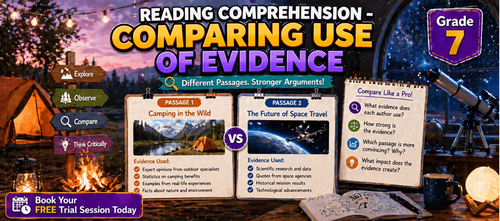

Clues That Count: English Grammar Worksheet for Grade 7 on Comparing Use of Evidence in Reading Comprehension
In this Grade 7 English grammar worksheet, students explore how evidence plays a key role in understanding and solving problems in reading comprehension. Through an engaging mystery set in a busy market, learners follow how observation, reasoning, and evidence help characters reach correct conclusions, while assumptions and guesses can lead to confusion.
This worksheet introduces students to the idea that not all answers come directly from the text—some require careful thinking and connecting clues. By comparing strong and weak uses of evidence, students begin to understand how logical thinking supports better decision-making. Along with comprehension, the worksheet also builds vocabulary and grammar skills through structured exercises.
Download these English grammar worksheets and practice regularly to strengthen your language skills and build a strong foundation. You can also book a free trial to get expert guidance and improve your reading, writing, and comprehension abilities. The worksheets are designed in a simple and structured way to help K–8 students learn grammar concepts easily and use them confidently in everyday communication.
What Is The Topic?
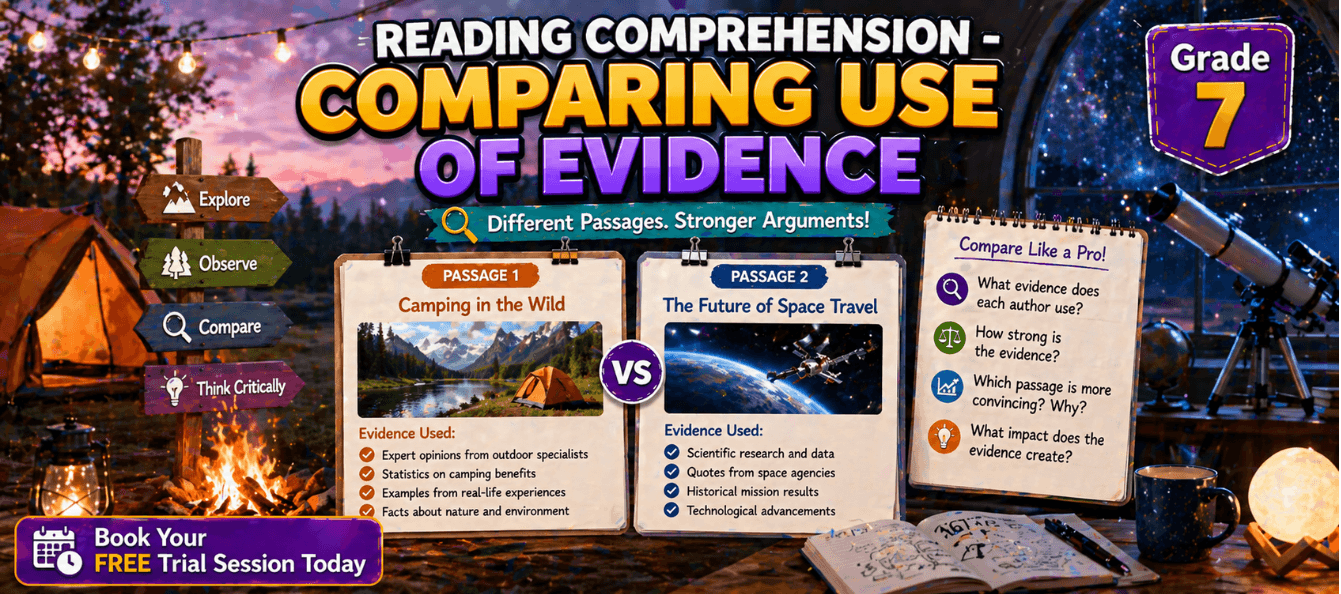
The topic of this worksheet is Comparing Use of Evidence in reading comprehension. Evidence refers to facts, observations, or details that support an idea or conclusion. In this worksheet, students learn how to identify strong evidence and distinguish it from weak assumptions or guesses.
The passage shows how characters solve a mystery by carefully observing their surroundings and using logical reasoning. Students are expected to understand how evidence helps in forming accurate conclusions and why relying on assumptions without proof can lead to incorrect answers.
What’s In This Worksheet?
This worksheet includes a variety of activities designed to strengthen comprehension and reasoning skills:
1. Multiple choice questions that focus on identifying how evidence is used in the passage.
2. Fill in the blanks activity that reinforces key vocabulary such as evidence, observation, assumptions, and search.
3. True or false questions that test understanding of facts and details.
4. Short answer questions that encourage students to explain their thinking clearly.
5. Paragraph completion that helps students apply vocabulary and understanding in context.
Each section builds the ability to analyze information carefully and respond thoughtfully.
Definitions, Examples, Techniques, And Tips
Evidence refers to information that supports a conclusion. It can come from direct observation, details in the text, or logical reasoning.
Observation means carefully noticing details in the surroundings. In the worksheet, characters use observation to understand what happened in the market.
Assumptions are ideas formed without proof. These are often incorrect if they are not supported by evidence.
For example, suspecting a stranger without proof is an assumption, while finding the wallet behind a box based on visible clues is evidence-based reasoning.
Techniques students practice include:
- Identifying clues in a passage
- Distinguishing between fact and assumption
- Using reasoning to connect ideas
- Supporting answers with evidence
Quick tips:
- Look for details that clearly support an idea
- Avoid jumping to conclusions without proof
- Read carefully to find clues in the passage
- Always choose answers based on evidence
Why Is It Important To Learn This?
Learning how to use evidence is important because it helps students think logically and make correct decisions. It strengthens their ability to understand what they read and analyze information carefully.
For Grade 7 students, this skill is essential for improving comprehension, as many questions require them to go beyond simple reading and think critically. It also helps in writing, where supporting ideas with evidence makes arguments stronger and clearer.
Where Will This Knowledge Help You?
This knowledge is useful in many situations:
- Reading comprehension exams where evidence-based answers are required
- Writing tasks that need clear support for ideas
- Classroom discussions that involve reasoning and explanation
- Real-life situations where logical thinking is important
It helps students become careful thinkers who rely on facts rather than guesses.
How To Use This Worksheet?
Follow these steps to make the most of this worksheet:
1. Read the passage carefully and understand the situation.
2. Attempt all questions independently before checking answers.
3. Review the answer key and compare your responses.
4. Identify mistakes and understand the correct reasoning.
5. Practice regularly to improve comprehension and thinking skills.
The solutions follow the exact worksheet order, so students should compare answers carefully for better understanding.
Important Tips And Tricks
1. Always look for evidence in the passage before answering.
2. Avoid choosing answers based on guesses or assumptions.
3. Pay attention to small details—they often provide important clues.
4. Read questions carefully to understand what is being asked.
5. Practice explaining answers in short answer questions clearly.
6. Use context clues to complete fill in the blanks accurately.
7. Review mistakes to strengthen understanding.
8. Focus on logical reasoning rather than quick answers.
9. Stay calm and read thoroughly to avoid errors.
10. Build the habit of supporting every answer with evidence.
Complete Answer Key (For Parents & Educators)
Exercise 1 – Multiple Choice Answers
1. (b) She used her observations of the surroundings.
2. (b) It relied on assumptions without evidence.
3. (b) They searched the area carefully.
4. (a) Direct observations and details.
5. (b) It slipped due to movement in the shop.
6. (c) Strong evidence leads to better conclusions.
7. (a) It was supported by clear observations.
8. (a) It helped explain how items moved.
9. (a) It was based on visible clues.
10. (a) Suspenseful and thoughtful.
Exercise 2 – Fill in the Blanks
1. wallet
2. observation
3. wind
4. shelves
5. idea
6. stranger
7. assumptions
8. search
9. box
10. evidence
Exercise 3 – True or False
1. True
2. False
3. True
4. True
5. False
6. False
7. True
8. False
9. False
10. True
Exercise 4 – Short Answers
1. Kavya guided the search.
2. The wallet was found behind a box near the shelves.
3. Rohan suspected a stranger.
4. Because her idea was based on clear observations and evidence.
5. A strong gust of wind caused objects to move.
6. A customer reported the missing wallet.
7. They searched the area carefully before deciding.
8. She used direct observation and physical evidence.
9. Because there was no proof against the stranger.
10. That strong evidence helps in making correct decisions.
Exercise 5 – Paragraph Completion
1. market
2. wallet
3. observation
4. wind
5. stranger
6. search
7. shelves
8. wallet
9. reasoning
10. evidence
With regular practice using this Grade 7 English grammar worksheet on Comparing Use of Evidence, students can develop strong reasoning skills and improve their ability to analyze information carefully. This will help them become confident readers and thoughtful learners.
Book a free trial!