
Conflict Resolution Worksheet for Grade 7 Exercises & Examples
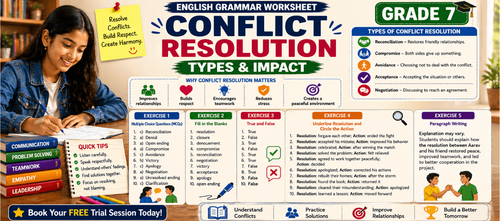

English grammar worksheet - Grade 7: Conflict Resolution (Types & Impact)
Conflict resolution is a critical skill that every student must develop. In Grade 7, students dive deeper into understanding how conflicts arise, the various ways to resolve them, and the impact of these resolutions on relationships and situations. Whether in a group project or a heated discussion with friends, knowing how to resolve conflicts amicably helps students build stronger, more positive relationships. This worksheet offers a variety of exercises designed to enhance these crucial conflict resolution skills. By practicing these exercises, students will improve their ability to navigate conflicts and contribute to a peaceful environment both in and out of the classroom.
Download these English grammar worksheets and practice regularly to strengthen your language skills and build a strong foundation. You can also book a free trial to get expert guidance and improve your reading, writing, and comprehension abilities. The worksheets are designed in a simple and structured way to help K–8 students learn grammar concepts easily and use them confidently in everyday communication.
What is the topic?
Conflict resolution involves strategies and methods
for managing and resolving disagreements or conflicts. In this worksheet, students learn about various types of conflict resolutions, including reconciliation, compromise, and avoidance. They explore how different strategies affect relationships and how conflict resolution can lead to better teamwork, improved communication, and restored harmony.
Students are expected to understand the different types of resolutions and recognize their impact on the situation. They will also practice identifying conflict resolution types in various scenarios and applying them to real-life examples.
What’s in this worksheet?
1. Multiple Choice Questions (MCQs): These questions help students identify different conflict resolution types in specific situations.
2. Fill in the Blanks: This activity reinforces key vocabulary related to conflict resolution.
3. True and False: Students evaluate statements to determine if they are accurate regarding the resolution process.
4. Underline the Words: This task helps students focus on key actions in conflict resolution scenarios.
5. Paragraph Writing: A final task that encourages students to reflect on the impact of resolution in a personal situation.
These exercises help students reinforce their understanding of conflict resolution, practice their grammar, and prepare for exams.
Definitions, examples, techniques, and tips
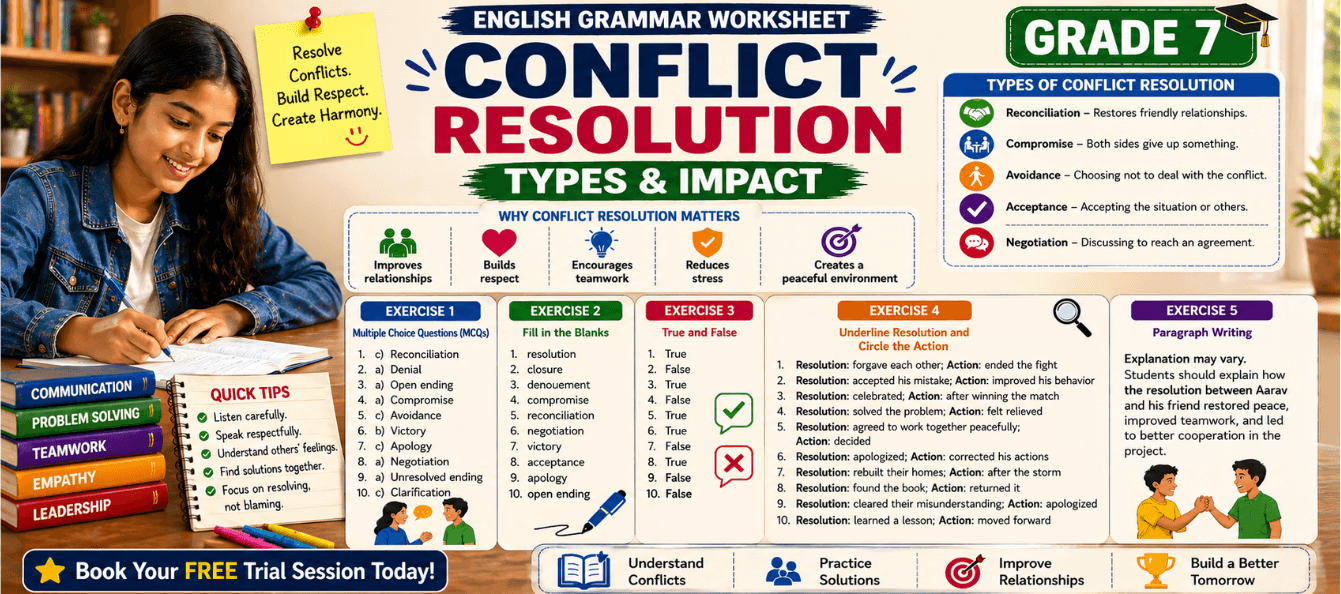
- Resolution: The process of resolving a conflict, typically at the end of a story or situation.
- Reconciliation: Restoring friendly relations after a disagreement.
- Compromise: Both parties make concessions to reach an agreement.
- Avoidance: Avoiding the issue or not addressing the conflict at all.
- Acceptance: Acknowledging and agreeing with the situation or the actions of others.
Examples from the worksheet include situations like two friends forgiving each other (Reconciliation), or a group deciding to share a prize equally (Compromise).
Quick Tip: To remember the types of conflict resolution, think of them in terms of their outcomes: "Reconciliation" brings people together, "Compromise" involves give and take, and "Avoidance" simply skips the conflict.
Why is it important to learn this?
Learning conflict resolution is important because it helps students develop emotional intelligence and social skills. It enables them to handle disagreements in a positive way, which is crucial for academic success and personal growth. Understanding how to resolve conflicts also reduces stress and anxiety, helping students focus better in school.
By learning these strategies, students can avoid unnecessary confrontations and create a more harmonious learning environment. These skills are not only useful in school but also in personal relationships, work, and future endeavours.
Where will this knowledge help you?
- Exams: Understanding the concepts of conflict resolution will help students perform better in exam questions related to communication and problem-solving.
- Writing tasks: Students can use conflict resolution examples in essays or projects, demonstrating their understanding of the topic.
- Class participation: In group discussions or activities, students can apply conflict resolution strategies to work collaboratively with others.
How to use this worksheet?
1. Attempt independently first: Work through the exercises on your own to test your knowledge.
2. Review answers carefully: After completing the exercises, check your answers with the answer key.
3. Correct mistakes: If you find any mistakes, correct them and understand why the correct answer works.
4. Practice regularly: Keep practicing these exercises to reinforce your learning and improve your skills in conflict resolution.
Remember, the solutions in the worksheet follow the exact order of the exercises. Compare your answers carefully to ensure full understanding.
Important tips and tricks
1. Common mistakes: Students often confuse "reconciliation" with "compromise" because both involve resolving differences. The key difference is that "reconciliation" restores the relationship, while "compromise" involves a give-and-take.
2. What examiners expect: Examiners want to see that students can identify different conflict resolution types and apply them to real-world situations.
3. How to score full marks: Ensure you understand the concepts clearly and use the right resolution type for each scenario in the exercises.
4. How to approach activity-based or writing-based tasks: When writing, reflect on how the conflict was resolved and describe the impact of that resolution on the parties involved.
Complete Answer Key
Exercise No. 1
1. c) Reconciliation
2. a) Denial
3. a) Open ending
4. a) Compromise
5. c) Avoidance
6. b) Victory
7. c) Apology
8. a) Negotiation
9. a) Unresolved ending
10. c) Clarification
Exercise No. 2
1. resolution
2. closure
3. denouement
4. compromise
5. reconciliation
6. negotiation
7. victory
8. acceptance
9. apology
10. open ending
Exercise No. 3
1. True
2. False
3. True
4. False
5. True
6. True
7. False
8. True
9. False
10. False
Exercise No. 4
1. Resolution: forgave each other; Action: ended the fight
2. Resolution: accepted his mistake; Action: improved his behavior
3. Resolution: celebrated; Action: after winning the match
4. Resolution: solved the problem; Action: felt relieved
5. Resolution: agreed to work together peacefully; Action: decided
6. Resolution: apologized; Action: corrected his actions
7. Resolution: rebuilt their homes; Action: after the storm
8. Resolution: found the book; Action: returned it
9. Resolution: cleared their misunderstanding; Action: apologized
10. Resolution: learned a lesson; Action: moved forward
Exercise No. 5
Explanation may vary. Students should explain how the resolution between Aarav and his friend restored peace, improved teamwork, and led to better cooperation in the project.
Conclusion
By practicing the exercises in this worksheet, Grade 7 students will develop a deeper understanding of how conflicts can be resolved in various ways. These skills will not only enhance their academic performance but also help them in their personal and social lives. Keep practicing, and soon you’ll be a pro at handling conflicts with ease.
Book a free trial!