
Class 7 Contrasting Information in Texts - Worksheet for Practice


Solve the Missing Necklace Story: English grammar worksheet Grade 7 on Contrasting Information Across Sources
Have you ever misplaced something important and received many different suggestions about where it could be? This English grammar worksheet for Grade 7 on Reading Comprehension – Contrasting Information Across Sources brings such a relatable situation to life through an engaging story. Students follow Kavya’s experience as she searches for a lost family necklace during a lively gathering. Along the way, they learn how different people can give different ideas based on what they observe.
This topic helps students understand how to compare information from multiple sources and think carefully before deciding what to believe. Through simple questions, vocabulary exercises, and grammar tasks, learners practice how to analyze situations logically while improving their language skills.
Download these English grammar worksheets and practice regularly to strengthen your language skills and build a strong foundation. You can also book a free trial to get expert guidance and improve your reading, writing, and comprehension abilities. The worksheets are designed in a simple and structured way to help K–8 students learn grammar concepts easily and use them confidently in everyday communication.
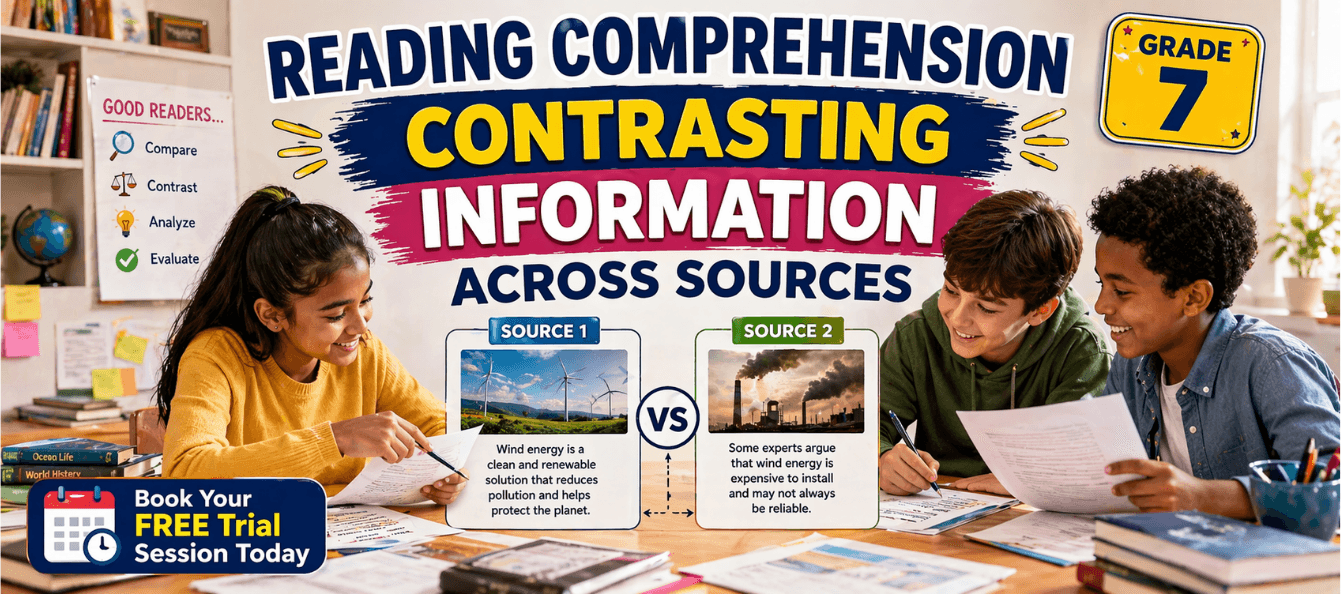
What Is the Topic?
Contrasting information across sources means understanding
that different people may give different ideas or suggestions about the same situation. In this worksheet, students read a story where multiple characters share their thoughts about where a missing necklace could be.
The focus is on recognizing that each person’s suggestion comes from their own perspective. Students learn to compare these ideas, evaluate them, and then identify what actually happened. This helps improve comprehension, reasoning, and decision-making skills.
What’s in This Worksheet?
1. Multiple-choice questions based on the story to check understanding of key details
2. Fill in the blanks using a word bank to improve vocabulary and recall
3. True or False statements to test comprehension accuracy
4. Sentence-based task to identify adverbs
5. Paragraph completion activity to reinforce understanding of the story
6. Questions arranged in a clear and logical order to support structured learning
7. Exercises that help students practice reading, thinking, and grammar skills together
Definitions, Examples, Techniques, and Tips
Definitions
Contrasting information means comparing different ideas or suggestions given by different people about the same situation.
Examples
In the story, Riya thinks the necklace is in the garden, while Anil believes it is near the kitchen. These are contrasting ideas.
Techniques
Students read carefully and identify what each person says. Then they compare all suggestions before understanding the final outcome.
Quick learning tips
Pay attention to who is giving the information
Notice differences in opinions
Follow the sequence of events in the story
Check what actually happens in the end
Why Is It Important to Learn This?
Learning to compare information helps students become better readers and thinkers. It teaches them not to accept every suggestion immediately but to think carefully and evaluate different ideas.
This skill is useful in both writing and speaking because it allows students to express ideas clearly and understand others’ viewpoints. It also helps in answering comprehension questions accurately in exams.
Where Will This Knowledge Help You?
This knowledge is useful in exams where students must read passages and answer questions based on them. It helps in writing tasks where comparing ideas is required.
It also improves classroom participation, as students can understand discussions better and respond thoughtfully when different opinions are shared.
How to Use This Worksheet?
1. Read the story carefully before attempting the questions
2. Attempt all questions independently without looking at answers
3. Review your answers carefully after completing each section
4. Compare your responses with the answer key in the exact worksheet order
5. Correct mistakes and understand where you went wrong
6. Practice similar worksheets regularly to improve comprehension skills
Important Tips and Tricks
1. Always read the passage slowly and carefully
2. Focus on details like names, places, and actions
3. Pay attention to who said what in the story
4. Do not guess answers without checking the passage
5. In fill-in-the-blank questions, use words that match the context
6. For True or False, verify each statement from the passage
7. While identifying adverbs, look for words that describe actions
8. In paragraph completion, ensure the meaning flows correctly
Complete Answer Key (For Parents & Educators)
Exercise 1 – Choose the most appropriate answer in relevance to the passage.
1. b) A lost family necklace.
2. a) In the garden area.
3. a) The necklace was near the kitchen.
4. c) Check inside the house carefully.
5. b) She received different suggestions.
6. c) In the garden.
7. a) She did not find the necklace.
8. a) In a small box in her room.
9. b) Information can differ based on perspective.
10. c) Sometimes answers are closer than expected.
Exercise 2 – Fill in the blanks in each sentence with a proper word from the word bank.
1. necklace
2. garden
3. kitchen
4. room
5. box
6. suggestions
7. search
8. found
9. people
10. help
Exercise 3 – Read the sentence. Choose True if it is correct according to the passage and False if not.
1. False
2. True
3. False
4. True
5. False
6. True
7. True
8. False
9. True
10. True
Exercise 4 – Read each sentence carefully and underline all the adverbs you find.
1. happily
2. cheerfully
3. suddenly
4. quickly
5. carefully
6. quietly
7. patiently
8. finally
9. warmly
10. happily
Exercise 5 – Fill in the blanks with suitable words to complete the paragraph meaningfully.
The Lost Necklace
Kavya was wearing her grandmother’s necklace at the function. Later, she realized it was missing. She asked others for help and listened to their suggestions. Kavya searched the garden but found nothing. She then checked the kitchen carefully. Finally, she looked in her room and found the necklace in a box. She felt relieved and understood that answers can be closer than we think. Sometimes, people give different ideas based on their thinking. This experience taught her an important lesson.
Practicing this English grammar worksheet for Grade 7 on Contrasting Information Across Sources helps students become more confident readers and thinkers. By working through the story of the missing necklace, learners improve their ability to understand different viewpoints and arrive at the correct conclusion. With regular practice, these skills will become stronger and more natural in both exams and everyday communication.
Book a free trial!