
Class 7 Cause and Effect Writing Worksheet: Printable PDF
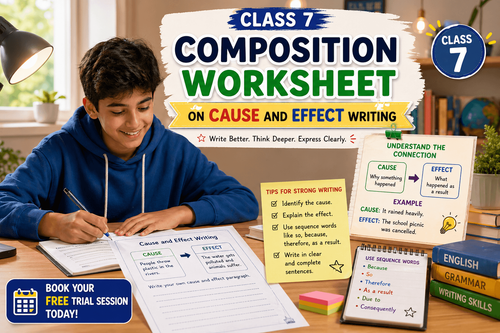

Master Cause–Effect Writing with This English Grammar Worksheet for Grade 7
Understanding how actions lead to consequences is an important part of both reading and writing. This Grade 7 worksheet on Cause–Effect Writing helps students explore how events are connected through a meaningful story about a village and its river. Through engaging exercises, students learn how one action can create multiple outcomes, both positive and negative.
The story in this worksheet shows how a factory affected a village’s river and how the villagers responded to the situation. By working through different types of questions, students improve their comprehension, logical thinking, and writing skills. This worksheet is designed to make learning interactive and practical, helping students apply grammar concepts in real-life contexts.
Download these English grammar worksheets and practice regularly to strengthen your language skills and build a strong foundation. You can also book a free trial to get expert guidance and improve your reading, writing, and comprehension abilities. The worksheets are designed in a simple and structured way to help K–8 students learn grammar concepts easily and use them confidently in everyday communication.
What Is The Topic?
Cause–Effect Writing is a way of explaining how one event leads to another. In this worksheet, students read a story where different actions create clear results. For example, when the factory dumped waste into the river, the water became dirty, fish died, and villagers fell sick.
Students are expected to identify these connections between causes (actions) and effects (results). They also learn to understand the overall message of the story and express it in their own words through structured writing.
What’s In This Worksheet?
1. A story based on cause–effect relationships that helps students understand the topic clearly.
2. Multiple Choice Questions to test comprehension and understanding of events and their outcomes.
3. Fill in the Blanks to reinforce vocabulary and key details from the story.
4. True and False statements to help students identify correct and incorrect information.
5. Underline the Words activity to recognize phrases that reflect the theme or message.
6. Paragraph Writing task to help students summarize the story using cause–effect relationships.
These activities help students prepare for exams by improving reading comprehension and writing accuracy.
Definitions, Examples, Techniques, And Tips
Cause refers to an action or event that makes something happen.
Effect is the result of that action or event.
In the worksheet story, the factory dumping waste is a cause, and the river becoming dirty is an effect. Another example is polluted water causing villagers to fall sick.
Students can use words like “because,” “as a result,” and “therefore” to show cause–effect relationships. The story itself uses such connections to clearly explain how events are linked.
A useful technique is to ask: “What happened?” and then “Why did it happen?” This helps identify the cause and effect easily.
Why Is It Important To Learn This?
Cause–effect writing helps students understand how events are connected. It improves logical thinking and helps in organizing ideas clearly.
This skill is important for writing structured paragraphs and answering comprehension questions. It also helps students understand real-life situations better, such as environmental problems and their solutions.
Learning this topic strengthens both reading and writing skills, which are essential for academic success.
Where Will This Knowledge Help You?
This knowledge helps students in school exams where they need to answer comprehension questions based on passages.
It also supports paragraph writing tasks, where students must explain ideas clearly and logically.
In class discussions, students can use cause–effect relationships to explain their thoughts better. It also helps in everyday communication when describing events and their outcomes.
How To Use This Worksheet?
1. Read the story carefully and understand the sequence of events.
2. Attempt all questions independently without looking at the answers.
3. Review your answers and compare them with the correct solutions.
4. Identify mistakes and correct them to improve understanding.
5. Practice regularly to become confident in identifying cause–effect relationships.
The solutions follow the exact worksheet order, so students should compare answers carefully.
Important Tips And Tricks
1. Always identify what happened first and what happened next to understand cause and effect.
2. Look for clue words like “because,” “as a result,” and “therefore” in the story.
3. Read each question carefully before selecting an answer.
4. In True and False questions, check each statement against the story details.
5. In paragraph writing, include both causes and effects clearly.
6. Avoid skipping important details from the story while answering questions.
Complete Answer Key
Exercise No. 1
1. a) Clear
2. c) It gave them jobs
3. c) Dumped waste into it
4. b) They died
5. b) Because of polluted water
6. c) They dried up
7. a) They complained to authorities
8. a) Ordered the factory to treat waste
9. a) The river became clean again
10. c) Pollution has effects, but action can solve problems
Exercise No. 2
1. clear
2. washing
3. jobs
4. waste
5. dirty
6. die
7. sick
8. clean
9. authorities
10. waste
Exercise No. 3
1. True
2. True
3. False
4. True
5. True
6. False
7. True
8. False
9. False
10. True
Exercise No. 4
1. pollution made it harmful for everyone
2. villagers suffered from illness and loss
3. affects human life
4. necessary for a healthy future
5. helped restore the village’s health
6. caused serious damage to nature
7. bigger consequences over time
8. helped the villagers solve their problem
9. important for both people and the environment
10. bring positive changes to the environment
Exercise No. 5
Read the story and write a short paragraph.
In a small village, a clean river was an important source of water for daily needs. When a factory was built nearby, it provided jobs, making the villagers happy. However, the factory started dumping waste into the river, which caused the water to become dirty. As a result, fish died, birds stopped coming, and villagers fell sick due to polluted water. The crops also dried up because there was no clean water for farming. Therefore, the villagers complained to the authorities, who ordered the factory to treat its waste. Gradually, the river became clean again, and life returned to normal. This shows that pollution can cause serious problems, but timely action can solve them.
By practicing this English grammar worksheet for Grade 7 on Cause–Effect Writing, students can improve their ability to understand connections between events and express ideas clearly. Regular practice will help build confidence in both comprehension and writing tasks, making learning more effective and enjoyable.