
Class 7 Narrative Plot Development Worksheet: PDF for Kids
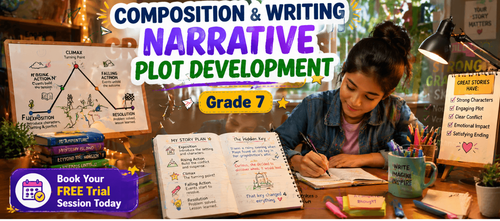

English grammar worksheet on narrative plot development
Are you ready to embark on
an exciting adventure? In Grade 7, one of the most important skills students learn is how to develop a strong narrative plot. This worksheet focuses on the various elements that go into creating a captivating story. Through multiple choice questions, fill-in-the-blanks, and more, you will discover how to analyze and craft your own narratives. From learning about the importance of setting and characters to understanding the structure of the plot, this worksheet will help you build the foundation needed to write stories that will engage and captivate readers. Let’s explore the narrative plot development process in detail!
Download these English grammar worksheets and practice regularly to strengthen your language skills and build a strong foundation. You can also book a free trial to get expert guidance and improve your reading, writing, and comprehension abilities. The worksheets are designed in a simple and structured way to help K–8 students learn grammar concepts easily and use them confidently in everyday communication.
What is the topic?
In this worksheet, we will focus on **narrative plot development**, a key component of writing and storytelling. Narrative plot development refers to how the events of a story unfold and how they are organized to build a compelling narrative. Every story has a plot, and a well-developed plot keeps readers engaged by introducing characters, setting, conflict, climax, and resolution.
As a Grade 7 student, you will learn about how stories develop, from the initial setup to the conclusion. You'll also focus on understanding the key themes and how the characters' actions and decisions influence the story's events. Through various exercises in this worksheet, you’ll get to practice identifying and applying these elements in your own writing.
What’s in this worksheet?
1. **Multiple Choice Questions** – Test your understanding of narrative elements like plot structure, setting, and character development.
2. **Fill-in-the-Blanks** – Practice identifying key plot elements and inserting appropriate words based on the story.
3. **True/False Statements** – Verify your comprehension of the story's key facts and the lessons Sarah and Tom learned.
4. **Underline the Words** – Highlight the key words or phrases that represent the central theme or lesson of the story.
5. **Paragraph Writing** – Write a short summary of the story, focusing on the main events, the lesson learned, and the theme.
This worksheet is designed to help you gain a deeper understanding of how narrative plots are structured and how you can apply these principles to your own writing. It will also help you prepare for exams by practicing these important grammar skills.
Definitions, examples, techniques, and tips
**Definitions**
**Narrative Plot**: The sequence of events in a story that includes the introduction, rising action, climax, falling action, and resolution.
**Setting**: The time and place where the story takes place, which provides context for the events and characters.
**Character Development**: How the characters evolve throughout the story, often influenced by the events they experience.
**Examples**
In the story, Sarah and Tom find an old map in their grandmother's attic, which leads to an exciting adventure. This represents the **inciting incident**, where the characters are pushed into action.
- The **climax** of the story occurs when Sarah opens the chest, expecting treasure but finding a collection of family history instead.
**Techniques**
When writing your own narrative, focus on creating a **strong conflict** that drives the plot forward. Think about how the characters' decisions influence the outcome of the story.
Use descriptive language to bring the **setting** and **characters** to life. The more vivid the details, the more engaging the story becomes.
**Quick Learning Tips**
Focus on understanding the **rising action** and **climax** in a story. These are the most exciting parts, where the plot reaches its highest tension.
- Always ensure that your plot has a **clear resolution**. This helps to tie up any loose ends and provide closure to the readers.
Why is it important to learn this?
Understanding narrative plot development is crucial for building strong writing and communication skills. It helps students not only to create engaging stories but also to recognize the elements that make any narrative compelling. This skill is important for reading comprehension because it allows students to better understand and analyze stories. It also strengthens writing by encouraging students to think about how they organize their ideas and develop characters.
Moreover, narrative plot development is key to **exam writing** as students must write stories, essays, and other assignments that follow a clear structure. Learning how to develop a plot gives students the tools they need to tell engaging stories that captivate their audience.
Where will this knowledge help you?
1. **Exams** – Many exams require students to write stories or essays. Understanding how to structure a plot will help you write more effectively.
2. **Writing Tasks** – Whether in school assignments or creative writing, you will need to develop plots that make sense and hold the reader’s attention.
3. **Class Participation** – When discussing literature or storytelling in class, being able to identify and discuss plot structure will help you contribute valuable insights.
How to use this worksheet?
1. **Attempt independently first** – Try to complete the exercises on your own to test your knowledge.
2. **Review answers carefully** – After completing the worksheet, check your answers carefully to see how well you understood the material.
3. **Correct mistakes** – If you made any errors, revisit the relevant sections to understand what went wrong.
4. **Practice regularly** – The more you practice identifying plot structures and themes, the better you will become at writing your own stories.
The solutions follow the exact worksheet order. Students should compare answers carefully.
Important tips and tricks
1. **Common mistakes**: One common mistake students make is skipping over the **rising action** or **climax** in their own writing. Make sure every story has these crucial elements.
2. **What examiners expect**: Examiners expect clear, well-organized plots. Make sure your story has a beginning, middle, and end.
3. **How to score full marks**: Be sure to follow the exact order of events in the plot and make sure each section flows logically into the next.
4. **How to approach activity-based or writing-based tasks**: For writing tasks, focus on providing a **clear theme** and **resolution** for your story.
Complete answer key
**Exercise 1 – Multiple Choice Questions**
1. b) In their grandmother’s attic
2. b) A hidden treasure in the forest
3. a) A large tree
4. a) A storm hit
5. c) The old letters and photographs
6. a) A family history
7. b) Stories of their grandmother’s adventurous past
8. c) Proud of the family’s history
9. b) True treasures are found in memories
10. a) Proud of their family’s history
**Exercise 2 – Fill in the Blanks**
1. attic
2. forest
3. tree
4. storm
5. letters
6. history
7. stories
8. history
9. connection
10. memories
**Exercise 3 – True/False Statements**
1. False
2. True
3. False
4. True
5. True
6. True
7. True
8. True
9. True
10. True
**Exercise 4 – Underline the Words**
(Answers will vary depending on which words the student chooses, but key themes 1. grandmother’s attic
2. stories of their grandmother’s past
3. family history, more valuable than gold
4. story,not riches
5. True treasures, memories, not wealth
6. family history
7. old letters and photographs
8. deeper connection to their family
9. proud of their family’s history
10. Memories, true treasure
**Exercise 5 – Paragraph Summary**
(Answers may vary. Sample response: "Sarah and Tom discovered an old map in their grandmother's attic that led them to a hidden treasure in the forest. The real treasure was a collection of letters and photographs telling the story of their family’s history. Through this adventure, they learned that true treasures are found in memories, not material wealth.")