
Class 7 Writing Strong Endings Worksheet: Free PDF
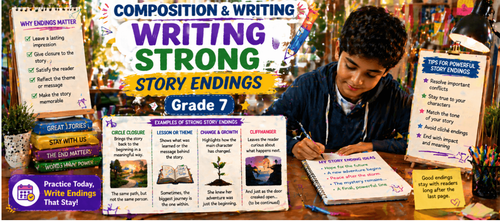

Writing Strong Story Endings: English Grammar Worksheet for Grade 7
Writing a strong ending is one of the most important skills in storytelling. In Grade 7, students focus on writing endings that are engaging and leave a lasting impression on the reader. Whether they are crafting a personal story or fictional narrative, understanding how to tie a story together effectively is key to becoming a confident writer. This worksheet, specifically designed for Grade 7 students, will help learners master the techniques for creating strong conclusions that resonate with readers.
Download these English grammar worksheets and practice regularly to strengthen your language skills and build a strong foundation. You can also book a free trial to get expert guidance and improve your reading, writing, and comprehension abilities. The worksheets are designed in a simple and structured way to help K–8 students learn grammar concepts easily and use them confidently in everyday communication.
What is the topic?
In this worksheet, students focus on writing strong story endings. A story's ending is crucial because it wraps up the narrative, resolves key plot points, and leaves a lasting impression on the reader. Writing a strong ending involves bringing closure to the story, reinforcing its themes, and ensuring that the conclusion matches the tone and mood established throughout the narrative. This worksheet will guide Grade 7 students through exercises that help them identify the elements of a strong ending, making sure they understand the importance of a satisfying conclusion.
What’s in this worksheet?
1. **Multiple Choice Questions** – Students will answer questions based on a story provided. These questions focus on identifying key story elements like themes, character changes, and the emotional tone of the ending.
2. **Fill in the Blanks** – Students will complete sentences from the story by filling in the blanks with suitable words, reinforcing vocabulary and comprehension.
3. **True/False Statements** – A set of statements based on the story where students will determine the accuracy of each statement, testing their understanding of the story's content.
4. **Underline the Words** – Students will read sentences and underline key words or phrases that reflect the story's theme or message, helping them identify critical elements in narrative writing.
5. **Paragraph Writing** – In this exercise, students will summarize Rhea’s journey, focusing on the theme of self-discovery and the process of finding her true calling as an artist.
This worksheet is designed to support exam preparation by reinforcing comprehension and writing skills that are often tested in language assessments. By practicing these exercises, students will improve their ability to analyze and create strong story endings.
Definitions, examples, techniques, and tips
**Definitions**:
- **Strong Ending**: A conclusion that ties up the story’s plot, answers lingering questions, and satisfies the reader’s expectations.
- **Theme**: The underlying message or central idea of the story, such as self-discovery or overcoming obstacles.
- **Character Development**: The process by which a character changes or grows throughout the story, often culminating in the conclusion.
**Examples**:
- In the story “Rhea’s True Calling,” Rhea finds her passion for painting by the end. The strong ending comes when she realizes that her true calling is to be an artist, bringing her journey to a fulfilling close.
**Techniques**:
- To create a strong ending, students should focus on:
- Tying up loose ends: Resolve the main conflict.
- Reinforcing the theme: Ensure the ending aligns with the central message of the story.
- Emotional resonance: Aim for an ending that evokes an emotional response from the reader, such as happiness, relief, or satisfaction.
**Quick Learning Tips**:
- Ensure the ending answers the “what happens next” question for the main character.
- Reflect on how the character has changed over the course of the story.
- Avoid introducing new plot points in the final paragraph; the conclusion should reflect what has already occurred.
Why is it important to learn this?
Learning to write strong story endings is crucial for any writer, as the ending of a story can impact the reader's overall satisfaction. A well-crafted ending:
- Brings resolution to the narrative and resolves any conflicts.
- Reinforces the theme, providing closure to the character’s journey.
- Leaves a lasting impression, which can make the story memorable for the reader.
By mastering strong endings, students enhance their storytelling abilities and gain confidence in their writing, which is essential for both academic success and creative expression.
Where will this knowledge help you?
- **Exams**: This worksheet helps prepare students for writing assignments and story-based questions in language exams, where they will need to demonstrate their ability to conclude stories effectively.
- **Writing Tasks**: Understanding how to write strong endings is essential for any writing task, from essays to creative writing projects.
- **Class Participation**: Students will feel more confident when contributing to class discussions about storytelling and when asked to share their own written work.
How to use this worksheet?
1. **Attempt independently first**: Students should try completing the worksheet on their own to test their understanding of the story and the concept of strong endings.
2. **Review answers carefully**: After completing the exercises, students should compare their answers to the answer key and check if they have understood the story and its themes correctly.
3. **Correct mistakes**: If any answers are incorrect, students should revisit the story and re-read the sections that seem confusing.
4. **Practice regularly**: To reinforce the concept of strong endings, students should complete similar worksheets and practice writing their own endings for short stories.
Important tips and tricks
1. **Common mistakes**: Students often make the mistake of creating an ending that feels rushed or disconnected from the rest of the story. Ensure that the ending ties up all the main plot points.
2. **What examiners expect**: Examiners look for clarity in the conclusion. The ending should clearly answer the question, “What happens to the character after everything is resolved?”
3. **How to score full marks**: Write an ending that feels earned, showing the character's growth and addressing the main conflict. Make sure the ending aligns with the tone of the story.
4. **Approaching activity-based tasks**: In writing exercises, it’s essential to first identify the central theme and character arc before crafting the ending. Keep the focus on resolving the conflict in a meaningful way.
Complete answer key
**Exercise 1 – Multiple Choice Questions**
1. a) Her true calling as an artist
2. b) Self-discovery
3. a) Hopeful
4. b) Grateful
5. b) Finding her true passion
6. b) Shy
7. b) She becomes more confident
8. a) Find your passion
9. b) She becomes more confident
10. b) joy
**Exercise 2 – Fill in the Blanks**
1. purpose
2. passion
3. artist
4. challenges
5. grateful
6. calling
7. fulfilled
8. confident
9. passion
10. calling
**Exercise 3 – True/False**
1. True
2. True
3. True
4. False
5. False
6. True
7. True
8. False
9. False
10. False
**Exercise 4 – Underline the Words**
1. unsure of her place in the world
2. drawing in her notebook
3. encouraged Rhea to follow her talent
4. went on a journey to find her true calling
5. faced many challenges during her journey
6. painted a beautiful sunset
7. realized that art was her true calling
8. learned to believe in herself
9. grew in confidence as an artist
10. showed her the path was always in front of her
**Exercise 5 – Paragraph Writing**
Answers may vary.
Example:
Rhea’s journey was one of self-discovery and overcoming doubt. She started unsure of her place in the world, but through the encouragement of an artist, she learned to follow her passion for painting. Despite facing challenges, Rhea persisted, eventually realizing that art was her true calling. Her journey led her to a place of fulfillment and confidence, proving that following one's passion leads to happiness.