
Class 7 Mixed Narrative & Descriptive Writing Worksheet: Free PDF
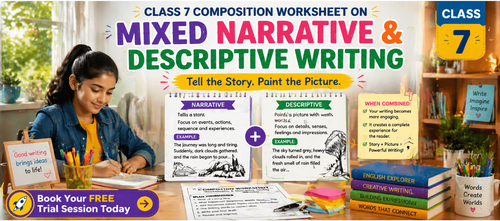

English grammar worksheet: Mixed narrative and descriptive writing
Writing a compelling narrative requires more than just a good story idea; it requires the ability to paint vivid pictures with words and capture emotions through carefully chosen details. In Grade 7, students begin to explore these techniques, developing the skills to craft both descriptive and narrative passages. This worksheet, focused on mixed narrative and descriptive writing, helps students hone these skills by engaging them in activities that challenge them to create vivid imagery and bring their stories to life.
Download these English grammar worksheets and practice regularly to strengthen your language skills and build a strong foundation. You can also book a free trial to get expert guidance and improve your reading, writing, and comprehension abilities. The worksheets are designed in a simple and structured way to help K–8 students learn grammar concepts easily and use them confidently in everyday communication.
What is the topic?
In this worksheet, we focus on mixed narrative and descriptive writing. Narrative writing is all about telling a story, and descriptive writing is about painting pictures with words. Students learn how to blend these two elements, using narrative techniques such as plot and character development while also integrating vivid descriptions of settings, people, and emotions. The goal is for students to use both techniques to craft a more complete and engaging piece of writing.
Students will learn how to:
- Create compelling stories by describing the setting, characters, and emotions with rich detail.
- Use sensory details to make their writing more vivid and immersive.
- Understand how to write a narrative that also functions as a descriptive piece, using clear, concise, and powerful language.
What’s in this worksheet?
This worksheet includes several types of questions that engage students in both narrative and descriptive writing techniques. By completing these exercises, students will improve their ability to use descriptive language while developing their storytelling abilities.
1. Multiple Choice Questions (MCQs): Students will answer questions related to the main setting, sensory details, and emotional tone in a narrative.
2. Fill in the Blanks:This section helps students practice applying descriptive language by completing sentences with the right words.
3.True/False Statements: Students will evaluate statements about the story's themes, settings, and actions, reinforcing their understanding of narrative elements.
4. Underline the Words: Students will underline phrases in the text that reflect the theme or mood of the story, honing their skills in identifying descriptive language.
5. Write a Short Paragraph:In this final task, students will summarize the story and its key elements, focusing on the theme and tone.
Definitions, examples, techniques, and tips
Here are some important definitions and tips related to narrative and descriptive writing:
Narrative Writing: This is a type of writing that tells a story. It often includes characters, a plot, conflict, and resolution. A good narrative will keep the reader engaged by building tension or interest throughout the story.
Descriptive Writing: This type of writing paints a picture with words. It appeals to the senses, describing sights, sounds, smells, tastes, and textures. Descriptive writing makes the reader feel like they are experiencing the scene firsthand.
Example of narrative writing:
"Maya smiled as she walked through the village, feeling the cool breeze on her face."
Example of descriptive writing:
"The leaves rustled in the breeze, each one dancing gently to the ground as the sun dipped below the horizon."
Quick learning tips:
- When writing descriptively, focus on the senses: What can you see, hear, smell, taste, or touch?
- Keep your writing organized: In narrative writing, remember to follow a clear sequence (beginning, middle, and end).
- Show, don’t just tell: Use descriptive language to show the reader what’s happening, rather than simply telling them.
Why is it important to learn this?
Mastering both narrative and descriptive writing is essential for students because these skills will serve them throughout their academic careers and beyond. Narrative writing helps students tell compelling stories, while descriptive writing enables them to bring those stories to life with vivid details. These skills not only improve writing but also help in effective communication, making it easier for students to express themselves clearly and creatively.
Understanding these two writing styles is also crucial for academic success. Whether students are writing essays, book reports, or personal stories, the ability to describe people, places, and events in an engaging way will make their writing stand out.
Where will this knowledge help you?
The skills learned from this worksheet will benefit students in multiple areas, both academically and personally. Here's where this knowledge will prove valuable:
Exams: Many writing tests require students to use both narrative and descriptive techniques to create strong essays or responses.
Writing tasks: Whether it’s a short story or a descriptive paragraph, students will need to use these skills regularly.
Class participation: In discussions and presentations, students who are comfortable with descriptive language will be able to communicate more effectively.
How to use this worksheet?
To make the most out of this worksheet, follow these steps:
1. Attempt independently first: Encourage students to answer each exercise on their own to build confidence and understanding.
2. Review answers carefully: Once completed, students should go through their answers to identify areas of improvement.
3. Correct mistakes: Students should note any mistakes and make corrections to understand where they went wrong.
4. Practice regularly: To reinforce learning, students should complete similar exercises regularly.
The solutions follow the exact order of the worksheet. Be sure to compare the answers carefully to understand why certain answers are correct.
Important tips and tricks
Here are some tips for students to make the most of their practice:
1. Common mistakes to avoid:
- Overusing adjectives: Don’t just say "beautiful," try to describe why it’s beautiful.
- Lack of sensory details: Make sure to include what can be seen, heard, felt, etc.
2. What examiners expect:
- Examiners expect clear organization in both narrative and descriptive writing. Be sure to structure your stories logically, with a clear beginning, middle, and end.
- In descriptive writing, be specific. Instead of "The tree was big," say "The oak tree towered over the field, its thick trunk twisted with age."
3. How to score full marks:
- Make your writing engaging and rich in detail.
- Stay on topic and ensure that every element of the story or description contributes to the overall picture.
4. How to approach activity-based or writing-based tasks:
- For writing tasks, focus on the emotions and atmosphere you want to convey. Use descriptive words that match the mood you want the reader to feel.
Complete answer key
Exercise 1 – Multiple Choice Questions (MCQs)
1. a) The village street
2. a) The scent of freshly baked bread
3. c) Peaceful
4. c) Climbing the oak tree
5. a) The moon rises
6. b) Quiet and peaceful
7. a) At home 8. b) The oak tree's leaves 9. c) Relaxed and nostalgic 10. b) It was her childhood hideout
Exercise 2 – Fill in the Blanks
1. sun
2. bread
3. fields
4. bark
5. breeze
6. moon
7. quiet
8. home
9. leaves
10. Nostalgic
Exercise 3 – True or False
1. True
2. True
3. True
4. False
5. True
6. False
7. False
8. True
9. True
10. False
Exercise 4 – Underlined Words (Sample Answers)
1. setting over the village
2. smelled the bread
3. playing in the fields
4. touched the rough bark
5. rustled gently in the breeze
6. rose in the sky
7. felt peaceful and quiet
8. feeling calm
9. cool against her skin
10. reminded her of childhood
Exercise 5 – Sample Paragraph
Maya walked down the village street, feeling calm and peaceful as she passed the oak tree that reminded her of her childhood. The sunset bathed the village in golden light, and the scent of fresh bread filled the air. As the moon rose, she felt at home again in this familiar place.