
Class 7 Narrative Writing Structure Worksheet: Free Printable
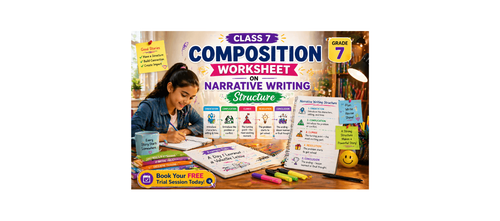

English grammar worksheet for Grade 7: Narrative writing structure
Meera was running late for school when she discovered an unexpected key that opened a hidden chest in the attic, unveiling childhood memories and a letter from her grandmother. This story from Grade 7’s **Narrative Writing Structure** worksheet teaches how to structure a narrative effectively while keeping it engaging. By practicing this worksheet, students will not only learn the importance of sequence and clear progression in a story but also enhance their ability to write compelling narratives. Understanding the structure and flow of a story is an essential skill for students, especially in exams and writing tasks.
Download these English grammar worksheets and practice regularly to strengthen your language skills and build a strong foundation. You can also book a free trial to get expert guidance and improve your reading, writing, and comprehension abilities. The worksheets are designed in a simple and structured way to help K–8 students learn grammar concepts easily and use them confidently in everyday communication.
**What is the topic?**
In this **Narrative Writing Structure** worksheet, Grade 7 students will learn the essential components of a well-structured narrative. Narrative writing is a storytelling method that involves organizing events in a sequence to convey a clear, engaging story. Students will be expected to focus on setting, characters, plot, and conflict, following a structured format.
The worksheet encourages students to write stories with a clear beginning, middle, and end, using transitions to move the story along smoothly. This is critical in crafting a cohesive story that readers can follow easily, with each event logically leading to the next.
**What’s in this worksheet?**
1. **Multiple-choice questions** – Assessing comprehension of narrative structure, focusing on character reactions, setting, and story themes.
2. **Fill-in-the-blank exercises** – Practicing vocabulary and using words from the narrative to complete sentences accurately.
3. **True and false questions** – Helping students identify the truthfulness of statements based on the story’s events.
4. **Underline the words exercise** – Students will underline the words that convey the main theme or lesson of the story.
5. **Paragraph writing** – The final task asks students to summarize the key events of the story while focusing on clarity and structure.
This worksheet focuses on narrative writing, helping students improve their ability to organize thoughts and create well-structured stories, which are valuable skills in exams and other assessments.
**Definitions, examples, techniques, and tips**
- **Narrative writing**: Writing that tells a story. It can be based on real events (a biography) or imaginary events (fiction).
- **Key components**: Setting, characters, plot, conflict, resolution.
- **Setting**: Where and when the story takes place.
- **Characters**: The people or creatures involved in the story.
- **Plot**: The sequence of events in the story.
- **Conflict**: The main problem the characters face.
- **Resolution**: How the problem is solved or resolved by the end of the story.
**Examples**:
- Meera finds an unexpected key and uses it to open a chest in the attic. This unexpected discovery sets the stage for her adventure.
- The letter from her grandmother is an essential part of the resolution, tying back to Meera’s past and the emotional growth she experiences.
**Techniques**:
- **Sequencing**: Organize events in a logical order to help the reader follow the narrative.
- **Character development**: Focus on how the characters change throughout the story.
- **Conflict and resolution**: Make sure your narrative has a central conflict that is resolved by the end.
**Quick learning tips**:
1. Keep your story simple with a clear sequence of events.
2. Focus on describing characters’ emotions and actions to help readers connect with them.
3. Use transition words (e.g., then, next, after, finally) to guide the reader through the story.
**Why is it important to learn this?**
Learning narrative writing structure is important for several reasons:
- It helps in creating stories that are not only engaging but also logically coherent.
- Mastery of narrative structure enhances writing skills, helping students communicate their ideas clearly.
- It teaches students how to build tension and resolve conflicts, which are key components of good storytelling.
- Understanding the structure of a narrative prepares students for exams where they may be required to write essays or short stories.
**Where will this knowledge help you?**
- **Exams**: Knowing how to structure your story will help in narrative writing sections of exams.
- **Writing tasks**: This skill is essential when writing stories, essays, or reports.
- **Class participation**: Understanding narrative structure enables students to engage more effectively in discussions about stories or reading assignments.
**How to use this worksheet?**
1. **Attempt independently first**: Try to complete the worksheet on your own before looking at any answers.
2. **Review answers carefully**: Once you’re done, check your answers against the provided solutions to see where you went wrong.
3. **Correct mistakes**: Understanding why an answer is incorrect helps reinforce learning.
4. **Practice regularly**: The more you practice writing and analyzing stories, the better your narrative writing skills will become.
Remember, the answers follow the exact worksheet order, so compare each answer carefully with the solution provided.
**Important tips and tricks**
1. **Common mistakes**:
- Not following the logical sequence of events.
- Focusing too much on one event and neglecting others.
2. **What examiners expect**:
- A clear beginning, middle, and end.
- Well-developed characters and a clear conflict with a resolution.
3. **How to score full marks**:
- Ensure your story has a clear structure.
- Use appropriate vocabulary and vary your sentence structure to keep the reader interested.
4. **How to approach activity-based or writing-based tasks**:
- Focus on coherence: Each part of your narrative should relate to the next.
- Always check your work for grammatical errors to ensure clarity.
**Complete answer key**
**Exercise 1 – Multiple Choice Questions**
1. a) A shiny key
2. c) Happy and surprised
3. b) Childhood memories and a letter from her grandmother
4. c) School bag
5. b) Life’s surprises can lead to unexpected treasures
6. b) Running late for school
7. a) On the floor
8. b) The old chest in the attic
9. b) Tell her friends about the hidden chest
10. c) The time and being late for school
**Exercise 2 – Fill in the Blanks**
1. school bag
2. key
3. chest
4. memories
5. happy
6. clothes
7. surprised
8. hope
9. attic
10. hope
**Exercise 3 – True or False**
1. False
2. True
3. True
4. False
5. False
6. False
7. True
8. False
9. False
10. True
**Exercise 4 – Underline the Words**
1. **early for school**
2. **shiny ring on the floor**
3. **drawer of memories**
4. **Meera promised never to visit the attic again**
5. **Meera felt angry when she found the chest**
6. **chest full of old clothes**
7. **Meera felt sad after discovering the key**
8. **key opened a drawer of memories**
9. **Meera felt confused**
10. **Meera felt angry when she found the chest**
**Exercise 5 – Write a Paragraph**
**Answers may vary**
Meera’s adventure with the mysterious key and chest teaches a valuable lesson about the unexpected treasures life can bring. Through this exercise, Grade 7 students will develop their skills in organizing ideas, using transitions, and creating engaging narratives.