
Class 7 English Worksheet: Literary Argument Paragraph PDF
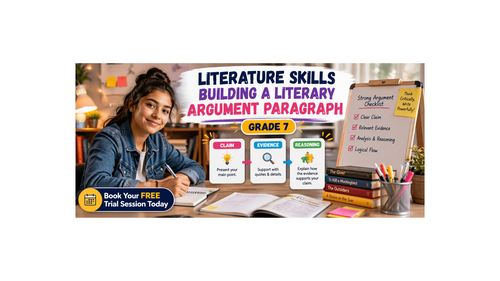

Build Strong Reasoning Skills with This English Grammar Worksheet Grade 7 on Literary Argument Paragraph
Understanding how to form clear and logical arguments is an important skill for every student. In Grade 7, students begin to move beyond simple answers and start explaining their ideas with reasons and evidence. This English grammar worksheet on “Literature Skills - Building a Literary Argument Paragraph” helps students practice exactly that in a structured and engaging way.
Through a relatable classroom story and carefully designed questions, students learn how to observe details, avoid quick judgments, and support their ideas using facts. The worksheet focuses on how one character, Ananya, uses careful thinking and evidence instead of assumptions. This makes it easier for students to connect with the lesson and apply it in their own writing and speaking.
Download these English grammar worksheets and practice regularly to strengthen your language skills and build a strong foundation. You can also book a free trial to get expert guidance and improve your reading, writing, and comprehension abilities. The worksheets are designed in a simple and structured way to help K–8 students learn grammar concepts easily and use them confidently in everyday communication.
What Is the Topic?
The topic of this worksheet is “Literature Skills - Building a Literary Argument Paragraph.” It focuses on helping students understand how to form a clear argument based on a story.
A literary argument means explaining an idea from a story using evidence and logical thinking. Instead of guessing or blaming, students learn to carefully study details and draw fair conclusions. In this worksheet, students read a story about a broken classroom window and analyze how Ananya uses clues and reasoning to reach a fair conclusion.
Students are expected to learn how to:
- Identify important details in a story
- Understand the importance of evidence
- Avoid making quick assumptions
- Build logical and fair arguments
What’s in This Worksheet?
This English grammar worksheet Grade 7 is designed in a structured way to build understanding step by step.
1. Story-based learning
Students begin by reading a story titled “The Debate on the Broken Window,” which forms the base for all questions.
2. Multiple choice questions
These questions help students check their understanding of the story, theme, and reasoning.
3. Fill in the blanks
This section focuses on recalling key details and important words from the story.
4. True and false
Students analyze statements and decide whether they match the events and ideas in the story.
5. Underline the words
This activity helps students identify correct ideas and themes by choosing between two options.
6. Paragraph writing
Students apply their understanding by writing a short paragraph explaining how a literary argument is formed.
This structure supports exam preparation by improving comprehension, reasoning, and writing skills.
Definitions, Examples, Techniques, and Tips
Definitions
A literary argument is a way of explaining ideas from a story using evidence and logical thinking. It focuses on proving a point instead of guessing.
Examples from the worksheet
In the story, Ananya observes the glass pieces, notices a cricket ball, and checks the weather conditions. These details help her form a conclusion instead of blaming someone without proof.
Techniques
Students are encouraged to:
- Observe carefully
- Collect information before deciding
- Think logically
- Use facts to support ideas
Quick learning tips
- Always look for clues in the story
- Do not jump to conclusions
- Support your answer with details
- Think calmly before deciding
Why Is It Important to Learn This?
Learning how to build a literary argument is important because it helps students think clearly and express their ideas confidently. Instead of making random guesses, students learn to support their thoughts with proper reasoning.
This skill improves writing by making answers more structured and meaningful. It also strengthens speaking skills, as students learn to explain their ideas clearly. In academics, this helps students perform better in comprehension, literature, and writing tasks.
Where Will This Knowledge Help You?
This knowledge is useful in many areas of a student’s learning journey.
In exams, students can write better answers by explaining their ideas clearly.
In writing tasks, they can create structured paragraphs with proper reasoning.
In class discussions, they can share their thoughts confidently with supporting points.
It also helps students become careful thinkers who do not make unfair judgments.
How to Use This Worksheet?
1. Attempt independently first
Read the story carefully and try to answer all questions on your own.
2. Review answers carefully
Go through each question again and check if your answers match the story details.
3. Correct mistakes
Identify where you went wrong and understand the correct idea.
4. Practice regularly
Repeat similar exercises to improve your reasoning and writing skills.
The solutions follow the exact worksheet order, so students should compare answers carefully and learn from their mistakes.
Important Tips and Tricks
1. Do not guess answers
Always base your answer on the story details.
2. Focus on evidence
Look for facts like objects, actions, and observations in the story.
3. Avoid quick judgments
The worksheet clearly shows that quick assumptions can be incorrect.
4. Understand the theme
The main idea of the story is about fairness and using evidence before judging.
5. Write clearly in paragraph tasks
In writing questions, focus on explaining ideas using examples from the story.
6. Read questions carefully
Many questions test understanding of small details, so careful reading is important.
Complete Answer Key
Story:
The Debate on the Broken Window
In a government school in Lucknow, a classroom window was found broken one morning. Some students quickly blamed Rahul, but Ananya decided to investigate instead of making assumptions.
She observed that the glass pieces were inside the classroom and found a cricket ball nearby. She also checked the area carefully, spoke to a few students, and confirmed that there were no strong winds that night.
Ananya thought about all the clues before making a decision. When she presented her findings, she explained that while the ball likely caused the damage, there was no proof against Rahul. The teacher appreciated her fair reasoning and calm approach.
The students learned that strong arguments require evidence, and that blaming without proof can lead to unfair conclusions.
Exercise No. 1
1. b
2. c
3. a
4. b
5. c
6. b
7. a
8. b
9. b
10. c
Exercise No. 2
1. Ananya
2. window
3. cricket ball
4. winds
5. inside
6. evidence
7. argument
8. logical
9. unfair
10. evidence
Exercise No. 3
1. False
2. False
3. False
4. True
5. True
6. True
7. False
8. True
9. True
10. True
Exercise No. 4
1. careful
2. fairness
3. patience
4. justice
5. logic
6. strong
7. evidence
8. truth
9. quick judgment
10. calm
Exercise No. 5
Read the story and write a short paragraph.
Write a short paragraph explaining how a clear literary argument is developed in the passage, focusing on the theme, Ananya’s actions, the use of evidence, and how reasoning supports the conclusion.
Ananya develops a clear literary argument by carefully examining the situation instead of making quick assumptions. The theme of the passage focuses on using evidence before judging. She observes important details such as the glass pieces inside the classroom, the presence of a cricket ball, and the absence of strong winds. These clues help her build a logical explanation. Instead of blaming Rahul without proof, she presents her findings based on facts. Her reasoning is calm and fair, which leads to a justified conclusion. This shows that strong arguments are formed using evidence and logical thinking.
By practicing this English grammar worksheet Grade 7 on Literary Argument Paragraph, students can build strong reasoning skills and learn how to support their ideas with confidence. Regular practice will help them become better readers, writers, and thinkers who can express their ideas clearly and fairly.