
Class 7 English Worksheet: Synthesizing Text Ideas Practice

Class 7 English Worksheet: Synthesizing Text Ideas Practice
Understanding how ideas connect across different texts is an important skill for growing readers. This Class 7 English grammar worksheet focuses on synthesizing text ideas practice through an interesting story and carefully designed exercises. Students learn how to compare events, connect character actions, and understand one shared lesson from different situations. These skills help learners answer comprehension questions, write better responses, and think more deeply while reading. With regular practice, students can become more confident in reading, writing, and classroom discussions.
Download these English grammar worksheets and practice regularly to strengthen your language skills and build a strong foundation. You can also book a free trial to get expert guidance and improve your reading, writing, and comprehension abilities. The worksheets are designed in a simple and structured way to help K–8 students learn grammar concepts easily and use them confidently in everyday communication.
What Is the Topic?
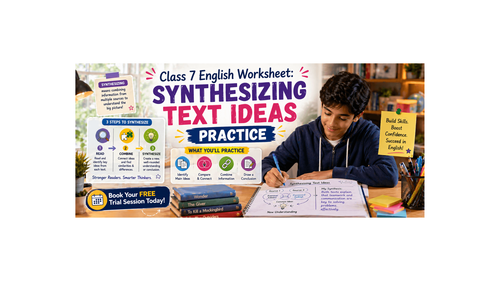
Synthesizing text ideas means combining information from different parts of a passage or from more than one text to understand a bigger message. In this worksheet, students read about Aarav and Meera. Their situations are different, but both characters show courage. By connecting both stories, students understand that courage can appear in different ways. This topic teaches learners how to compare details, identify common ideas, and explain deeper meaning clearly.
What’s in This Worksheet?
1. A reading passage called Two Stories, One Lesson introduces two characters and their brave actions.
2. Multiple choice questions test understanding of characters, events, and the message.
3. Fill in the blanks gives practice with important vocabulary from the story.
4. True and False checks whether students understand details correctly.
5. Underline the Words helps students identify phrases that show synthesis.
6. Paragraph writing asks students to explain the shared lesson using ideas from the story.
7. The worksheet supports comprehension, reasoning, and exam preparation.
Definitions, Examples, Techniques, and Tips
Definition:
Synthesizing means bringing ideas together to understand one complete message.
Example:
Aarav helped a lost puppy in the rain. Meera spoke the truth in class. When both actions are considered together, the message becomes clear: courage means doing the right thing.
Technique:
1. Read each part carefully.
2. Find the important actions.
3. Look for similarities.
4. Identify the common lesson.
Quick Tips:
1. Focus on what both characters did.
2. Notice feelings such as fear or nervousness.
3. Look for shared themes like courage.
4. Use clear words while explaining connections.
Why Is It Important to Learn This?
This topic is important because students need more than simple reading skills. They must understand meaning, compare ideas, and explain lessons clearly. Synthesizing improves writing because learners organize thoughts better. It also helps speaking because students can discuss stories with confidence. In exams, many questions ask students to connect information before answering, so this skill is very useful for Class 7 learners.
Where Will This Knowledge Help You?
1. Exams – Helps answer comprehension and theme-based questions.
2. Writing tasks – Useful for paragraphs and detailed answers.
3. Class participation – Helps students share thoughtful ideas.
4. Reading practice – Builds stronger understanding of passages.
5. Critical thinking – Encourages deeper learning and analysis.
How to Use This Worksheet?
1. Attempt independently first by reading the story carefully.
2. Answer each question in order without skipping any section.
3. Review answers carefully after finishing the worksheet.
4. Correct mistakes and understand the right responses.
5. Compare your work with the solutions in the exact worksheet order.
6. Practice regularly to improve speed and accuracy.
Important Tips and Tricks
1. Read both stories before answering any question.
2. Do not focus on only one character when the question asks about both.
3. Look for common qualities such as courage and honesty.
4. In multiple choice questions, remove wrong options first.
5. In True and False, check every statement word by word.
6. In writing tasks, include the common message clearly.
7. Keep answers neat, direct, and connected to the story.
8. To score full marks, answer in the correct order and revise carefully.
Complete Answer Key
Story:
Two Stories, One Lesson
Exercise No. 1
Choose the correct answer for each question based on the story.
1. What did Aarav do in the first story?
a) Helped a lost puppy in the rain
2. What did Meera do in the second story?
c) Spoke the truth in class
3. What common quality did both Aarav and Meera show?
b) Courage
4. How was Aarav’s courage shown?
b) By helping a puppy in difficult conditions
5. How was Meera’s courage shown?
c) By speaking the truth despite fear
6. What did Riya understand after reading both stories?
a) Courage can appear in different ways
7. Why did Meera feel nervous?
a) She chose to tell the truth
8. What is one similarity between Aarav and Meera?
c) Both helped others
9. What is the main message of both stories together?
a) Courage means doing the right thing
10. What skill did Riya use to connect ideas from both stories?
b) Synthesis
Exercise No. 2
Fill in the blanks with suitable words based on the story.
1. Riya uses synthesis to connect both stories.
2. Ravi finds similarities in both stories as both show courage.
3. Meera shows courage when she speaks the truth.
4. Aarav shows courage by helping the puppy in the rain.
5. Riya tries to synthesize ideas from both stories.
6. Students compare the two characters to see how they are alike.
7. Both stories share common ideas about courage.
8. Riya writes down details from both stories in her notebook.
9. Raj explains the deeper meaning of both actions.
10. Riya is able to understand the message after reading both stories.
Exercise No. 3
Read each statement based on the story and tick (✓) the correct option (True or False).
1. False
2. True
3. True
4. False
5. True
6. False
7. False
8. True
9. False
10. True
Exercise No. 4
Read each sentence and underline the word or phrase that shows synthesis (combining ideas from both stories).
1. combining their actions
2. connects both characters
3. links both stories
4. uses ideas from both stories
5. similar ideas in both stories
6. shared message in both stories
7. compares both characters
8. combining both stories
9. joins both ideas
10. bringing ideas together
Exercise No. 5
Read the story and write a short paragraph.
Write a short paragraph explaining Synthesizing Ideas Across Texts from the passage. Focus on the common message and how both characters show courage in different ways.
Sample Answer:
Synthesizing Ideas Across Texts means combining ideas from different stories to understand one message. In the passage, Aarav helped a lost puppy during heavy rain even though he was scared. Meera spoke the truth in class even though she felt nervous. Their actions were different, but both showed courage. The common message is that courage means doing the right thing in different situations.
This Class 7 English grammar worksheet helps students build confidence in reading and thinking skills. By practicing how to connect ideas from Aarav and Meera’s stories, learners understand deeper meanings more clearly. Keep practicing synthesizing text ideas regularly to improve comprehension, writing, and classroom success.