
Class 7 English Worksheet: Theme Review Exercises PDF

Class 7 English Worksheet: Theme Review Exercises PDF
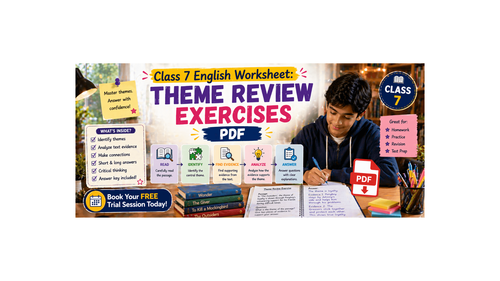
Understanding stories is not just about reading words—it’s about connecting ideas, learning from characters, and discovering deeper meanings. In this Grade 7 English grammar worksheet on Theme Synthesis Review, students explore how different stories can share similar messages. Through engaging activities, learners observe how effort, persistence, and determination play a key role in success.
This worksheet focuses on the stories of Arjun and Kavya, who face challenges but overcome them through regular practice and dedication. By comparing both stories, students learn how to identify common themes and connect ideas across texts. This helps build strong comprehension and analytical skills that are essential for academic success.
Download these English grammar worksheets and practice regularly to strengthen your language skills and build a strong foundation. You can also book a free trial to get expert guidance and improve your reading, writing, and comprehension abilities. The worksheets are designed in a simple and structured way to help K–8 students learn grammar concepts easily and use them confidently in everyday communication.
What Is the Topic?
Theme and synthesis are important concepts in understanding stories. Theme refers to the main message or lesson that a story teaches. In this worksheet, the theme is clearly shown through the experiences of Arjun and Kavya, where effort and persistence lead to success.
Synthesis means connecting ideas from different texts. Students learn how to compare two stories and identify similarities between them. By doing this, they understand that even though characters may face different challenges, the message can still be the same.
This worksheet helps students:
• Identify the theme in a story
• Understand how characters grow through effort
• Connect ideas from multiple texts
• Use clues from the text to understand meaning
What’s in This Worksheet?
1. Story reading section that introduces the theme of effort and growth through Arjun and Kavya’s experiences.
2. Multiple choice questions that test understanding of key ideas and themes.
3. Fill in the blanks to reinforce vocabulary and concept clarity.
4. True and False statements to check comprehension of the story.
5. Underline the words activity to identify theme-related phrases.
6. Paragraph writing task to encourage expression of understanding.
Definitions, Examples, Techniques, and Tips
Definitions:
• Theme is the main idea or message in a story.
• Synthesis means connecting ideas from different stories.
Examples:
• Arjun improves by practicing regularly.
• Kavya works hard after failing and becomes confident.
• Both stories show that effort leads to success.
Techniques:
• Read carefully to understand events.
• Look for repeated ideas in both stories.
• Compare characters and their actions.
Tips:
• Focus on what the characters learn.
• Use clues from the story to understand the message.
• Think about how both stories are similar.
Why Is It Important to Learn This?
Learning theme and synthesis helps students become better readers. It allows them to understand deeper meanings in stories instead of just reading the surface. This skill also improves writing, as students can express ideas clearly and connect different thoughts effectively.
It also builds confidence in answering comprehension-based questions in exams.
Where Will This Knowledge Help You?
This knowledge is useful in many areas:
• School exams where students need to analyze stories
• Writing tasks that require explanation of ideas
• Class discussions where students compare texts
• Daily reading where understanding meaning is important
How to Use This Worksheet?
1. Read the story carefully before attempting the questions.
2. Attempt all questions independently.
3. Review answers carefully after completing the worksheet.
4. Correct mistakes and understand where you went wrong.
5. Practice similar worksheets regularly to improve skills.
The solutions follow the exact worksheet order, so students should compare answers carefully.
Important Tips and Tricks
1. Always read the story more than once for better understanding.
2. Do not guess answers—use clues from the text.
3. Pay attention to repeated ideas, as they often show the theme.
4. In True/False questions, think carefully before choosing.
5. For writing tasks, focus on the main idea and examples from the story.
6. Avoid ignoring important details in the story.
Complete Answer Key
Story:
Effort and Growth
Exercise No. 1
Read each sentence and circle the correct answer based on the story.
1. perseverance
2. regular practice
3. theme
4. synthesis
5. dedication
6. similar ideas
7. meaningful
8. emotional
9. similarities
10. textual
Exercise No. 2
Read the story carefully and fill in the blanks with appropriate words based on the theme.
1. perseverance
2. synthesis
3. inferences
4. thinking
5. connections
6. understanding
7. similarities
8. evidence
9. theme
10. consistent
Exercise No. 3
Read each statement based on the story and tick (✓) the correct option (True or False).
1-T
2-T
3-F
4-T
5-F
6-F
7-T
8-F
9-T
10-F
Exercise No. 4
Read the paragraph and underline the word or phrase that best reflects the theme or message based on the story.
1. practices every evening
2. learns lessons from failure
3. improves through regular practice
4. shares thoughts
5. compare stories
6. writes answers
7. reads stories
8. discuss ideas
9. explains the lesson
10. studies topics
Exercise No. 5
Read the story and write a short paragraph.
Write a short paragraph explaining the impact of theme and synthesis in the passage. Focus on the common theme, Arjun and Kavya’s experiences, and how connecting both stories shows that effort leads to success.
By practicing this Grade 7 English grammar worksheet on Theme Synthesis Review, students can clearly understand how to connect ideas across stories and identify important messages. With regular practice, these skills become stronger, helping students perform better in exams and express their thoughts confidently.