
Class 7 Fact-Checking & Evidence Verification - Worksheet for Practice

Bridge or Bluff? English Grammar Worksheet Grade 7 on Fact-Checking & Evidence Verification
Have you ever heard a shocking piece of news and immediately believed it, only to later discover that it was not true? This happens often, especially when information spreads quickly through messages and social media. In this English grammar worksheet, Grade 7 students explore the topic of Fact-Checking & Evidence Verification through an engaging and realistic story set in Thrissur. The story shows how a viral rumour about a collapsed bridge spreads rapidly and how one student carefully investigates the situation to uncover the truth.
This worksheet helps students understand that not all information should be accepted at face value. Instead, they learn to pause, question, and verify facts before believing or sharing them. Through structured activities, students develop strong comprehension and analytical skills while learning the importance of evidence-based thinking. This approach not only improves their grammar and reading skills but also prepares them to handle real-life situations more responsibly.
Download these English grammar worksheets and practice regularly to strengthen your language skills and build a strong foundation. You can also book a free trial to get expert guidance and improve your reading, writing, and comprehension abilities. The worksheets are designed in a simple and structured way to help K–8 students learn grammar concepts easily and use them confidently in everyday communication.
What Is the Topic?
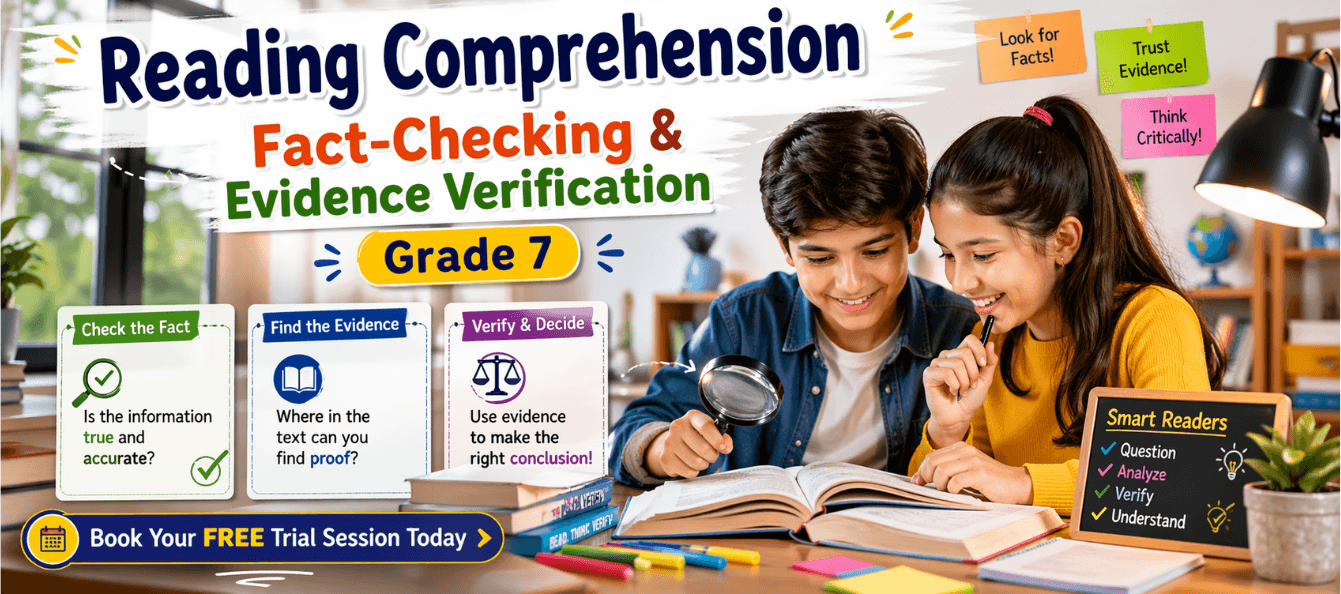
Fact-Checking & Evidence Verification is an essential part of reading comprehension that teaches students how to question information and confirm its accuracy before accepting it as true.
In this Grade 7 English grammar worksheet, students learn how to evaluate claims, identify reliable sources, and understand the importance of evidence in decision-making. They see how misinformation can spread quickly and how careful investigation can reveal the truth.
This topic encourages students to think critically, rely on evidence, and avoid being misled by incomplete or false information.
What’s in This Worksheet?
This English grammar worksheet for Grade 7 includes five engaging activities that build comprehension and analytical thinking:
1. Multiple Choice Questions – Students answer questions based on the story, focusing on reasoning, credibility, and evaluation of evidence.
2. Fill in the Blanks (Word Bank) – Students complete sentences using key vocabulary such as evidence, verify, source, and reliable to reinforce understanding of fact-checking.
3. True or False – Learners evaluate statements and decide whether they align with the story, improving comprehension accuracy.
4. Identify the Evidence – Students underline parts of sentences that represent evidence, helping them distinguish between claims and proof.
5. Paragraph Completion – Students fill in a meaningful paragraph about verifying information, applying both vocabulary and conceptual understanding.
These activities guide students to think carefully and understand that evidence plays a key role in verifying information.
Definitions, Examples, Techniques, and Tips
Definitions
Fact-checking means examining information carefully to determine whether it is true.
Evidence verification means checking proof or supporting details before accepting a claim.
Examples
Students read a story about a rumour of a collapsed bridge and answer questions based on evidence and verification.
They identify parts of sentences that show proof and complete paragraphs using appropriate words.
Techniques
Students compare claims with available evidence.
They check whether information comes from reliable sources.
They observe details carefully before making conclusions.
Quick Learning Tips
Always question information that seems unclear or surprising.
Look for evidence before believing any claim.
Use multiple sources to confirm information.
Pay attention to details while reading and answering questions.
Why Is It Important to Learn This?
Learning fact-checking and evidence verification is important because it helps students become thoughtful readers and responsible communicators. It teaches them not to accept information blindly.
For Grade 7 students, this topic strengthens logical reasoning and critical thinking. It also helps them understand how to identify reliable information and avoid being misled by rumours or false claims.
By practicing this English grammar worksheet, students build confidence in analyzing information and making informed decisions.
Where Will This Knowledge Help You?
This knowledge is useful in both academic and real-life situations.
In exams, students can answer comprehension questions accurately by focusing on evidence and reasoning.
In writing tasks, they can support their ideas with proper proof.
In everyday life, they can avoid spreading misinformation by verifying facts before sharing information.
It also helps them become responsible and careful communicators.
How to Use This Worksheet?
1. Read the story carefully before attempting the questions.
2. Answer all questions independently.
3. Review your answers after completing each section.
4. Compare your responses with the answer key provided.
5. Correct mistakes and understand the correct answers.
6. Practice regularly to improve comprehension and analytical skills.
The solutions follow the exact worksheet order, so students should compare their answers carefully.
Important Tips and Tricks
1. Always look for evidence before accepting any claim.
2. Read each question carefully to avoid mistakes.
3. Pay attention to details while identifying evidence.
4. Do not rely on a single source of information.
5. Check whether the information is supported by proof.
6. Avoid rushing through paragraph completion tasks.
7. Remember that visuals and messages can sometimes be misleading.
8. Examiners expect clear understanding and accurate answers.
Complete Answer Key (For Parents & Educators)
Exercise 1 – Multiple Choice Questions
1. b) It shows she questions information without evidence.
2. a) It lacks any official confirmation or source.
3. a) Different sources help confirm accuracy.
4. c) It provides real-world confirmation.
5. b) It shows visuals can be misleading evidence.
6. c) They relied only on emotional impact.
7. a) It adds direct observation as evidence.
8. a) She followed a systematic verification process.
9. b) People often react without checking.
10. c) Evidence should be checked before accepting claims.
Exercise 2 – Fill in the Blanks
1. verify
2. claim
3. sources
4. image
5. evidence
6. confirm
7. report
8. observe
9. mislead
10. reliable
Exercise 3 – True or False
1. True
2. True
3. False
4. True
5. False
6. False
7. True
8. False
9. False
10. True
Exercise 4 – Underline the Evidence
1. “checked official websites which showed no reports of a bridge collapse”
2. “confirmed that no accident had occurred near the bridge”
3. “found it was from another place”
4. “uncle had not heard about any such incident”
5. “looked dramatic”
6. “observed normal traffic movement”
7. “No reliable news reports mentioned the bridge collapse”
8. “teacher clarified that the trip was not cancelled”
9. “did not include any official source or announcement”
10. “used multiple sources to support her conclusion”
Exercise 5 – Paragraph Completion
1. quickly
2. source
3. verify
4. sources
5. mislead
6. confirm
7. critical
8. misinformation
9. informed
10. evidence
Empower your child to question, analyze, and verify information confidently in today’s digital world with expert-led guidance.
By practicing this English grammar worksheet for Grade 7 on Fact-Checking & Evidence Verification, students can develop strong comprehension and reasoning skills. With regular practice, they will learn to rely on evidence, think critically, and make confident decisions in both academic and real-life situations.
Book a free trial!