
Foreshadowing Worksheet for Grade 7 Exercises with Answers

Improve Story Understanding with This English Grammar Worksheet for Grade 7 on Foreshadowing (Subtle & Explicit)
Have you ever noticed how stories sometimes give small hints about what will happen next? These clues make reading more exciting and help build curiosity. This English grammar worksheet for Grade 7 focuses on foreshadowing and helps students understand how writers give hints about future events in a story.
In this worksheet, students explore both subtle and explicit foreshadowing. They learn how small details, warnings, and background clues prepare readers for upcoming events. The exercises are designed to help students recognize these hints and understand how they add meaning and excitement to stories.
Download these English grammar worksheets and practice regularly to strengthen your language skills and build a strong foundation. You can also book a free trial to get expert guidance and improve your reading, writing, and comprehension abilities. The worksheets are designed in a simple and structured way to help K–8 students learn grammar concepts easily and use them confidently in everyday communication.
What Is the Topic?
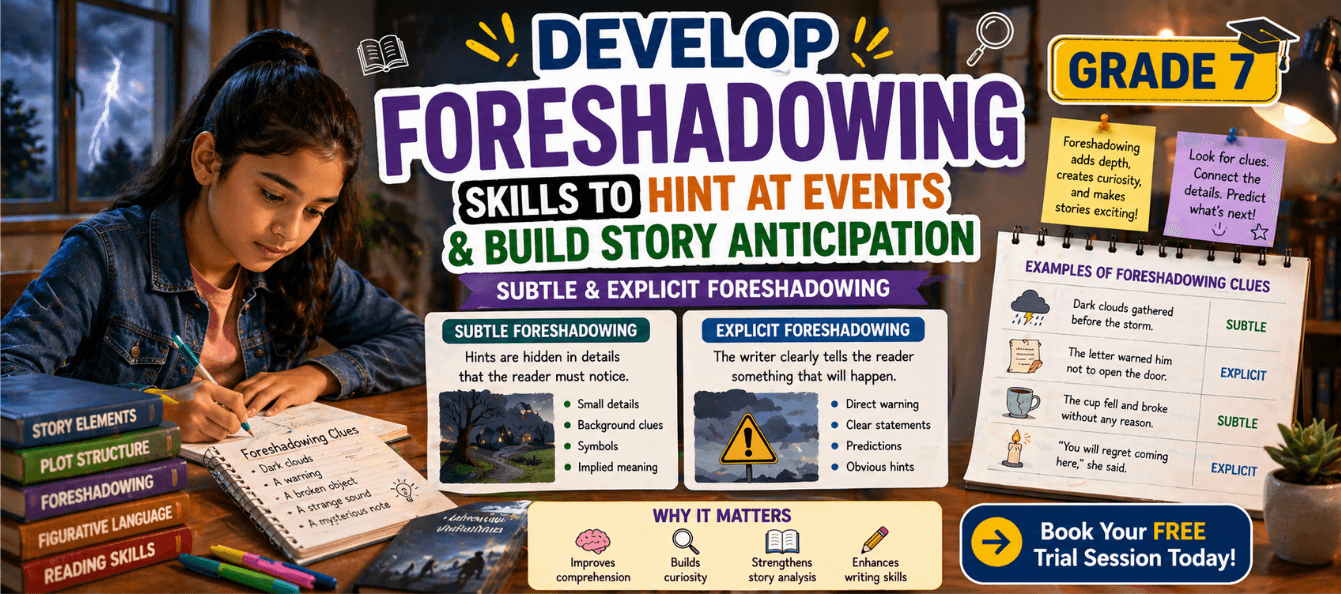
Foreshadowing is a technique that signals
later events in a story. It gives hints or clues about what may happen in the future. These hints can be clear and direct or hidden in small details.
In this worksheet, students learn about subtle foreshadowing, which uses indirect clues, and explicit foreshadowing, which clearly states future events. Students are expected to identify these clues and understand how they contribute to storytelling.
What’s in This Worksheet?
1. Multiple choice questions to identify foreshadowing terms.
2. Fill in the blanks using words related to foreshadowing.
3. True and false questions to test understanding.
4. Sentence-based exercises to identify foreshadowing clues.
5. A passage-based activity to explain how foreshadowing is used.
6. A mix of recognition and application-based exercises.
7. Structured learning from basic concepts to deeper analysis.
Definitions, Examples, Techniques, and Tips
Dark clouds gathering is an example of foreshadowing.
A small detail hinting at events is called clue.
When the writer clearly states the future it is explicit.
A quiet background clue is an example of subtle.
A direct warning about danger is called explicit.
A technique that signals later events is foreshadowing.
A feeling of worry before events is anticipation.
A sign that danger may come is a signal.
A clear statement predicting outcome is prediction.
When meaning is suggested indirectly it is implication.
These concepts are directly practiced through the worksheet exercises.
Why Is It Important to Learn This?
Learning foreshadowing helps students understand how stories create interest and build anticipation. It improves reading comprehension by helping students notice important clues. It also supports writing skills by allowing students to add depth and meaning to their stories.
Understanding foreshadowing helps students connect events in a story and predict possible outcomes.
Where Will This Knowledge Help You?
This knowledge is useful in exams where students analyze passages and answer questions. It helps in writing tasks such as stories and essays. It also supports class discussions about how events are connected in a story.
How to Use This Worksheet?
1. Attempt all questions independently first.
2. Read each sentence carefully.
3. Review your answers after completing the worksheet.
4. Compare your answers with the answer key in the exact worksheet order.
5. Identify mistakes and correct them.
6. Practice regularly to improve understanding of foreshadowing.
Important Tips and Tricks
1. Look for small hints or clues in sentences.
2. Identify whether the clue is direct or indirect.
3. Pay attention to words that suggest future events.
4. Do not confuse foreshadowing with flashback.
5. Focus on how clues connect to later events.
6. Practice identifying foreshadowing in different passages.
Complete Answer Key
Exercise No. 1
Read each statement carefully and choose the correct term from the options.
1. foreshadowing
2. foreshadowing
3. explicit
4. implication
5. subtle
6. prediction
7. explicit
8. signal
9. clue
10. anticipation
Exercise No. 2
Choose one word from the box to complete the sentence.
1. anticipation
2. prediction
3. tension
4. implication
5. outcome
6. expectation
7. clue
8. indication
9. signal
10. anticipation
Exercise No. 3
Choose True if the statement is correct and false if the statement is incorrect.
1. False
2. True
3. False
4. True
5. False
6. True
7. False
8. True
9. True
10. False
Exercise No. 4
Underline the words or phrases in each sentence that act as foreshadowing clues.
1. Riya carried a lantern through the cave.
2. She warned that danger would come soon.
3. He remembered a dream from yesterday.
4. The dog barked loudly in the dark.
5. A shadow moved near the window.
6. The sky darkened as the wind rose.
7. A sign stood near the broken bridge.
8. The wind howled before the storm.
9. The silence made the place unsafe.
10. A crack appeared in the wall.
Exercise No. 5
Read the passage carefully and explain how foreshadowing is used in the passage.
Answers may vary.
Practicing this English grammar worksheet for Grade 7 on foreshadowing will help students recognize important clues in stories and understand how writers hint at future events. With regular practice, students can improve both their reading and writing skills and become more confident in analyzing texts.
Book a free trial!