
Class 7 Grammar Worksheet: Main & Auxiliary Verbs

Master Main and Auxiliary Verbs with This English Grammar Worksheet for Grade 7
Verbs are the backbone of every sentence, and understanding how they work can make a huge difference in how clearly we speak and write. For students in Grade 7, learning about main and auxiliary verbs is an important step toward building strong grammar skills. This English grammar worksheet focuses on helping learners identify, use, and correct verbs through engaging and structured practice.
Whether it is recognizing the helping verb in a sentence or choosing the correct verb form, this worksheet gives students a chance to practice real examples in a simple and guided way. With different types of questions like multiple choice, true or false, fill in the blanks, sentence rewriting, and paragraph writing, students can improve their understanding step by step.
Download these English grammar worksheets and practice regularly to strengthen your language skills and build a strong foundation. You can also book a free trial to get expert guidance and improve your reading, writing, and comprehension abilities. The worksheets are designed in a simple and structured way to help K–8 students learn grammar concepts easily and use them confidently in everyday communication.
What Is The Topic?
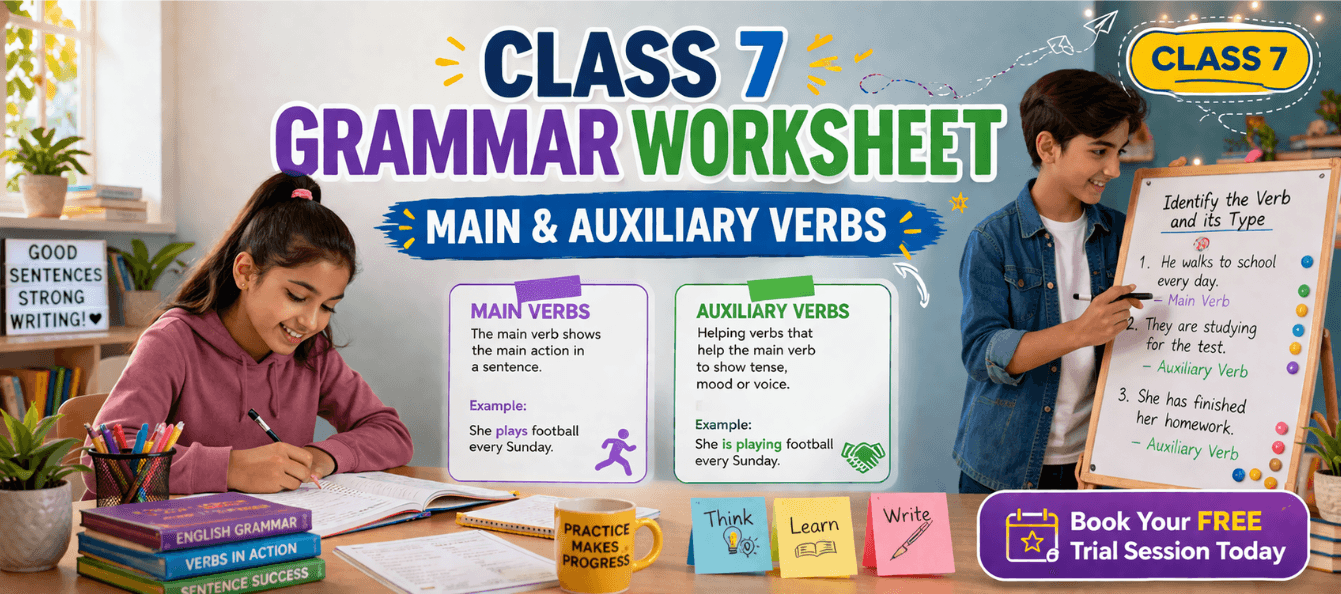
This English grammar worksheet for Grade 7 focuses on verbs, specifically main verbs and auxiliary verbs. Main verbs show the main action in a sentence, while auxiliary verbs help the main verb to form tenses, questions, and negative sentences.
Students are expected to learn how to identify both types of verbs, understand how they work together, and use them correctly in different sentence structures. The worksheet provides direct practice through identification, correction, and usage-based questions.
What’s In This Worksheet?
1. Multiple choice questions that test identification of main and auxiliary verbs.
2. True and False sentences to check understanding of correct verb usage.
3. Fill in the blanks to practice forming correct verb combinations.
4. Sentence rewriting tasks to correct incorrect verb usage.
5. A paragraph writing activity where students complete sentences using suitable verbs.
Definitions, Examples, Techniques, And Tips
Definitions:
Main verbs indicate the primary action in a sentence.
Auxiliary verbs support the main verb and help express tense, mood, or voice.
Examples:
She is reading a novel.
They have completed the project.
Ravi was playing cricket.
Techniques:
Read the sentence carefully and identify the action.
Look for helping words like is, have, was, can, etc.
Check if the verb form matches the subject.
Quick learning tips:
Always check subject-verb agreement.
Identify whether the sentence needs a helping verb.
Practice rewriting incorrect sentences to improve accuracy.
Why Is It Important To Learn This?
Learning main and auxiliary verbs helps students form correct sentences and avoid common grammatical errors. It improves both writing and speaking skills. When students understand how verbs work, they can express ideas more clearly and confidently.
This topic is also important for exams, as many grammar questions test verb usage directly. Mastering this concept helps students score better and write more accurately.
Where Will This Knowledge Help You?
This knowledge is useful in:
Exams where grammar accuracy is tested
Writing tasks such as essays and paragraphs
Speaking clearly in class discussions
Understanding and correcting sentences
How To Use This Worksheet?
1. Attempt all questions independently first.
2. Read each sentence carefully before answering.
3. Review your answers and compare them with the correct ones.
4. Correct any mistakes and understand why they occurred.
5. Practice regularly to improve accuracy and confidence.
The solutions follow the exact worksheet order, so students should compare their answers carefully.
Important Tips And Tricks
1. Always match the verb with the subject correctly.
2. Do not confuse main verbs with auxiliary verbs.
3. Check if the sentence needs a helping verb.
4. Avoid common mistakes like using incorrect verb forms.
5. Read the sentence aloud to check if it sounds correct.
6. Pay attention to sentence structure in rewriting tasks.
Complete Answer Key
Exercise No. 1
Choose only one option (a or b) for each question and tick (✔) the correct answer.
1. a) is
2. a) completed
3. b) He does like chocolate.
4. a) She going to school daily.
5. a) playing
6. a) They are playing outside.
7. a) I do understand your point.
8. b) has
9. b) We has finished our work.
10. b) solve
Exercise No. 2
Read each sentence carefully. Tick ‘T’ for True or ‘F’ for False based on the topic.
1. T
2. F
3. T
4. T
5. F
6. T
7. T
8. F
9. T
10. F
Exercise No. 3
Fill each blank with one suitable word as per the topic.
1. has
2. followed
3. are
4. completed
5. are
6. have visited
7. is
8. asked
9. is
10. have finished
Exercise No. 4
Rewrite each sentence using the correct main and auxiliary verb.
1. She does not like spicy food.
2. He can solve this puzzle easily.
3. We were watching a movie last night.
4. They have completed their project.
5. Meera has written a letter to her friend.
6. I know the correct answer.
7. She does not understand the question.
8. They have gone to the market.
9. The boys have been playing in the rain.
10. Ravi plays the guitar very well.
Exercise No. 5
Complete the paragraph by filling in each blank with a suitable main or auxillary verb.
Ravi is preparing for his final test and has completed all his notes. He revises every day and clears doubts in class. His friends are helping him and giving useful tips. Together, they have planned a group study session and are feeling more confident. However, one student is not taking it seriously and is making careless mistakes. The teacher has advised him and given extra practice. Now, he is trying harder and is improving slowly.
Practicing this English grammar worksheet for Grade 7 on main and auxiliary verbs will help students gain confidence in using verbs correctly. With regular practice and careful review, students can improve their grammar skills and perform better in both writing and exams. Keep practicing and exploring more worksheets to strengthen your understanding of verbs.