
Class 7 Grammar Worksheet: Modals (Can, Could, May)
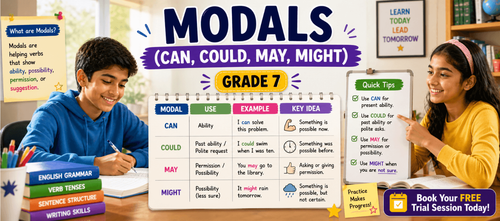

Mastering Modals Made Easy: English Grammar Worksheet Grade 7 on Can, Could, May, Might
Learning English grammar can sometimes feel confusing, especially when similar words are used in different ways. Modals like can, could, may, and might are a great example of this. They look simple, but they are used to express ability, permission, and possibility in different situations. For Grade 7 students, understanding how to use these correctly is an important step toward improving both writing and speaking skills.
This English grammar worksheet for Grade 7 focuses on Modals (Can, Could, May, Might) and provides structured practice through a variety of engaging exercises. Students get the opportunity to identify correct sentences, evaluate usage, fill in blanks, rewrite sentences, and apply their understanding in a paragraph. With consistent practice, learners can become more confident in using these modals correctly in everyday communication.
Download these English grammar worksheets and practice regularly to strengthen your language skills and build a strong foundation. You can also book a free trial to get expert guidance and improve your reading, writing, and comprehension abilities. The worksheets are designed in a simple and structured way to help K–8 students learn grammar concepts easily and use them confidently in everyday communication.
What Is The Topic?
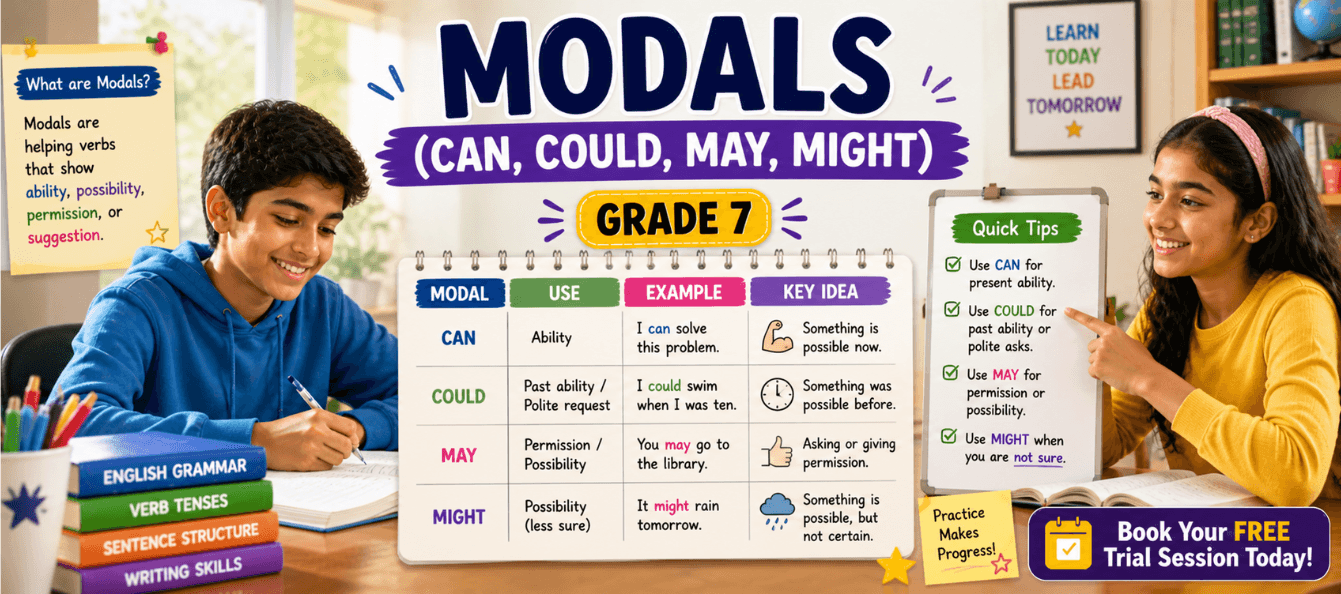
Modals (Can, Could, May, Might) are helping verbs used to express different meanings in sentences. These include ability, permission, polite requests, and possibility. Each modal is used in a specific context.
For example, “can” is used to show ability in the present, while “could” is used to talk about past ability or polite requests. “may” is often used for formal permission, and “might” expresses a weaker possibility.
In this worksheet, students are expected to understand how these modals function in sentences and identify the correct structure and usage. The exercises focus on choosing the correct form, identifying errors, and applying modals appropriately in different contexts.
What’s In This Worksheet?
1. Multiple choice questions where students choose the correct sentence using modals.
2. True and false statements to test correct and incorrect usage.
3. Fill in the blanks using suitable modals based on context.
4. Sentence rewriting tasks without changing meaning.
5. Paragraph writing activity using appropriate modals.
These exercises help students practice grammar in a structured way and prepare them for exams by improving accuracy and clarity.
Definitions, Examples, Techniques, And Tips
Modals are used in different ways depending on the situation. In this worksheet, students work with sentences that show:
• Ability in the present and past
• Permission (formal and informal)
• Polite requests
• Possibility (strong and weak)
Students are encouraged to observe sentence structure carefully. For example, correct verb forms are important after modals. The worksheet highlights correct and incorrect usage through comparison, helping students identify mistakes and improve accuracy.
A useful technique is to read each sentence carefully and check whether the verb form after the modal is correct. Another helpful approach is to understand the meaning of the sentence before selecting the modal.
Why Is It Important To Learn This?
Learning modals is important because they are commonly used in everyday communication. They help express ability, ask for permission, and talk about possibilities.
Understanding modals improves sentence construction and makes communication clearer. It also helps students avoid common grammatical errors, especially in exams and written tasks.
For Grade 7 students, mastering modals builds a strong foundation for advanced grammar topics.
Where Will This Knowledge Help You?
This knowledge is useful in many situations:
• Writing answers in exams correctly
• Speaking politely and clearly
• Participating in classroom discussions
• Completing grammar-based questions with accuracy
Using the correct modal helps students express ideas more effectively and confidently.
How To Use This Worksheet?
1. Attempt each question independently without help.
2. Read each sentence carefully before selecting or writing an answer.
3. Review your answers after completing the worksheet.
4. Compare your responses carefully with the answer key.
5. Practice regularly to improve accuracy and confidence.
The solutions follow the exact worksheet order, so students should check each answer step by step.
Important Tips And Tricks
1. Always use the base form of the verb after a modal.
2. Avoid adding “to” after modals unless required in structure.
3. Read the sentence meaning carefully before choosing a modal.
4. Check whether the sentence is about ability, permission, or possibility.
5. Be careful with past forms when using “could.”
6. For formal permission, prefer “may.”
7. For weak possibility, use “might.”
Complete Answer Key
Exercise No. 1
1. b) She can sing very well.
2. a) May I leave the classroom early today?
3. a) He could solve difficult problems when he was young.
4. b) It might rain later in the evening.
5. a) Students may use the laboratory after school hours.
6. b) Could you help me with this project?
7. b) She can write reports efficiently.
8. a) He might come to the meeting later.
9. b) May I borrow your notes for revision?
10. a) They can solve this puzzle easily.
Exercise No. 2
1. T
2. F
3. F
4. T
5. F
6. T
7. F
8. T
9. F
10. F
Exercise No. 3
1. can
2. May
3. could
4. might
5. must
6. Could
7. may
8. can
9. could
10. May
Exercise No. 4
1. She can solve difficult equations quickly.
2. It might rain later tonight.
3. He could speak three languages when he was a child.
4. May I leave the classroom now?
5. They might arrive late due to traffic.
6. Can you help me with this assignment?
7. She might forget the instructions.
8. I could finish the task before the deadline.
9. Students may use the library after school.
10. May I borrow your book for a day?
Exercise No. 5
Yesterday, Riya was preparing for her exam. She could complete all her revision before evening if she stayed focused. Her teacher told her that she may ask for help whenever needed. Riya thought she might finish the syllabus early, but she wasn’t fully sure. It might take more time than expected due to difficult topics. Later, her friend called and asked if they could study together. Riya replied that she might join after finishing her work. Her parents said she may take short breaks to stay fresh. By night, she felt she could revise most of the chapters. However, she knew she might forget some points if she didn’t revise again. The next day, she asked, “May I clarify my doubts before the test?”
Practicing this English grammar worksheet for Grade 7 on Modals (Can, Could, May, Might) can help students become more confident in using grammar correctly. With regular practice, students will find it easier to understand sentence structures and use modals accurately in both writing and speaking. Keep practicing and stay consistent to build strong grammar skills over time.