
Class 7 Grammar Worksheet: Modals for Requests & Permission

Master Polite Communication with This English Grammar Worksheet for Grade 7 on Modals of Permission & Request
Have you ever wondered how to ask for something politely in class or request help without sounding rude? Whether it’s asking your teacher for permission or requesting a friend to help you, using the right words makes a big difference. This English grammar worksheet for Grade 7 focuses on Modals of Permission & Request, helping students learn how to speak and write in a respectful and appropriate way.
In daily life, situations often require us to ask for permission or make polite requests. This worksheet gives students practical examples and structured exercises so they can confidently use the correct modal verbs in real-life conversations. With a variety of engaging questions, students get to practice how to frame sentences correctly while maintaining politeness.
Download these English grammar worksheets and practice regularly to strengthen your language skills and build a strong foundation. You can also book a free trial to get expert guidance and improve your reading, writing, and comprehension abilities. The worksheets are designed in a simple and structured way to help K–8 students learn grammar concepts easily and use them confidently in everyday communication.
What Is The Topic?
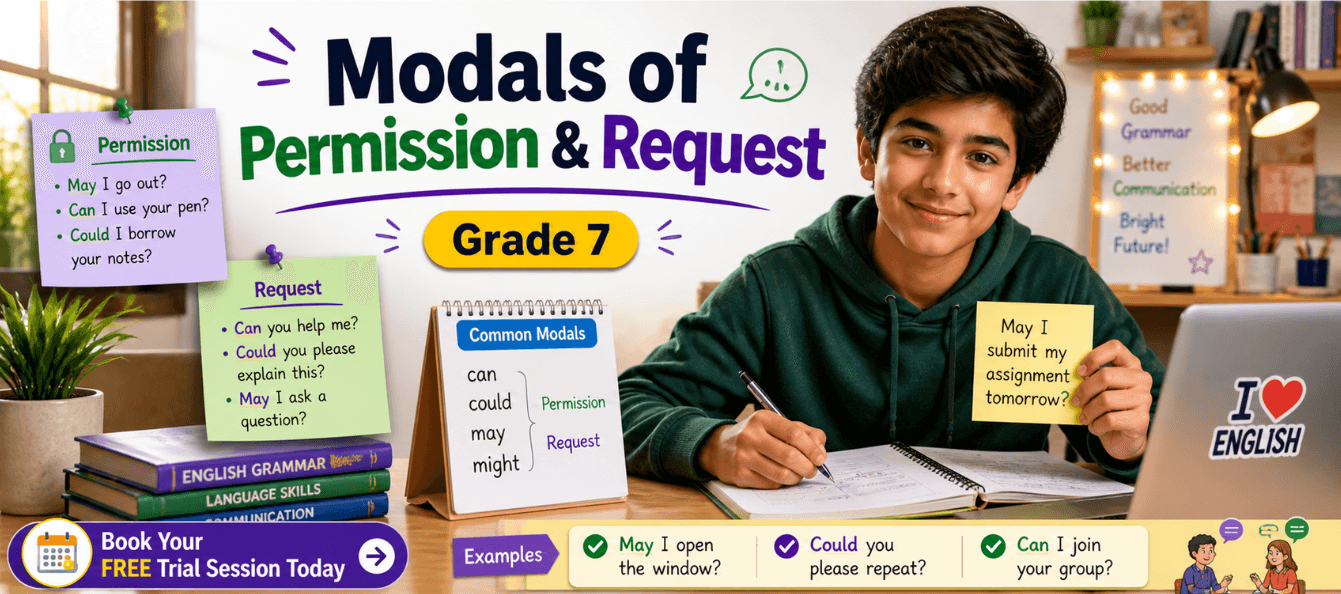
Modals of Permission & Request are used when we want to ask for something politely or give/seek permission. Words like “can,” “may,” “could,” and “would” help us form respectful and grammatically correct sentences.
In this worksheet, students learn how to:
• Ask for permission in a polite way
• Request help or actions respectfully
• Use correct sentence structure with modal verbs
The focus is on choosing the correct form of the modal and avoiding common grammatical mistakes such as incorrect verb forms or improper sentence construction.
What’s In This Worksheet?
1. Multiple Choice Questions
Students choose the correct sentence that uses modals properly for permission and requests.
2. True and False
Students identify whether the given sentence uses the modal correctly.
3. Fill in the blanks
Students complete sentences using suitable modals to express permission or polite requests.
4. Sentence rewriting
Students rewrite direct or informal sentences into polite requests using modals.
5. Paragraph writing
Students fill in blanks within a passage using appropriate modals based on context.
This structure helps students practice recognition, correction, and application of modals step by step, which supports both exam preparation and real-life communication skills. Book a free trial!
Definitions, Examples, Techniques, and Tips
Definitions
Modals are helping verbs used to express ability, permission, requests, or possibility. In this worksheet, the focus is on permission and polite requests.
Examples from the worksheet include:
• May I come in, sir?
• Could you help me with this sum?
• May I borrow your pen?
Techniques
• Identify whether the sentence is asking permission or making a request
• Choose the correct modal based on politeness
• Ensure the verb form after the modal is correct (base form)
Tips
• Avoid adding “-ing” or “-s” after modal verbs
• Use “may” for formal permission
• Use “could” or “would” for polite requests
Why Is It Important To Learn This?
Learning modals of permission and request helps students communicate politely and effectively. It improves both spoken and written English by making sentences sound respectful and grammatically correct.
This topic is important because:
• It builds proper communication habits
• It improves sentence formation skills
• It is commonly tested in school exams
Using correct modals also helps students avoid sounding rude or incorrect in conversations.
Where Will This Knowledge Help You?
This knowledge is useful in many situations:
• In exams – for MCQs, grammar corrections, and writing tasks
• In classrooms – while speaking with teachers and classmates
• In daily life – when making requests or asking permission politely
It also helps in improving confidence while speaking English.
How To Use This Worksheet?
1. Attempt independently first
Read each question carefully and try to answer without help.
2. Review answers carefully
Compare your responses with the answer key provided below.
3. Correct mistakes
Understand where you went wrong and fix the errors.
4. Practice regularly
Repeat similar exercises to improve accuracy.
The solutions follow the exact worksheet order, so students should compare answers carefully and ensure they match each question correctly.
Important Tips And Tricks
1. Always use the base form of the verb after a modal
Incorrect: Can you explains
Correct: Can you explain
2. Do not use “to” after modals
Incorrect: Can you to pass
Correct: Can you pass
3. Avoid using “-ing” forms after modals
Incorrect: Can I borrowing
Correct: Can I borrow
4. Use polite forms like “could” and “would” for requests
These sound more respectful than direct commands.
5. In rewriting tasks, change commands into polite requests
Example: Open the window → Could you open the window?
6. For paragraph-based questions, understand the context before filling blanks
Complete Answer Key
Exercise No. 1
Choose the correct option (a or b) for each question and tick (✔) the correct answer.
1. b) May I come in, sir?
2. a) Could you help me with my homework?
3. a) May I borrow your pen?
4. b) Could you open the window?
5. a) Can I leave early today?
6. b) Would you pass the book?
7. b) Can you explain this question?
8. a) May I use your phone?
9. b) Could you close the door?
10. a) May I go to the washroom?
Exercise No. 2
Tick (✔) T if the sentence uses the modal correctly, or (✔) F if it is incorrect.
1. True
2. True
3. False
4. False
5. True
6. False
7. True
8. True
9. False
10. True
Exercise No. 3
Fill in the blanks using suitable modals to express permission or polite requests.
1. May I step out for a moment, sir?
2. Would you mind explaining this solution again?
3. I may use your laptop for this assignment, if that’s okay.
4. Could you please lower your voice in the library?
5. May I be allowed to submit the project tomorrow?
6. Would you kindly guide me through this chapter?
7. I would like to take your permission to leave early today.
8. Would you mind passing me that file from the table?
9. May I ask a question regarding this topic?
10. Would you be able to help me after class?
Exercise No. 4
Rewrite each sentence using suitable modals to express permission or polite requests.
1. Could you give me your notebook?
2. Could you open the window?
3. May I borrow your pen?
4. May I go out for a minute?
5. Could you help me with this question?
6. May I use your phone?
7. May I ask something?
8. Could you pass me the salt?
9. Could you close the door?
10. May I leave early today?
Exercise No. 5
Read the passage carefully and fill in each blank with a suitable modal to express permission or a polite request.
Riya said,
“May I ask you a question, ma’am?”
The teacher replied that she may ask her doubts anytime. Ravi said,
“Could you help me with this sum?” His friend replied he would try his best.
A student asked,
“May I go to the library?” The teacher said he may go, but he must return quickly. Another student said,
“Would you mind closing the window?”
Later, Riya asked,
“May I borrow your notes?” Her friend said she would share them. A student asked if he could leave early, and the teacher said he may leave after finishing his work.
Practicing this English grammar worksheet for Grade 7 on Modals of Permission & Request is a great way to build confidence in polite communication. With consistent practice, students can easily learn how to form correct and respectful sentences in both speaking and writing. Keep practicing regularly to improve your grammar skills and become more confident in using English in everyday situations.