
Class 7 Grammar Worksheet: Reflexive & Emphatic Pronouns
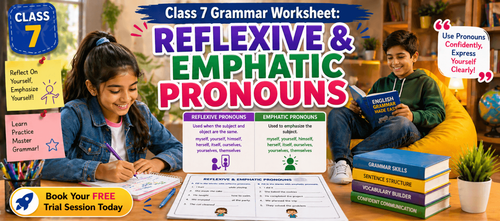

Boost Your Skills with This English Grammar Worksheet for Grade 7 on Reflexive & Emphatic Pronouns
Understanding how to use pronouns correctly can make your sentences clearer and more effective. In Grade 7, students explore important grammar topics like reflexive and emphatic pronouns, which help express actions clearly and add emphasis where needed. This English grammar worksheet on Reflexive & Emphatic Pronouns gives students the opportunity to practise identifying correct usage, spotting errors, and improving sentence construction through a variety of structured exercises.
Download these English grammar worksheets and practice regularly to strengthen your language skills and build a strong foundation. You can also book a free trial to get expert guidance and improve your reading, writing, and comprehension abilities. The worksheets are designed in a simple and structured way to help K–8 students learn grammar concepts easily and use them confidently in everyday communication.
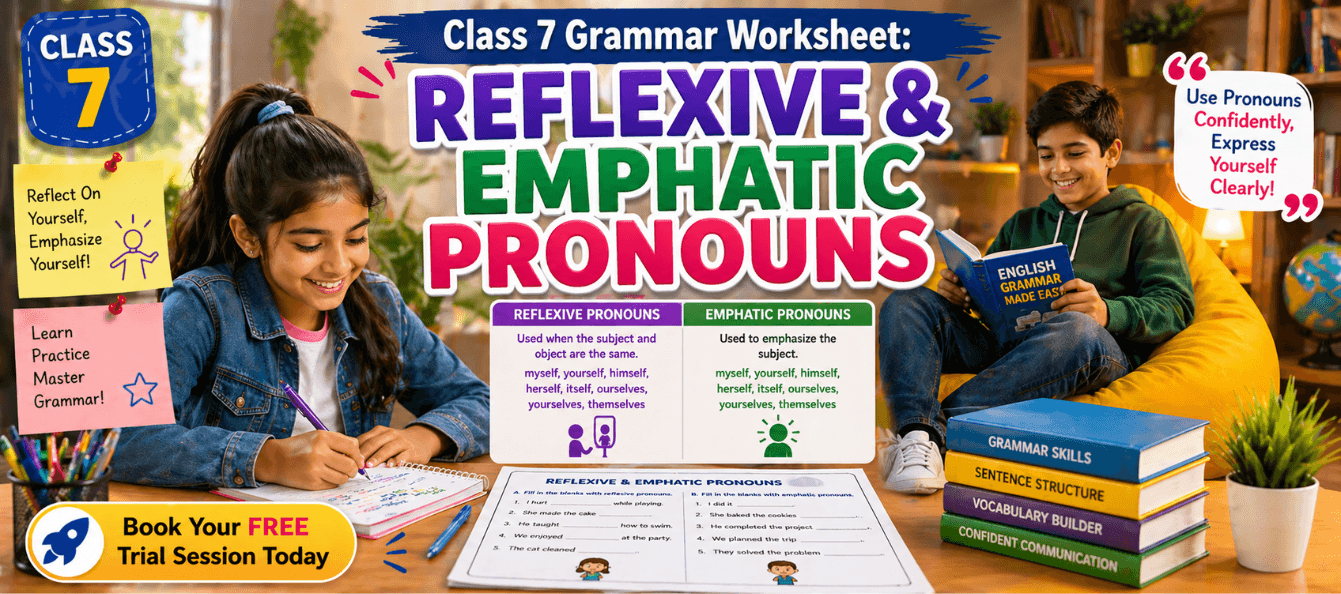
What Is the Topic?
Reflexive and emphatic pronouns are used to make sentences more meaningful and precise. Reflexive pronouns are used when the subject performs an action on itself. Emphatic pronouns are used to add emphasis to the subject without changing the sentence’s basic meaning.
In this worksheet, students learn how to identify when the subject and object are the same, how to use pronouns correctly in different sentence structures, and how to add emphasis appropriately.
What’s in This Worksheet?
1. Multiple Choice Questions that focus on identifying correct and incorrect usage of pronouns
2. True and False statements to test understanding of correct grammar usage
3. Fill in the Blanks to practise selecting suitable pronouns
4. Sentence Rewriting tasks to correct incorrect pronoun usage
5. Paragraph Completion to apply learning in a longer context
These exercises help students practise both recognition and application of reflexive and emphatic pronouns.
Definitions, Examples, Techniques, and Tips
Reflexive pronouns are used when the subject performs an action on itself. Examples include words like “himself,” “herself,” and “themselves.”
Emphatic pronouns are used to emphasise the subject. Examples include “I myself,” “she herself,” and “they themselves.”
Examples from the worksheet include:
Rahul blamed himself for the mistake.
Meera herself baked the cake.
They themselves built the model.
A helpful technique is to check whether the pronoun reflects the subject or simply adds emphasis. If removing the pronoun does not change the meaning, it is emphatic. If the action refers back to the subject, it is reflexive.
Why Is It Important to Learn This?
Learning reflexive and emphatic pronouns helps students avoid common grammar mistakes and write clearer sentences. It improves both writing and speaking skills and builds confidence in using correct sentence structures.
Where Will This Knowledge Help You?
This knowledge is useful in school exams, especially in grammar sections. It also helps in writing tasks, paragraph construction, and class discussions where clear communication is important.
How to Use This Worksheet?
1. Attempt all questions independently first
2. Read each sentence carefully before answering
3. Compare your answers with the answer key
4. Correct your mistakes and understand the right usage
5. Practise regularly to improve accuracy
The solutions follow the exact worksheet order, so compare each answer carefully.
Important Tips and Tricks
1. Use reflexive pronouns only when the subject and object are the same
2. Use emphatic pronouns to add emphasis, not to change meaning
3. Avoid incorrect forms like “themself” or “me” instead of “myself”
4. Read sentences carefully to check correctness
5. Focus on correcting only the pronoun in rewriting tasks
Complete Answer Key
Exercise No. 1
1. b
2. a
3. b
4. a
5. b
6. a
7. a
8. a
9. b
10. a
Exercise No. 2
1. True
2. False
3. True
4. False
5. True
6. True
7. False
8. True
9. True
10. False
Corrections (False Sentences):
Riya blamed herself for breaking the window.
He taught himself to solve the problem.
They prepared the dinner themselves.
He saw himself in the mirror.
Exercise No. 3
1. herself
2. themselves
3. myself
4. himself/herself
5. ourselves
6. himself
7. herself
8. themselves
9. himself/herself
10. themselves
Exercise No. 4
1. Riya hurt herself during practice.
2. He blamed himself for the mistake.
3. Meera baked the cake herself.
4. They enjoyed themselves at the fair.
5. I introduced myself to the new teacher.
6. We completed the project ourselves.
7. She looked at herself in the mirror.
8. The players congratulated themselves after the match.
9. He fixed the broken chair himself.
10. The principal himself/herself announced the results.
Exercise No. 5
1. herself
2. herself
3. himself/herself
4. herself
5. herself
6. themselves
7. herself
8. herself
9. herself
10. herself
With regular practice using this English grammar worksheet for Grade 7 on Reflexive & Emphatic Pronouns, you can improve your grammar skills and build confidence in writing correct and meaningful sentences.