
Class 7 Grammar Worksheet: Subject–Verb Agreement


Mastering Subject–Verb Agreement: English Grammar Worksheet for Grade 7 (Basic Practice Guide)
Have you ever felt confused about whether to use “is” or “are” in a sentence? You’re not alone. Many Grade 7 students face this challenge when learning subject–verb agreement. This topic may seem simple at first, but it requires careful attention to how subjects and verbs work together.
This English grammar worksheet for Grade 7 on Subject–Verb Agreement (Basic) is designed to help students build clarity through structured and engaging exercises. With different question types and practical practice, students can strengthen their understanding step by step and gain confidence in forming correct sentences.
Download these English grammar worksheets and practice regularly to strengthen your language skills and build a strong foundation. You can also book a free trial to get expert guidance and improve your reading, writing, and comprehension abilities. The worksheets are designed in a simple and structured way to help K–8 students learn grammar concepts easily and use them confidently in everyday communication.
What Is The Topic?
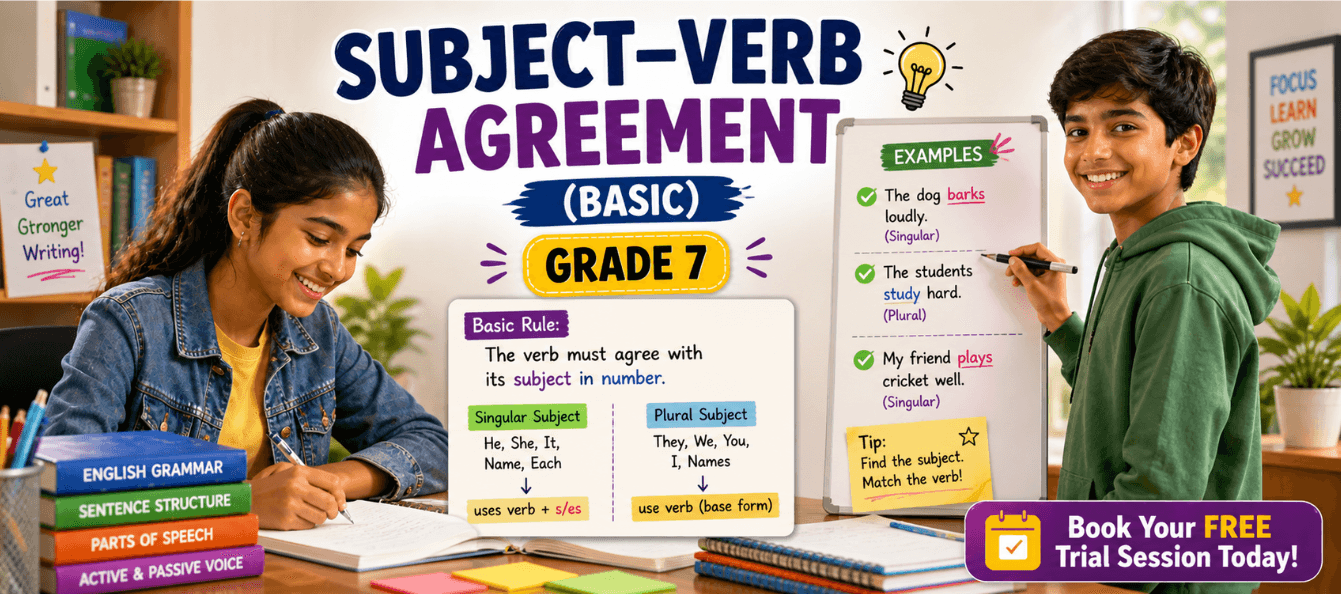
Subject–verb agreement means that the verb in a sentence must match the subject in number. If the subject is singular, the verb should also be singular. If the subject is plural, the verb should be plural.
In this worksheet, students learn how to identify correct verb forms and apply them in sentences. They also practice spotting incorrect usage and correcting it. The focus is on building a strong foundation in basic grammar rules related to subject–verb agreement.
What’s In This Worksheet?
1. Multiple choice questions where students choose the correct sentence with proper subject–verb agreement
2. True and False statements to identify correct and incorrect usage
3. Fill in the blanks with the correct verb form
4. Sentence rewriting tasks to correct errors
5. A paragraph-based activity to apply learning in context
These exercises help students practice grammar in different formats and prepare for exams by improving accuracy and understanding.
Definitions, Examples, Techniques, And Tips
Definitions:
Subject–verb agreement refers to the correct matching of a subject with its verb.
Examples:
Each of the students has a notebook.
The bouquet of flowers smells lovely.
There are many books on the shelf.
Techniques:
Identify the main subject of the sentence before choosing the verb
Ignore extra phrases that come between subject and verb
Pay attention to words like “each,” “everyone,” “number,” and “many a”
Quick learning tips:
Read sentences carefully before choosing answers
Check whether the subject is singular or plural
Practice rewriting incorrect sentences to improve understanding
Why Is It Important To Learn This?
Learning subject–verb agreement is important because it helps students form correct and meaningful sentences. It improves writing clarity and ensures that communication is accurate.
This topic is essential for exams, as grammar accuracy is often tested. Strong understanding also supports better speaking and writing skills in everyday situations.
Where Will This Knowledge Help You?
This knowledge helps in school exams where grammar questions are common. It also supports writing tasks such as essays, paragraphs, and answers in class.
Students can participate more confidently in class discussions and avoid common grammatical mistakes while speaking and writing.
How To Use This Worksheet?
1. Attempt each question independently before checking answers
2. Read each sentence carefully and identify the subject
3. Compare your answers with the answer key provided below
4. Correct mistakes and understand why the correct answer is right
5. Practice regularly to improve accuracy
The solutions follow the exact worksheet order, so students should compare answers carefully.
Important Tips And Tricks
1. Words like “each,” “everyone,” and “one” usually take singular verbs
2. “A number of” takes a plural verb, while “the number of” takes a singular verb
3. Phrases like “along with,” “with,” and “together with” do not change the subject
4. In “either…or” and “neither…nor,” the verb agrees with the nearest subject
5. Read full sentences carefully to avoid confusion
Complete Answer Key
Exercise No. 1
1. a
2. b
3. b
4. a
5. b
6. a
7. a
8. b
9. b
10. a
Exercise No. 2
1. T
2. F
3. T
4. F
5. T
6. F
7. T
8. T
9. F
10. F
Exercise No. 3
1. has
2. is
3. is
4. are
5. is
6. are
7. was
8. is
9. was
10. has
Exercise No. 4
1. Each of the books has been checked by the teacher.
2. The bouquet of roses smells fresh.
3. A number of tourists are visiting the monument today.
4. Neither of the players is ready for the match.
5. The number of pages in this book is quite high.
6. Either the principal or the teachers are attending the meeting.
7. Rice and curry is my favourite meal.
8. Everyone in the class was excited about the trip.
9. One of the girls has completed the project early.
10. Many a child has participated in the competition.
Exercise No. 5
Riya and her friends are planning a class event. Each of them has responsible for a different task. A list of activities is prepared by the group. The number of participants is expected to increase this year. A number of students are already volunteered to help. Neither the teacher nor the students are aware of the final schedule yet. One of the organisers is handling the decorations. Everyone in the team is working with great enthusiasm. Bread and juice is arranged for refreshments. Many a student is showing interest in the event. The captain, along with her teammates, is ensuring that everything runs smoothly.
By practicing this English grammar worksheet for Grade 7 on Subject–Verb Agreement, students can steadily improve their grammar skills and build confidence in using correct sentence structures. With regular practice, mastering this topic becomes much easier and more natural.