
Class 7 Grammar Worksheet: Transitive & Intransitive Verbs
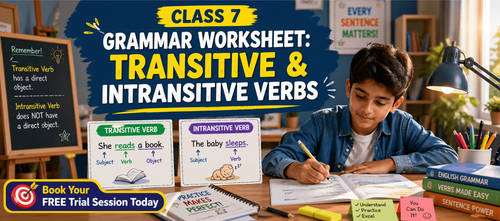

Mastering Transitive & Intransitive Verbs: English Grammar Worksheet for Grade 7 Students
Understanding how verbs work can make a big difference in how clearly you speak and write. In Grade 7, one important concept students learn is the difference between transitive and intransitive verbs. These verbs help us express actions more accurately and make sentences more meaningful.
This worksheet on Transitive & Intransitive Verbs is designed to help students practice identifying, using, and correcting verbs in different contexts. With a mix of multiple-choice questions, true or false statements, fill-in-the-blanks, rewriting tasks, and paragraph writing, students get a complete learning experience.
Download these English grammar worksheets and practice regularly to strengthen your language skills and build a strong foundation. You can also book a free trial to get expert guidance and improve your reading, writing, and comprehension abilities. The worksheets are designed in a simple and structured way to help K–8 students learn grammar concepts easily and use them confidently in everyday communication.
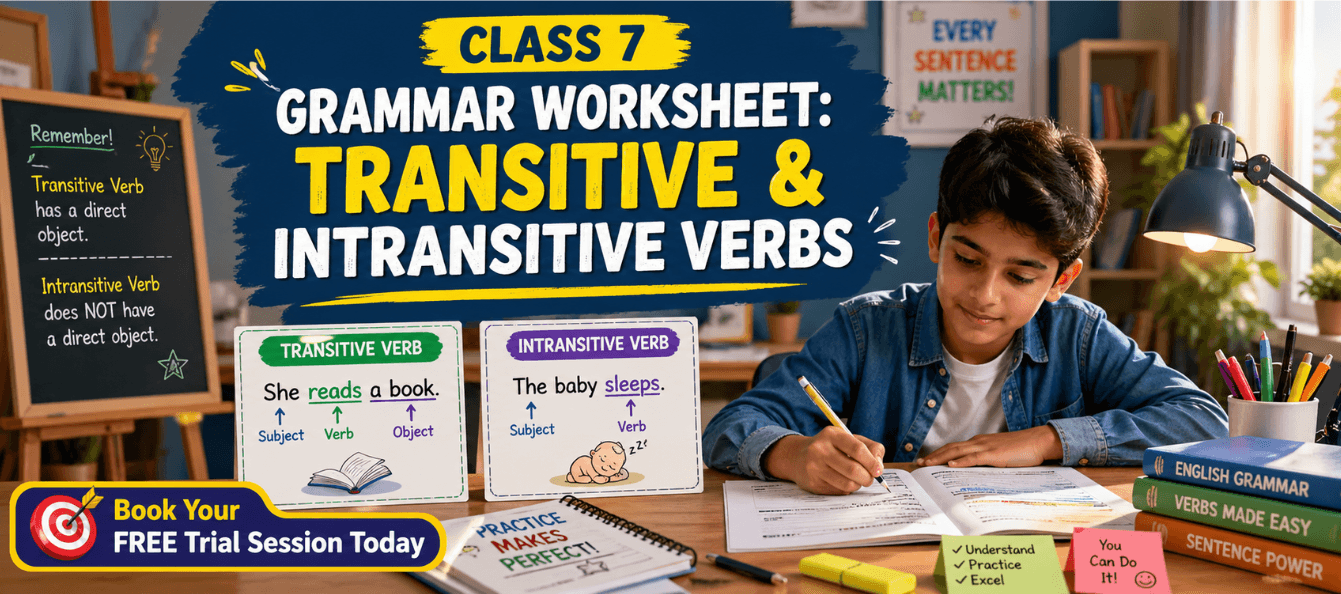
What Is The Topic?
Transitive & Intransitive Verbs are types of action words used in sentences.
A transitive verb needs an object to complete its meaning. The action is done to someone or something.
An intransitive verb does not need an object. The action stands alone and does not pass on to anything else.
In this worksheet, students learn how to identify whether a verb is transitive or intransitive, use them correctly in sentences, and recognize incorrect usage.
What’s In This Worksheet?
1. Multiple Choice Questions that test understanding of transitive and intransitive verbs in sentences.
2. True and False statements to check correct and incorrect usage of verbs.
3. Fill in the Blanks to practice choosing suitable verbs based on context.
4. Sentence Rewriting tasks to convert verbs between transitive and intransitive forms.
5. Paragraph Writing to apply understanding in a real-life context.
This structured format helps students prepare for exams and improves their grammar accuracy step by step.
Definitions, Examples, Techniques, And Tips
Definitions:
Transitive verbs require an object.
Intransitive verbs do not require an object.
Examples:
The boy carried the bag.
The baby slept peacefully.
Techniques:
Look for an object after the verb.
If the sentence feels incomplete without something receiving the action, it is transitive.
If the sentence makes sense on its own, it is intransitive.
Quick learning tips:
Always check what comes after the verb.
Read the sentence aloud to see if it sounds complete.
Practice identifying verbs in different sentence types.
Why Is It Important To Learn This?
Learning about transitive and intransitive verbs helps students form correct sentences. It improves both writing and speaking skills. When students understand how verbs work, they can express ideas more clearly and avoid common grammar mistakes.
This topic is also important for exams, where identifying correct sentence structure is essential for scoring well.
Where Will This Knowledge Help You?
This knowledge helps in school exams where grammar questions are common. It improves writing tasks such as essays, paragraphs, and answers. It also helps students participate confidently in class discussions and communicate clearly in everyday situations.
How To Use This Worksheet?
1. Attempt all questions independently without looking at answers.
2. Read each sentence carefully before choosing or writing an answer.
3. Review your answers and compare them with the correct ones.
4. Practice regularly to improve accuracy and confidence.
The solutions follow the exact worksheet order, so students should compare answers carefully and learn from their mistakes.
Important Tips And Tricks
1. Do not confuse verbs that need objects with those that do not.
2. Always check if the verb is followed by an object.
3. Avoid using verbs incorrectly in sentences.
4. Read instructions carefully before answering.
5. For writing tasks, focus on using verbs correctly in context.
Complete Answer Key
Exercise No. 1
Choose only one option (a or b) for each question and tick (✔) the correct answer.
1. b) The boy carried the bag.
2. a) The girl sang beautifully.
3. b) He wrote quickly the pen.
4. b) The baby slept peacefully.
5. a) She solved the problem.
6. b) They built yesterday.
7. b) The horse jumped.
8. b) The teacher explained the lesson.
9. b) She ate quickly.
10. a) The artist painted a portrait.
Exercise No. 2
Read each sentence carefully. Tick ‘T’ for True or ‘F’ for False based on the topic.
1. True
2. False
3. False
4. True
5. False
6. True
7. True
8. False
9. True
10. False
Exercise No. 3
Fill each blank with a suitable verb (transitive or intransitive) based on the context.
1. conducted
2. fell
3. expressed
4. applauded
5. built
6. rushed
7. sent
8. flowed
9. prepared
10. slept
Exercise No. 4
Rewrite each sentence by making the verb transitive or intransitive as required.
1. The teacher explained clearly.
2. He reads every night.
3. The baby slept the whole night.
4. The children played a game in the park.
5. They built in the city.
6. She finished early.
7. The car broke something. (context-based variation acceptable)
8. The birds chirped songs in the morning.
9. The students answered quickly.
10. We ate food at noon.
Exercise No. 5
Complete the paragraph by filling in each blank with a suitable transitive or intransitive verb.
Early in the morning, Rohan woke from bed and wore his school uniform neatly. He quickly packed his bag and ran down the stairs. Outside, the birds chirped cheerfully while the sun shone brightly. On the way to school, he helped an old man across the road and gave a kind smile. After reaching school, he showed his homework to the teacher and listened carefully to the instructions. During the break, he played with his friends and ran around the playground. Later, he solved a difficult question in class and wrote the answer confidently. At the end of the day, he walked back home and ended his day with satisfaction.
Keep practicing this English grammar worksheet on Transitive & Intransitive Verbs for Grade 7 to build stronger sentence skills and improve your confidence. With regular practice, you will be able to identify and use verbs correctly in all types of sentences.