
Class 7 Identifying Bias in Argumentative Texts - Worksheet
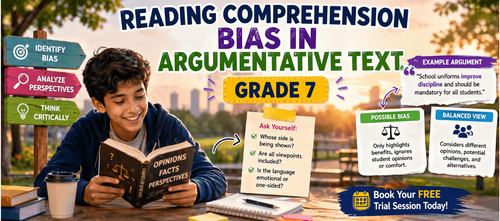

One Side or the Whole Story? English Grammar Worksheet Grade 7 on Bias in Argumentative Texts
Have you ever listened to someone argue strongly about something and felt convinced—only to later realize that you heard only one side of the story? This is something many Grade 7 students experience, especially during discussions about topics like mobile phones in school. This English grammar worksheet focuses on Bias in Argumentative Texts through a relatable classroom discussion. It helps students understand how one-sided arguments can influence thinking and why it is important to look at both sides before forming an opinion.
In this worksheet, students explore how arguments can sometimes be unfair or incomplete. They learn to identify bias, recognize emotional language, and understand the importance of balanced reasoning. Instead of accepting every argument as true, students are encouraged to question, analyze, and think independently. These skills are essential not just for exams, but also for real-life decision-making and communication.
Download these English grammar worksheets and practice regularly to strengthen your language skills and build a strong foundation. You can also book a free trial to get expert guidance and improve your reading, writing, and comprehension abilities. The worksheets are designed in a simple and structured way to help K–8 students learn grammar concepts easily and use them confidently in everyday communication.
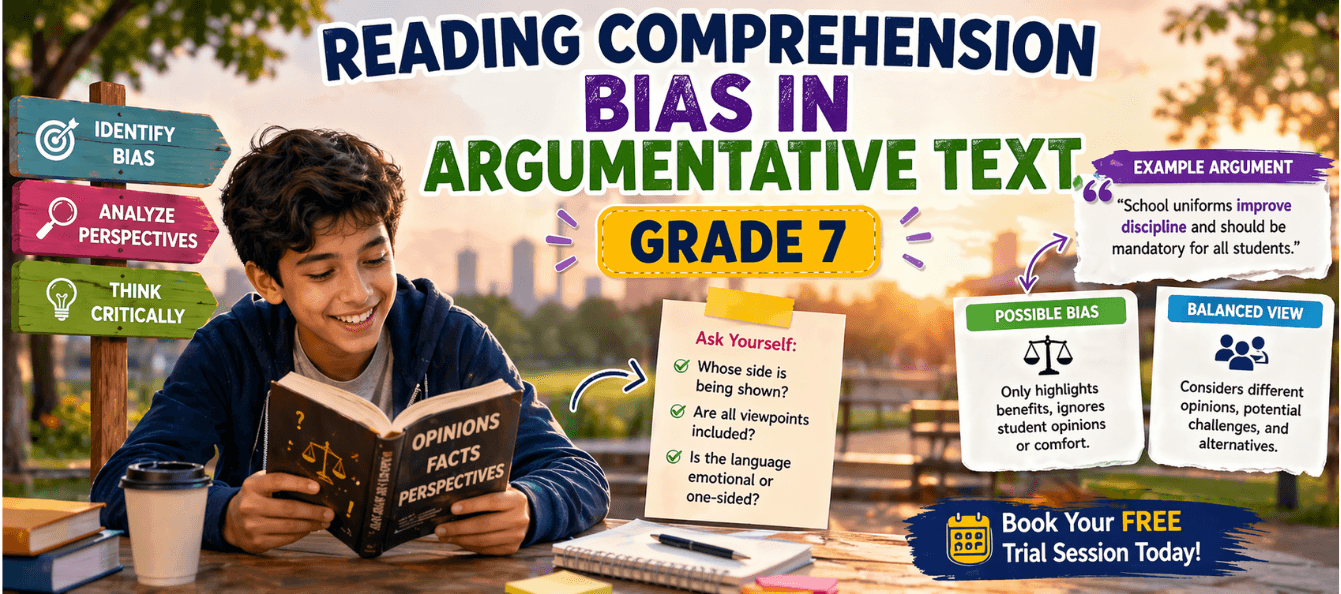
What Is the Topic?
Bias in Argumentative Text is an important reading comprehension concept that helps students understand how opinions can be presented in a one-sided way.
In this Grade 7 English grammar worksheet, students learn how to identify bias, evaluate fairness, and question strong opinions in texts. They understand that some arguments may ignore other viewpoints or use emotional language to influence readers.
This topic teaches students to think critically, distinguish between opinion and evidence, and develop balanced thinking.
What’s in This Worksheet?
This English grammar worksheet for Grade 7 includes five engaging activities that develop comprehension and critical evaluation skills:
1. Multiple Choice Questions – Students answer questions focusing on identifying bias, tone, and argument strength.
2. Fill in the Blanks (Word Bank) – Students complete sentences using key terms such as bias, evidence, viewpoint, and balanced.
3. True or False – Learners evaluate statements to test their understanding of the text and its bias.
4. Identify the Bias – Students underline biased language in sentences to recognize exaggeration and one-sided opinions.
5. Paragraph Completion – Students complete a paragraph on fair arguments, applying their understanding of balanced reasoning.
These activities help students understand how arguments are structured and how bias can affect meaning.
Definitions, Examples, Techniques, and Tips
Definitions
Bias means presenting information in a one-sided or unfair way.
Argumentative text is writing that presents opinions and tries to convince the reader.
Examples
Students read about a classroom discussion on mobile phones and identify whether the argument is balanced or biased.
They underline biased phrases and complete sentences using appropriate words.
Techniques
Students analyze whether both sides of an argument are presented.
They identify emotional or exaggerated language.
They compare statements to see if they are supported by evidence.
Quick Learning Tips
Always check if both sides of an argument are included.
Look for evidence that supports claims.
Be careful of strong or emotional language.
Think independently before agreeing with any opinion.
Why Is It Important to Learn This?
Learning about bias in argumentative texts is important because it helps students become critical readers and thoughtful communicators. It teaches them to question what they read instead of accepting everything as true.
For Grade 7 students, this topic builds analytical thinking and improves comprehension skills. It also helps them understand how to form fair and balanced opinions.
By practicing this English grammar worksheet, students learn to evaluate arguments carefully and avoid being influenced by one-sided information.
Where Will This Knowledge Help You?
This knowledge is useful in both academic and real-life situations.
In exams, students can answer comprehension questions more accurately by identifying bias and evaluating arguments.
In writing tasks, they can present balanced ideas supported by evidence.
In discussions, they can express opinions clearly while considering different viewpoints.
It also helps them become confident and independent thinkers.
How to Use This Worksheet?
1. Read the passage carefully before answering questions.
2. Attempt all questions independently.
3. Review your answers after completing each section.
4. Compare your responses with the answer key provided.
5. Correct mistakes and understand the correct answers.
6. Practice regularly to improve comprehension and analytical skills.
The solutions follow the exact worksheet order, so students should compare their answers carefully.
Important Tips and Tricks
1. Always check if the argument is one-sided or balanced.
2. Read questions carefully before answering.
3. Pay attention to keywords in fill in the blanks.
4. Identify biased language by looking for exaggeration.
5. Do not confuse opinion with evidence.
6. Think about what information might be missing.
7. Avoid rushing through paragraph completion tasks.
8. Examiners expect clear understanding and logical reasoning.
Complete Answer Key (For Parents & Educators)
Exercise 1 – Multiple Choice Questions
1. b) It argues strongly against mobile phones in school.
2. a) It presents only one side of the argument.
3. a) Strong and emotional language.
4. c) It ignores other viewpoints.
5. b) Supporting evidence and examples.
6. c) As completely harmful devices.
7. a) Limited or supervised use of phones.
8. a) They should present both sides.
9. b) It helps readers think critically.
10. c) One-sided and forceful.
Exercise 2 – Fill in the Blanks
1. strong
2. evidence
3. negative
4. ignored
5. viewpoint
6. argument
7. opinion
8. balanced
9. argument
10. bias
Exercise 3 – True or False
1. False
2. True
3. False
4. True
5. False
6. True
7. True
8. False
9. False
10. True
Exercise 4 – Identify the Bias
1. “every student becomes careless”
2. “only sensible rule”
3. “dismisses all educational uses”
4. “praises strict control without considering any flexible solutions”
5. “students cannot use phones responsibly”
6. “harmful without offering proof”
7. “ignores situations where phones may help learning”
8. “single opinion as if it were a fact”
9. “overlooks the role of guidance”
10. “exaggerates the negative effects”
Exercise 5 – Paragraph Completion
1. language
2. evidence
3. ignored
4. viewpoint
5. argument
6. evidence
7. opinion
8. viewpoint
9. balanced
10. judgment
Help your child become a confident reader who can spot bias, think independently, and evaluate arguments with clarity.
By practicing this English grammar worksheet for Grade 7 on Bias in Argumentative Texts, students can develop strong comprehension and critical thinking skills. With regular practice, they will learn to identify bias, evaluate arguments, and form balanced opinions with confidence.
Book a free trial!