
Narrative Pacing Worksheet for Grade 7 Practice & Examples
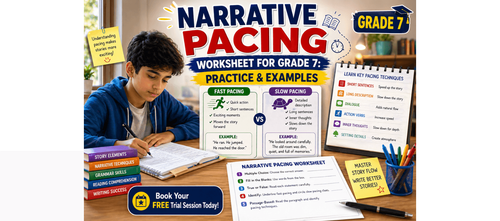

Master Story Flow with This English Grammar Worksheet for Grade 7 on Narrative Pacing (Fast vs Slow Narrative)
Have you ever noticed how some stories feel fast and exciting, while others move slowly and describe every detail? That difference is called pacing, and it plays a big role in how we experience a story. This English grammar worksheet for Grade 7 focuses on narrative pacing and helps students understand how the speed of a story changes using different techniques.
In this worksheet, students explore how writers use short sentences, dialogue, description, and inner thoughts to control how fast or slow a story moves. By practicing these concepts, students can improve both their reading comprehension and writing skills. The exercises are designed to help learners recognize pacing techniques and apply them effectively.
Download these English grammar worksheets and practice regularly to strengthen your language skills and build a strong foundation. You can also book a free trial to get expert guidance and improve your reading, writing, and comprehension abilities. The worksheets are designed in a simple and structured way to help K–8 students learn grammar concepts easily and use them confidently in everyday communication.
What Is the Topic?
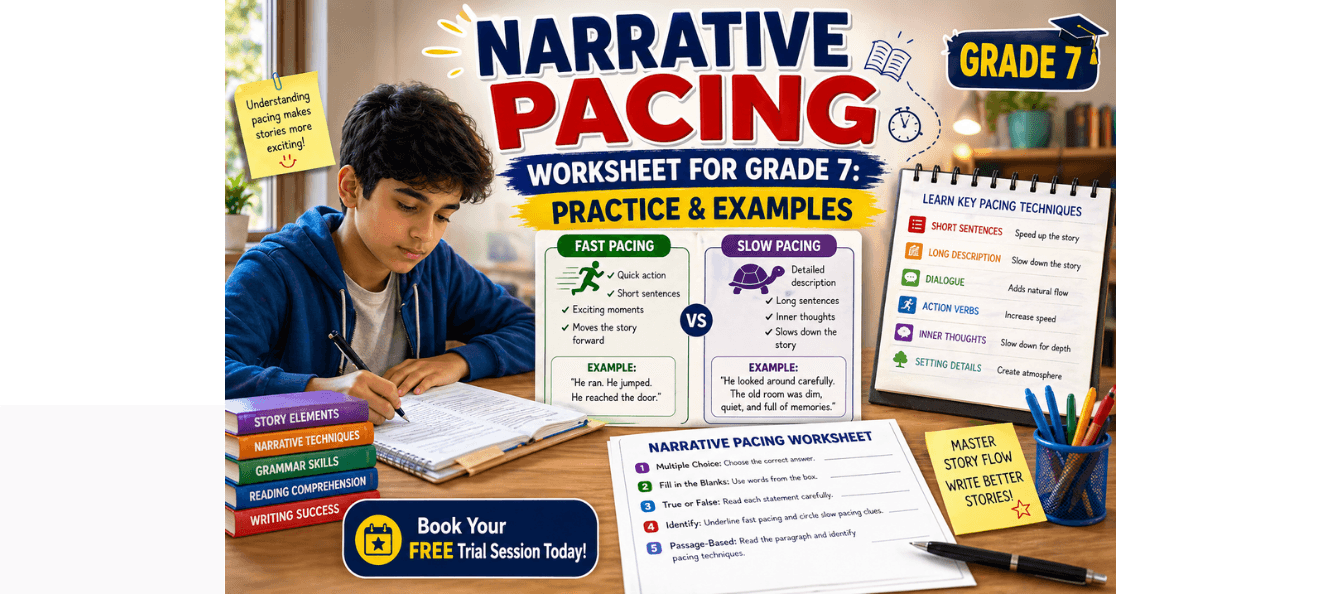
Narrative pacing refers to the speed of a story. It shows how quickly or slowly events happen in a text. Some parts of a story may move fast with quick actions, while others may slow down to describe details or thoughts.
In this worksheet, students learn about fast pacing and slow pacing. Fast pacing uses short sentences and action words, while slow pacing includes detailed descriptions and inner thoughts. Students are expected to identify these techniques and understand how they affect storytelling.
What’s in This Worksheet?
1. Multiple choice questions that test understanding of pacing concepts.
2. Fill in the blanks using pacing-related terms from a word bank.
3. True and false questions to check conceptual clarity.
4. Sentence-based exercises to identify fast and slow pacing clues.
5. A paragraph-based activity to recognize pacing techniques in context.
6. A combination of recognition, understanding, and application questions.
7. Structured exercises that move from basic identification to deeper analysis.
Definitions, Examples, Techniques, and Tips
The speed of a story is called pacing term.
A story with quick events is fast pacing.
A story with detailed description is slow pacing.
Conversation in text is called dialogue.
Long descriptive lines are long description.
Brief sentences are called short sentences.
Words showing movement are action verb.
Thinking inside the mind is inner thought.
Description of place is setting details.
Text with many details is detailed text.
These terms are directly used in the worksheet exercises to help students understand pacing clearly.
Why Is It Important to Learn This?
Learning narrative pacing helps students understand how stories are structured. It improves reading skills by helping students identify when a story speeds up or slows down. It also improves writing skills, as students can use pacing techniques to make their stories more engaging and clear.
Understanding pacing helps students control the flow of their writing and create better storytelling experiences.
Where Will This Knowledge Help You?
This knowledge is useful in exams where students analyze passages and answer questions. It helps in writing tasks such as essays and stories. It also improves class participation when discussing how a story develops and how events are presented.
How to Use This Worksheet?
1. Attempt all questions independently first.
2. Read each sentence and question carefully.
3. Review your answers after completing all exercises.
4. Compare your answers with the answer key in the exact worksheet order.
5. Identify mistakes and correct them.
6. Practice regularly to improve understanding of pacing.
Important Tips and Tricks
1. Look for keywords like “quickly,” “slowly,” or “detail” to identify pacing.
2. Short sentences usually indicate fast pacing.
3. Long descriptions often indicate slow pacing.
4. Action verbs increase speed in a story.
5. Inner thoughts and descriptions slow down the narrative.
6. Read carefully to identify whether the sentence focuses on action or detail.
Complete Answer Key
Exercise No. 1
Read each question carefully and choose the correct option.
1. short sentences
2. short sentences
3. pacing term
4. inner thought
5. long description
6. short sentences
7. long description
8. setting detail
9. dialogue
10. short sentences
Exercise No. 2
Fill in the blanks using correct pacing terms from the bank.
1. speed
2. quicklong
3. slow pacing
4. conversation
5. detailed text
6. brief
7. action verb
8. mind
9. place
10. detailed text
Exercise No. 3
Choose True if the statement is correct and false if the statement is incorrect.
1. True
2. True
3. True
4. False
5. True
6. False
7. False
8. False
9. True
10. True
Exercise No. 4
Underline fast pacing and circle slow pacing clues in each sentence.
1. Ravi ran fast, jumped, and reached the gate quickly.
2. She described every small detail in a calm voice.
3. The runner dashed forward and crossed the finish line.
4. The child explained everything step by step in detail.
5. The ball flew, hit the wall, and bounced back fast.
6. The long road stretched endlessly with quiet trees around.
7. He rushed, slipped, stood, and ran again in fear.
8. The old house stood silently with dusty broken windows.
9. The calm lake reflected the slow moving clouds above.
10. The evening sky changed slowly with fading sunlight.
Exercise No. 5
Read the paragraph carefully and identify pacing techniques used.
Answers may vary.
By practicing this English grammar worksheet for Grade 7 on narrative pacing, students can clearly understand how stories move and how writers control speed using different techniques. Regular practice will help improve both reading and writing skills, making storytelling more effective and engaging.
Book a free trial!