
Class 7 Noun Clauses Worksheet: English Worksheet
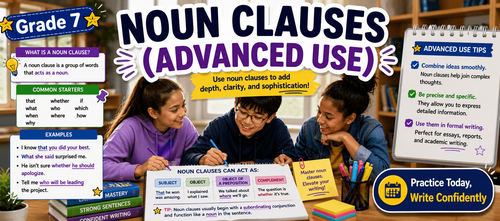

Sharpen Sentence Skills with This English Grammar Worksheet Grade 7 Noun Clauses (Advanced Use)
Learning how to build stronger and more meaningful sentences becomes very important in middle school grammar. This English grammar worksheet Grade 7 Noun Clauses (Advanced Use) gives students a focused chance to understand how a group of words can work like a noun inside a sentence. Instead of only reading simple statements, learners begin to notice how clauses can carry information, explain thoughts, and complete ideas in a more advanced way. The worksheet uses school situations, weather situations, and everyday sentence patterns so that students can connect grammar with real language use while practicing carefully designed tasks.
Download these English grammar worksheets and practice regularly to strengthen your language skills and build a strong foundation. You can also book a free trial to get expert guidance and improve your reading, writing, and comprehension abilities. The worksheets are designed in a simple and structured way to help K–8 students learn grammar concepts easily and use them confidently in everyday communication.
What Is the Topic?
Noun Clauses (Advanced Use) is the grammar topic practiced in this worksheet. A noun clause is a part of a sentence that gives information and works like a noun. In this Grade 7 worksheet, students are expected to find noun clauses, choose sentences that contain noun clauses, rewrite incomplete sentences by correcting the noun clause structure, complete a paragraph with suitable noun clauses, and finally write their own short paragraph using noun clauses in school situations.
This means students are not only identifying grammar patterns but also using those patterns in written language. The worksheet helps learners understand that noun clauses can begin with words like that, what, and why, as shown throughout the questions.
What’s in This Worksheet?
1. The worksheet begins with an underlining activity where students carefully read ten sentences and underline each noun clause used in the sentence.
2. The next part gives multiple choice questions where students have to choose the sentence that contains a noun clause from three options.
3. Students then move to sentence rewriting. In this section, they apply the noun clause rule to rewrite each sentence correctly.
4. After that, there is a paragraph-based fill in the blanks activity. Students read a school and rain situation passage and complete each blank with suitable noun clauses.
5. The worksheet ends with a paragraph writing task where students write a short paragraph using noun clauses in school situations.
6. These five activities help students move from recognition to correction and finally to independent usage, which supports grammar revision and exam readiness.
Definitions, Examples, Techniques, and Tips
The worksheet repeatedly shows that a noun clause is not just a single word. It is a full part of a sentence that contains meaningful information.
Some examples directly seen in the worksheet are:
I know that Ravi missed the school bus.
We heard that the monsoon had arrived.
Asha forgot what the teacher announced.
Meera explained why the gate was closed.
In each of these examples, the highlighted clause gives the main information after the reporting verb.
One useful technique shown in this worksheet is underlining. By underlining the noun clause, students visually separate the reporting part from the information part.
Another technique is choosing between simple sentences and noun clause sentences. This helps learners compare sentence structures.
Sentence rewriting is another important technique because it trains students to place words in correct order and use that-clause or question-word clause correctly.
The paragraph filling section also teaches learners to think about sentence meaning before inserting a noun clause.
A quick learning tip from this worksheet is to look for reporting words such as know, heard, forgot, explained, wondered, said, noticed, and understand because noun clauses often come after these words in the worksheet.
Why Is It Important to Learn This?
Learning Noun Clauses (Advanced Use) is important because it helps students write fuller and more connected sentences. Instead of writing only short basic ideas, students can explain what someone knows, hears, forgets, wonders, or says.
This topic also helps learners improve comprehension because many school grammar questions ask students to identify or complete clause structures.
When students understand noun clauses, their writing becomes smoother. Their sentence flow improves because they can connect ideas inside one sentence instead of breaking every thought into small separate lines.
For Grade 7 students, this grammar topic also builds confidence in formal school writing.
Where Will This Knowledge Help You?
Students will use this grammar knowledge in many places.
In grammar exams, they may need to underline clauses, choose correct sentence forms, or rewrite incorrect structures.
In paragraph writing, they can use noun clauses to make writing more natural and informative.
During classwork, they can understand advanced sentence examples given by teachers.
In comprehension and writing tasks, noun clauses help students explain information in a complete way.
This means the English grammar worksheet Grade 7 Noun Clauses (Advanced Use) supports both grammar scoring and practical writing improvement.
How to Use This Worksheet?
1. Begin by reading every sentence carefully in the underlining section and identify the part that gives the main information.
2. Attempt the multiple choice questions independently and compare each option before selecting the sentence with the noun clause.
3. In the sentence rewriting section, focus on word order and read the corrected sentence again to check whether it sounds complete.
4. Complete the paragraph blanks by thinking about what information fits naturally in the school rain context.
5. For the paragraph writing task, write a short school-based paragraph using similar sentence patterns.
6. Review the solutions carefully because the complete answer key below follows the exact worksheet order.
7. Compare your responses one by one and correct mistakes before practicing again.
Important Tips and Tricks
1. Do not underline the whole sentence in noun clause identification. Only underline the noun clause part.
2. In MCQs, read all three options carefully because only one sentence contains the noun clause.
3. In rewriting tasks, check whether words like that, why, or where are placed naturally.
4. Read the sentence aloud after rewriting. If it sounds broken, the clause order may still be wrong.
5. In fill in the blanks, match the noun clause with the meaning of the school and weather situation.
6. In paragraph writing, use more than one noun clause to show better grammar control.
7. Practice these patterns regularly because exam questions often test identification and correction together.
Complete Answer Key
Exercise 1 – Underline the Noun Clauses
1. that Ravi missed the school bus
2. that the monsoon had arrived
3. that Delhi trains were late
4. that Pune roads were flooded
5. what the teacher announced
6. why the gate was closed
7. why the bus is late
8. that Mumbai shops shut early
9. that Asha studies daily
10. why Ravi looked worried
Exercise 2 – Multiple Choice Questions
1. b
2. a
3. c
4. b
5. c
6. b
7. c
8. a
9. b
10. c
Exercise 3 – Sentence Rewriting
1. I know that Ravi is absent.
2. We asked why Ravi missed school.
3. Meera thinks that Raj won.
4. She said that the bus was late.
5. I do not know where Asha went.
6. They heard that Chennai roads flooded.
7. Mother told that dinner was ready.
8. I asked why the coach cancelled the match.
9. Ravi explained why he was absent.
10. We believe that Pune trains were delayed.
Exercise 4 – Fill in the Blanks with Suitable Noun Clauses
1. why the sky became so dark
2. that heavy rain might begin soon
3. why the match was cancelled
4. that morning classes would continue
5. why the driver had arrived late
6. that the main road was flooded
7. whether school would close early
8. that students should stay indoors
9. that buses might be delayed
Exercise 5 – Paragraph Writing
I know that our school was very busy today. Meera said that the principal was checking all classes. We wondered why the playground was closed. Ravi told us that a special event was planned.
Practicing this English grammar worksheet Grade 7 Noun Clauses (Advanced Use) can make sentence building much easier and more confident for students. By identifying, choosing, rewriting, filling, and writing noun clauses, learners slowly begin to use advanced grammar in a natural way. Regular revision with this Grade 7 topic will improve both grammar understanding and writing quality over time.