
Class 7 Omitting Relative Pronouns Worksheet: English Grammar Worksheet
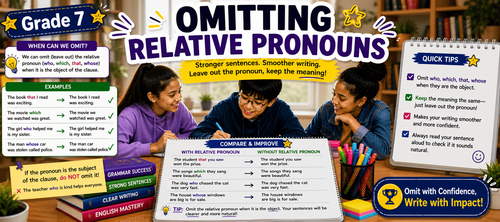

Master Sentence Flow with This English Grammar Worksheet: Grade 7 Omitting Relative Pronouns
Learning how to make sentences shorter, smoother, and more natural is an important part of grammar growth in middle school. This English grammar worksheet for Grade 7 on Omitting Relative Pronouns gives students structured practice in understanding how some relative pronouns are left out while the sentence still makes complete sense. Through underlining tasks, multiple choice questions, sentence rewriting, passage completion, and paragraph writing, learners become more confident in recognising hidden sentence links and using connected sentence patterns correctly.
Download these English grammar worksheets and practice regularly to strengthen your language skills and build a strong foundation. You can also book a free trial to get expert guidance and improve your reading, writing, and comprehension abilities. The worksheets are designed in a simple and structured way to help K–8 students learn grammar concepts easily and use them confidently in everyday communication.
What Is the Topic?
Omitting Relative Pronouns is a sentence skill where the connecting word is not written, but the sentence still stays meaningful. In this Grade 7 topic, students learn to identify where the missing connector belongs, choose the correct sentence without the connector, and rewrite longer relative pronoun sentences into shorter forms. The worksheet focuses on understanding how words like that, which, and whom are hidden inside the sentence pattern even when they are not written directly.
Students are expected to:
1. Notice the position of the omitted connector.
2. Recognise correct omitted relative pronoun sentence forms.
3. Rewrite full relative pronoun sentences correctly.
4. Read and understand connected sentence structures in a passage.
5. Apply the pattern in independent writing.
What’s in This Worksheet?
1. Underline the Words
Students read ten sentences and underline the omitted relative pronoun position in each sentence. This builds observation and grammar recognition.
2. Multiple Choice Questions
Learners choose the sentence that correctly shows omitted relative pronoun usage. This helps with comparison and understanding of sentence flow.
3. Sentence Rewriting
Students apply the rule to rewrite each sentence correctly without the pronoun. This checks practical grammar transformation.
4. Fill in the Blanks
A short passage asks students to read carefully and fill the blanks with suitable omitted words. This develops context-based sentence understanding.
5. Paragraph Writing
Students write a short paragraph on a book or movie they enjoyed recently. This gives them a chance to create connected sentences independently.
These five activities support exam preparation because students move from recognition to application and finally to free writing.
Definitions, Examples, Techniques, and Tips
Definition
An omitted relative pronoun means the sentence has a missing connector word, but the sentence still reads smoothly and clearly.
Examples from the worksheet:
The book I borrowed from Ravi was interesting.
The teacher Raj thanked after class smiled warmly.
The player the coach selected trained daily.
These examples show that there is a hidden linking word between the noun and the next part of the sentence.
Technique 1
First read the noun in the sentence.
Technique 2
Then check if another part of the sentence is giving extra information about that noun.
Technique 3
Look for the hidden place where a connector could fit naturally.
Technique 4
Practice changing full relative pronoun sentences into shorter forms.
Quick learning tip
When a sentence sounds complete but still gives extra information about a noun, there may be an omitted relative pronoun inside it.
Why Is It Important to Learn This?
This grammar topic matters because it teaches students how to build fluent English sentences. Instead of writing only long connector-heavy sentences, learners understand how connected writing can sound natural and polished. It also improves reading comprehension because students begin to notice sentence relationships quickly.
Academically, this topic strengthens:
1. Sentence editing skills
2. Grammar identification
3. Transformation questions
4. Writing fluency
5. Better understanding of connected clauses
Where Will This Knowledge Help You?
Students will use this grammar knowledge in many school situations.
1. In grammar exams, they may need to spot missing connectors or rewrite sentence forms.
2. In writing tasks, they can create smoother and less repetitive sentences.
3. In class participation, they can understand textbook passages with linked clauses more easily.
4. In paragraph writing, they can connect ideas in a more mature way.
5. In comprehension work, they can read long sentences with better understanding.
How to Use This Worksheet?
1. Attempt each section independently first.
Read every sentence carefully and try to understand where the omitted connector belongs.
2. Review answers carefully.
The solutions below follow the exact worksheet order, so compare every answer one by one.
3. Correct mistakes after checking.
Rewrite any incorrect sentence again so that the grammar pattern becomes clear.
4. Practice regularly.
Repeated work with omitted relative pronoun structures will improve speed and confidence.
Important Tips and Tricks
1. Read the sentence slowly before answering.
Many students miss the hidden connector because they read too fast.
2. Focus on the noun first.
The extra information after the noun usually shows where omission happens.
3. In rewriting tasks, remove only the connector and keep the rest of the sentence correct.
4. In fill in the blanks, read the full passage meaning before choosing the suitable omitted word.
5. In paragraph writing, try to use connected descriptive sentences to show grammar understanding.
Complete Answer Key
Exercise 1 – Underline the Omitted Relative Pronoun Position
1. The book (that/which) I borrowed from Ravi was interesting.
2. The teacher (whom/that) Raj thanked after class smiled warmly.
3. The player (whom/that) the coach selected trained daily.
4. The uncle (whom/that) Riya invited for dinner brought sweets.
5. The movie (that/which) we watched during holidays was inspiring.
6. The girl (whom/that) we met at the science fair won a medal.
7. The project (that/which) our group completed received praise.
8. The shop (that/which) Asha visited in Mumbai sold paintings.
9. The boy (whom/that) Meera called yesterday had shifted to Delhi.
10. The poem (that/which) we studied in assembly was meaningful.
Exercise 2 – Multiple Choice Questions
1. b
2. c
3. b
4. b
5. c
6. a
7. b
8. a
9. c
10.a
Exercise 3 – Rewrite Without the Relative Pronoun
1. The book I bought yesterday is useful.
2. The movie Raj watched was funny.
3. The shop Meera entered was crowded.
4. The girl we invited came early.
5. The song we sang in class was soft.
6. The bag Asha carried was heavy.
7. The sweets Riya distributed were fresh.
8. The lesson we learned was important.
9. The player the coach praised smiled.
10. The market Ravi explored was noisy.
Exercise 4 – Fill in the Blanks Passage
1. that
2. whom
3. that
4. that
5. that
6. that
7. who
8. who
9. that
10. that
Exercise 5 – Paragraph Writing (Sample Answer)
I recently watched a movie I enjoyed a lot with my family. It was a funny and inspiring story about a boy I admired for his courage. The scenes we liked most were full of adventure and excitement. There was also a teacher the boy respected deeply in the movie. The message I learned from the film was to stay brave in difficult times. It became a movie I will always remember.
This Grade 7 Omitting Relative Pronouns English grammar worksheet gives students strong practice in identifying hidden connectors, rewriting sentence structures, and building smoother written expression. With regular use, learners can become more accurate and confident in sentence formation and grammar exams.