
Class 7 Phrasal Verbs with Multiple Meanings – Printable Worksheet
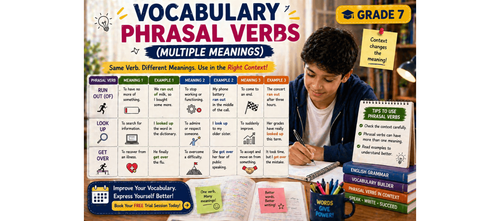

Vocabulary - Phrasal Verbs (Multiple Meanings): English Grammar Worksheet for Grade 7
Phrasal verbs with multiple meanings are essential components of mastering English vocabulary, and understanding how these verbs change based on context can greatly enhance communication skills. This Grade 7 English grammar worksheet on phrasal verbs with multiple meanings will help students identify and use these versatile expressions accurately in different situations.
Download these English grammar worksheets and practice regularly to strengthen your language skills and build a strong foundation. You can also book a free trial to get expert guidance and improve your reading, writing, and comprehension abilities. The worksheets are designed in a simple and structured way to help K–8 students learn grammar concepts easily and use them confidently in everyday communication. Book a free trial!
## What is the topic?
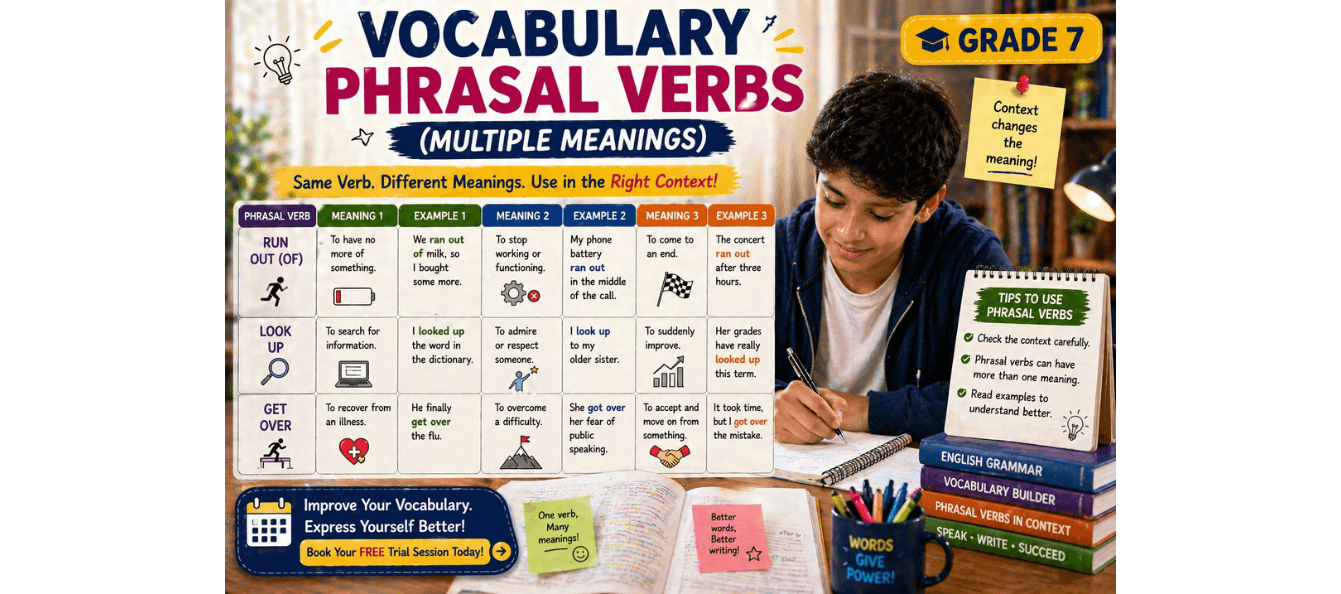
This worksheet focuses on **phrasal verbs with multiple meanings**, helping students understand how a single phrasal verb can have different interpretations based on the context in which it is used. For example, the phrasal verb "turn off" can mean "to stop something" or "to disconnect." Mastering these versatile verbs is essential for fluency in English.
By practicing these phrasal verbs, students will improve their understanding of context and gain the ability to choose the right expression depending on the situation.
## What’s in this worksheet?
This worksheet includes engaging exercises that help students practice and solidify their understanding of phrasal verbs with multiple meanings. The activities include:
1. **True or False:** Identify whether the sentence correctly describes the meaning of a phrasal verb.
2. **Sort the Words:** Sort phrasal verbs according to their meanings.
3. **Fill in the Blanks:** Complete sentences using the correct phrasal verb from a pair.
4. **Multiple Choice Questions:** Choose the correct meaning of the phrasal verb in context.
5. **Sentence Rewriting:** Rewrite sentences using the appropriate phrasal verb.
These exercises will help students master phrasal verbs and understand how their meanings change based on usage.
## Definitions, examples, techniques, and tips
- **Phrasal verb:** A verb combined with one or more prepositions or adverbs, creating a unique meaning. For example, “pick up” can mean “to collect” or “to lift.”
- **Example:**
- **Turn off**:
- **Meaning 1:** To stop something (e.g., "Turn off the light.")
- **Meaning 2:** To lose interest (e.g., "That movie turned me off.")
- **Technique:** Pay close attention to the surrounding words and context when using phrasal verbs. For example, “run out” can mean "to deplete a resource" or "to exit quickly," depending on the context.
- **Quick learning tip:** To enhance memory, pair phrasal verbs with their common usages. For example, "take off" is commonly used when talking about airplanes or clothes, so practice with those contexts first.
## Why is it important to learn this?
Understanding phrasal verbs with multiple meanings is crucial for mastering English because they are widely used in both spoken and written communication. Here’s why learning them is important:
- **Fluency:** Knowing how to use phrasal verbs naturally makes speech and writing more fluent and expressive.
- **Clarity and precision:** When used correctly, phrasal verbs can make communication clearer and more direct.
- **Understanding native speakers:** Native English speakers frequently use phrasal verbs, and understanding them helps you keep up in conversations.
This knowledge will also be useful in exams, where phrasal verbs are often tested in reading comprehension, writing tasks, and speaking exercises.
## Where will this knowledge help you?
Knowing phrasal verbs with multiple meanings is helpful in many areas of life:
- **Exams:** These phrasal verbs often appear in English language exams, especially in reading and writing sections. Mastering them will help you score better in these areas.
- **Writing tasks:** Whether writing an essay, a story, or a letter, phrasal verbs make your language sound more natural and engaging.
- **Daily communication:** Understanding and using phrasal verbs correctly will help you communicate more effectively in both personal and professional settings.
## How to use this worksheet?
To maximize your learning from this worksheet, follow these steps:
1. **Attempt independently first:** Try solving the exercises on your own to test your current understanding of phrasal verbs.
2. **Review answers carefully:** Once you complete the exercises, check your answers with the provided key to ensure you understand the correct usage.
3. **Correct mistakes:** If you misunderstood a phrasal verb, revisit its meaning and practice using it in a new sentence.
4. **Practice regularly:** Revisit the exercises and create new sentences using the phrasal verbs to reinforce your understanding.
The solutions follow the exact worksheet order, so comparing your answers will help you understand the correct usage better.
## Important tips and tricks
Here are some useful tips for mastering phrasal verbs with multiple meanings:
1. **Common mistakes:** Students often confuse phrasal verbs that sound similar. For instance, “turn off” and “turn down” can both mean “stop,” but their context differs.
2. **What examiners expect:** In exams, be sure to choose the right phrasal verb based on its meaning in the sentence. Examiners test your understanding of these verbs in context.
3. **How to score full marks:** To score well, ensure you understand the different meanings of phrasal verbs and use the correct one based on the sentence's context.
4. **Approaching activity-based tasks:** When rewriting sentences, focus on understanding the meaning and then selecting the correct phrasal verb based on its multiple meanings.
## Complete Answer Key
**Exercise No. 1 - True or False**
1. True
2. False
3. True
4. False
5. True
6. True
7. True
8. False
9. False
10. False
**Exercise No. 2 - Sort the phrasal verb into its meaning**
- **Phrasal Verbs:**
- Take off/Remove
- Break down/Stop working
- Look after/Take care of
- Set up/Organize
- Turn off/Stop
- Run out/Finish
- Pick up/Collect
- Bring up/Raise a topic
- Go on/Continue
- Turn up/Arrive
- **Meanings:**
- Take off: Remove
- Break down: Stop working
- Look after: Take care of
- Set up: Organize
- Turn off: Stop
- Run out: Finish
- Pick up: Collect
- Bring up: Raise a topic
- Go on: Continue
- Turn up: Arrive
**Exercise No. 3 - Choose the correct word from the pair**
1. Start a race/Finish
2. End a conversation/Raise a topic
3. Remove/Depart
4. Show off/Arrive
5. Broken/Stop working
6. Continue/Walk
7. Surveillance/Take care of
8. End/Quit
9. Donate/Quit
10. Compete/Wash
**Exercise No. 4 - Choose the correct option to complete the sentence**
1. Give up
2. Pick up
3. Look after
4. Break down
5. Set up
6. Turn off
7. Pick up
8. Break up
9. Turn off
10. Give up
**Exercise No. 5 - Rewrite the sentence using the phrasal verb**
1. He decided to give up smoking for good.
2. They need to pick up the book from the shelf.
3. She promised to look after her younger sister after school.
4. The car broke down in the middle of the road.
5. They were running out of supplies.
6. They turned off the lights before leaving.
7. He arrived late to the party.
8. He started the new project after the meeting.
9. They decided to break up the ongoing project.
10. She managed to bring up the issue after the explanation.
Book a free trial!