
Class 7 Phrase to Clause Worksheet: Grammar Worksheet
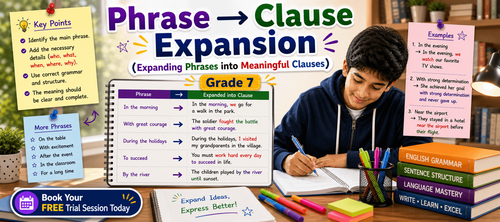

Build Better Sentences with This English Grammar Worksheet Grade 7 Phrase to Clause Expansion
Have you ever read a sentence and felt that it was too short or not detailed enough? In English grammar, small descriptive phrases can often be changed into full clauses to make writing more complete and expressive. That is exactly what students practice in this English grammar worksheet Grade 7 Phrase to Clause Expansion. This worksheet is designed to help learners notice short describing phrases in sentences and then expand them using suitable clause forms like who was, who had, which was, when, after, before, and while.
For Grade 7 students, sentence transformation is an important grammar skill because it improves writing quality and helps in understanding how different sentence parts work together. Instead of writing only short phrases, students learn to create longer and grammatically richer sentence structures. Through underlining tasks, multiple choice questions, sentence rewriting, fill in the blanks, and paragraph writing, this worksheet gives step-by-step practice in a very structured way.
Download these English grammar worksheets and practice regularly to strengthen your language skills and build a strong foundation. You can also book a free trial to get expert guidance and improve your reading, writing, and comprehension abilities. The worksheets are designed in a simple and structured way to help K–8 students learn grammar concepts easily and use them confidently in everyday communication.
What Is Phrase to Clause Expansion?
Phrase to Clause Expansion means changing a short phrase in a sentence into a full clause without changing the sentence meaning. A phrase gives only limited information, but a clause gives fuller information with a subject and verb.
In this Grade 7 worksheet, students are expected to:
• identify the noun and the main verb in simple sentences,
• recognise the correct clause-expanded form,
• rewrite phrase-based sentences into clause-based structures,
• complete a passage using suitable clause words,
• and use expanded clauses in their own paragraph writing.
This helps students understand that sentence details can be made clearer and stronger by expanding short expressions.
What’s in This Worksheet?
1. The worksheet begins with a sentence observation task where students underline the noun and circle the main verb. This builds awareness before actual transformation work begins.
2. The second part contains multiple choice questions. Students must choose the correct sentence that properly expands a phrase into a clause.
3. The next section gives direct rewriting practice. Learners are told which type of clause form to use and must rewrite accordingly.
4. A contextual fill in the blanks passage follows. This checks whether students can apply the same grammar understanding inside a connected paragraph.
5. The worksheet ends with a paragraph writing activity where students independently use phrase-to-clause expanded sentences.
6. Because the worksheet moves from guided identification to independent writing, it also supports exam preparation by gradually increasing confidence in sentence transformation.
Definitions, Examples, Techniques, and Tips
A phrase is a short group of words that does not always show a complete idea with a subject and verb. In many of the worksheet sentences, learners first observe these shortened parts.
A clause gives fuller meaning because it usually contains a clearer action relationship.
For example, the worksheet moves students from:
“The boy with a bag ran.”
to
“The boy who had a bag ran.”
Another example changes:
“We played after lunch.”
to
“We played after we ate lunch.”
Students also practise:
“The bench which was broken stood.”
“The baby who was smiling waved.”
“We left when the sun set.”
A useful technique shown throughout the worksheet is to look for describing words like with, after, during, at, in, and then think of a full clause that can explain the same meaning.
A quick learning tip is to first find who or what is being described and then ask what full action or condition can be added to explain it.
Why Is It Important to Learn This?
Learning Phrase to Clause Expansion is important because it teaches students how to make ordinary sentences more descriptive and grammatically complete. In school grammar, students are often asked to transform, rewrite, or improve sentences. This skill directly helps in such tasks.
It also improves writing because longer sentence forms sound smoother and clearer. Instead of using only short phrase details, students learn to connect ideas using proper clause structures.
For Grade 7 learners, this grammar topic also builds confidence in understanding relative clauses and time clauses, which are used often in comprehension, paragraph writing, and editing exercises.
Where Will This Knowledge Help You?
This knowledge helps in grammar exams where sentence transformation questions are common.
It helps in school writing tasks because students can write fuller and more natural descriptions.
It helps in comprehension passages because students understand sentence relationships more clearly.
It helps during class participation because learners become more confident in explaining ideas in complete sentence form.
It also supports paragraph writing, where expanded clauses make written work sound richer and more connected.
How to Use This Worksheet?
1. Attempt each section independently first. Begin by carefully reading the sentence and spotting the phrase that gives extra description.
2. In the multiple choice and rewriting sections, compare the short phrase with the fuller clause version and observe how the sentence meaning remains the same.
3. Review answers carefully after completing each part. The solutions below follow the exact worksheet order, so students should compare answers one by one.
4. Correct all mistakes by checking whether the clause added has both the correct meaning and the correct grammar connector.
5. Practice regularly by trying to expand similar short phrases into full clauses in your own notebook.
6. Complete the paragraph writing task only after finishing the guided sections, because it requires independent application.
Important Tips and Tricks
1. Always identify the noun first. Many students make mistakes because they do not see which word is being described.
2. Look carefully at clue words like with, after, during, at, in, and before. These usually show what kind of clause connector is needed.
3. Do not change the sentence meaning while expanding the phrase. The full clause must only explain the original phrase.
4. In MCQ questions, eliminate options that repeat the original phrase without expansion.
5. In rewriting tasks, use the exact prompted clause form such as who was, who had, which was, after, before, while, or when.
6. In writing-based tasks, try to include expanded clauses naturally instead of forcing them.
Complete Answer Key
Exercise No. 1
1. boy — runs
2. girl — answered
3. Raj — played
4. Asha — checked
5. Ravi — revised
6. Riya — greeted
7. Meera — sang
8. child — stayed
9. bench — looked
10. woman — smiled
Exercise No. 2
1. b) The boy who had a bag ran.
2. c) Riya who was brave spoke.
3. a) The player who was tired sat.
4. c) We walked when it rained.
5. b) The girl who was singing smiled.
6. b) We played after we ate lunch.
7. c) The bench which was broken stood.
8. a) We left when the sun set.
9. b) The baby who was smiling waved.
10. b) Ravi fell while he practised.
Exercise No. 3
1. The boy who was courageous won.
2. The girl who was in tears spoke.
3. Ravi practised before the match began.
4. We left after the lunch bell rang.
5. The window which was broken looked bad.
6. Meera sang while the assembly was going on.
7. They cheered when the sun set.
8. The child who had fever slept.
9. The man who was at the gate waited.
10. Asha revised after dinner was over.
Exercise No. 4
1. who
2. was
3. who
4. while
5. who
6. who
7. who were
8. when
Exercise No. 5
One day, our class was preparing for the science fair when a problem happened. Riya saw a boy who was carrying many charts alone. She quickly called Meera, who was standing near the door. Ravi, who had strong hands, helped lift the models. We entered the hall when the teacher was giving instructions. One chart fell after the table shook, but Asha, who was very alert, fixed it. Everyone smiled because friends who help each other make work easy. It was a day when teamwork made us happy.
This English grammar worksheet Grade 7 Phrase to Clause Expansion gives students a strong opportunity to move from short sentence details to fuller and more expressive writing. With regular practice, learners become more confident in sentence transformation, grammar correction, and structured paragraph writing. Grade 7 students who continue solving such focused worksheets will find English sentence building much easier and more natural over time.