
Class 7 Relative Clauses Worksheet: English Worksheet
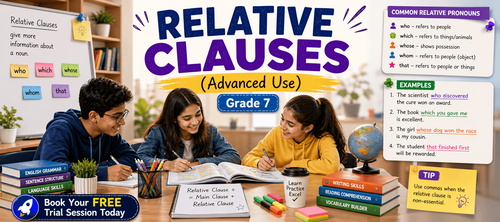

Master Advanced Relative Clauses with This English Grammar Worksheet for Grade 7
Sentences become more powerful when ideas are connected smoothly, and that is exactly what students begin to understand in this English grammar worksheet designed for Grade 7 learners. The topic, Relative Clauses (Advanced Use), helps children move beyond short and simple statements and start forming richer sentences that describe people, objects, and places in a more meaningful way. Instead of writing many separate thoughts, students learn how one clause can give extra information and make writing sound polished. This worksheet offers structured grammar practice through identification, multiple choice, rewriting, passage completion, and paragraph writing tasks so that learners become comfortable using relative clauses in many sentence situations.
Download these English grammar worksheets and practice regularly to strengthen your language skills and build a strong foundation. You can also book a free trial to get expert guidance and improve your reading, writing, and comprehension abilities. The worksheets are designed in a simple and structured way to help K–8 students learn grammar concepts easily and use them confidently in everyday communication.
What Is the Topic?
Relative Clauses (Advanced Use) is the grammar concept practiced in this Grade 7 worksheet. A relative clause is the part of a sentence that gives more information about a noun. In this worksheet, students are expected to recognize these clauses, choose correct sentence forms, repair incorrect clause usage, complete a paragraph with suitable clause words, and finally create their own writing using advanced relative clauses. This means students are not only spotting the grammar form but also learning how it works inside complete sentences.
What’s in This Worksheet?
1. The worksheet begins with an underlining task where students identify the relative clause in each sentence.
2. It then moves to multiple choice questions that ask learners to choose the grammatically correct sentence.
3. The next section asks students to rewrite incorrect sentences by applying the rule correctly.
4. A paragraph-based fill in the blanks section gives learners contextual grammar practice.
5. The worksheet ends with a paragraph writing activity where students use at least five advanced relative clauses on the given topic.
6. This structure helps students practice recognition, correction, application, and writing in one complete English grammar worksheet.
7. Such varied question formats are useful for grammar exams because students often face direct, objective, and writing-based grammar tasks together.
Definitions, Examples, Techniques, and Tips
The worksheet repeatedly shows that a relative clause is a connected part of a sentence that describes a noun more clearly. For example, in the sentence “Riya met the writer who inspired her,” the words “who inspired her” provide more information about the writer. In “Raj visited the museum that displayed coins,” the words “that displayed coins” describe the museum. Through such examples, students can observe how the sentence becomes more detailed.
The multiple choice section also helps learners compare correct and incorrect structures. Some sentences contain wrong word choices, while one sentence follows the correct clause pattern. This comparison technique helps students understand which sentence sounds grammatically complete.
The rewriting section teaches another useful technique: when a sentence sounds broken or incomplete, students must rebuild it correctly by replacing the faulty clause word with the proper one. This kind of correction work develops grammar alertness.
A quick learning tip from this worksheet is that students should read the noun first, then identify the words that describe it. Those descriptive words often form the relative clause.
Why Is It Important to Learn This?
Learning Relative Clauses (Advanced Use) is important because students need to express ideas in fuller and more connected ways. Short sentences may give information, but connected sentences make writing more mature. This topic helps Grade 7 learners add useful details, avoid repetitive writing, and understand how descriptive sentence parts improve meaning. It also trains students to notice grammar errors in sentence formation and repair them confidently. As learners move to higher grades, sentence sophistication becomes more important, so this English grammar worksheet gives valuable support.
Where Will This Knowledge Help You?
This knowledge helps in school grammar tests where students must identify correct sentence forms and rewrite incorrect ones. It also helps in paragraph writing because learners can connect ideas without making writing choppy. During classroom discussions, students can speak in fuller sentences that sound clearer and more informative. Reading comprehension also improves because many passages use detailed noun descriptions through relative clauses. So this Grade 7 worksheet supports not just one grammar chapter but wider language confidence.
How to Use This Worksheet?
1. First, students should attempt every section independently without looking at corrections.
2. Begin by carefully underlining the clause parts and then move to the objective questions.
3. In rewriting tasks, compare the incorrect sentence with the corrected pattern closely.
4. While doing the fill in the blanks, read the whole paragraph for meaning before choosing the missing word.
5. Attempt the paragraph writing task only after observing how the earlier exercises build sentence patterns.
6. The solutions below follow the exact worksheet order, so students should compare every answer carefully.
7. After checking mistakes, rewrite wrong answers once more for stronger retention.
8. Repeat this worksheet after a few days to improve grammar fluency.
Important Tips and Tricks
1. Do not underline the whole sentence in clause identification tasks. Only the descriptive part should be selected.
2. In objective questions, read all options fully because some may look similar but only one sentence is complete.
3. In rewriting tasks, focus on making the sentence sound smooth and meaningful.
4. While filling blanks in a paragraph, make sure the missing word connects properly with the noun before it.
5. In paragraph writing, students should include multiple connected descriptions rather than writing short unrelated lines.
6. Examiners usually expect grammatically connected writing, not just isolated facts.
7. To score full marks, students should maintain sentence clarity from beginning to end.
Complete Answer Key
Exercise No. 1
1. who inspired her
2. that explained stars
3. that carried lunch
4. that connects Delhi
5. whose notes helped
6. who guided him
7. who scored
8. who treated Ravi
9. that displayed coins
10. whose voice impressed us
Exercise No. 2
1. b) The boy who topped smiled.
2. c) The bus which arrived was full.
3. a) The girl whose project won cheered.
4. b) This is the man who fixed it.
5. c) The shop that we entered was bright.
6. a) The child whose kite tore cried.
7. c) I know the woman who teaches.
8. b) The singer whom we heard was popular.
9. c) The lane that leads home is narrow.
10. b) The friend who called was absent.
Exercise No. 3
1. The boy who won the quiz smiled.
2. The girl whose project shone thanked all.
3. This is the carpenter who fixed it.
4. The bus which reached late was crowded.
5. The hall that we entered was silent.
6. The singer whom we heard was famous.
7. The road whose joins Mumbai is wide.
8. The woman that teaches maths is kind.
9. The child who kite flew laughed loudly.
10. The artist who sketch sold thanked us.
Exercise No. 4
1. who
2. worked even in floods
3. villagers could use easily
4. solved water problems
5. saved time
6. villages needed
7. worked in rain
8. won praise
9. stayed dry in storms
10. connected farms
11. warned people before danger
12. remained strong during monsoon winds
Exercise No. 5
The scientist who changed my thinking was A.P.J. Abdul Kalam. He was a leader who inspired millions of children to dream big. The books that he wrote taught us the value of hard work and imagination. I admire the man whose ideas were simple yet powerful. He showed that science can improve human life in many ways.
Marie Curie is a scientist who changed my thinking deeply. She was a woman who worked fearlessly even in difficult conditions. The discoveries that she made helped doctors treat serious illnesses. I respect the scientist whose dedication still inspires students around the world. She proved that learning and courage can change the future.
Practising this English grammar worksheet on Relative Clauses (Advanced Use) gives Grade 7 students the confidence to build longer, clearer, and more effective sentences. With regular practice, learners become better at grammar correction, sentence connection, and thoughtful writing. Continue using such focused worksheets to make grammar feel easier and more natural every day.