
Class 7 Relative Pronouns Worksheet: Grammar Worksheet
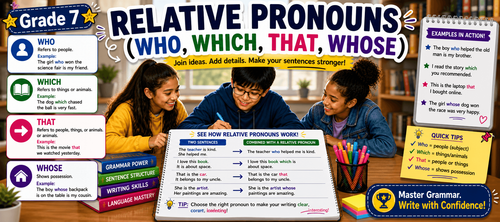

Master Relative Pronouns with This English Grammar Worksheet for Grade 7
Learning how to connect ideas smoothly makes writing more meaningful and expressive. This English grammar worksheet for Grade 7 on Relative Pronouns (Who, Which, That, Whose) gives students structured practice in understanding how these important words are used in everyday sentences. Instead of writing short and repetitive statements, learners begin to join details, describe people and things better, and improve sentence flow. Through underlining, choosing correct sentences, rewriting, paragraph completion, and paragraph writing, this worksheet gives students many chances to practice the topic in a guided and gradual way.
Download these English grammar worksheets and practice regularly to strengthen your language skills and build a strong foundation. You can also book a free trial to get expert guidance and improve your reading, writing, and comprehension abilities. The worksheets are designed in a simple and structured way to help K–8 students learn grammar concepts easily and use them confidently in everyday communication.
What Is the Topic?
Relative Pronouns (Who, Which, That, Whose) are the main focus of this Grade 7 worksheet. Students learn to identify these words, understand where they are used, and apply them correctly in sentences. The worksheet shows that these pronouns are used to connect a noun with more information. For example, some are used for people, some for things, and some to show belonging. Through repeated sentence practice, students are expected to learn how to recognize the correct pronoun and place it naturally inside a sentence.
What’s in This Worksheet?
1. The worksheet begins with an underlining task where students carefully identify the relative pronoun in ten sentences.
2. It then gives ten multiple choice questions where students must choose the sentence that uses the relative pronoun correctly.
3. Students next rewrite ten incorrect sentences by correcting the relative pronoun use.
4. A paragraph-based fill in the blanks task helps learners use suitable words in context.
5. The final paragraph writing activity asks students to write about A Person Who Inspires You using relative pronouns in their own sentences.
6. This step-by-step structure helps students move from identification to correction and then to independent grammar usage.
7. Such varied grammar tasks also support school exam preparation because they cover objective, short-answer, editing, contextual, and writing formats.
Definitions, Examples, Techniques, and Tips
Relative pronouns in this worksheet are shown through direct sentence examples. Students repeatedly work with who, which, that, and whose in natural sentence patterns.
Who is seen in examples like “The boy who won the race smiled.” This shows its use inside a sentence about a person.
That is seen in examples like “Ravi likes the bat that his coach gave.” This helps learners notice how it connects information about a thing.
Whose appears in examples like “Asha met a singer whose voice was soft.” This gives students a model for showing possession.
Which appears in examples like “The book which Meera borrowed is new.” This gives one more way to connect information about objects or places.
One useful technique shown in the worksheet is repeated recognition. Students first underline, then choose, then rewrite, and then fill blanks. This repeated exposure helps them become comfortable with sentence connection.
A quick tip while solving such tasks is to first look at the noun before the blank or pronoun. Then decide whether it talks about a person, a thing, or possession.
Why Is It Important to Learn This?
Learning Relative Pronouns (Who, Which, That, Whose) is important because they make writing smoother and clearer. Without them, students often write broken or repetitive sentences. This topic helps learners add details naturally. It also improves grammar confidence because students learn how one sentence can carry more than one idea. In school grammar, such sentence-linking words are used in comprehension, editing, paragraph writing, and formal assessments. So this Grade 7 topic is useful not only for grammar marks but also for better written communication.
Where Will This Knowledge Help You?
Students will use this knowledge in many classroom and exam situations.
In grammar tests, they may be asked to underline, fill, or correct relative pronouns.
In paragraph writing, they can write richer and longer sentences.
In sentence correction activities, they can quickly spot which pronoun is wrong.
In class discussions or speaking, they can describe people, places, and objects in a clearer way.
In comprehension writing, they can frame more connected answers instead of short disconnected lines.
How to Use This Worksheet?
1. Start by reading each sentence carefully before marking any answer.
2. Attempt every section independently so that you understand where confusion happens.
3. In the multiple choice and rewriting sections, pay close attention to whether the noun is a person, object, or shows possession.
4. After completing all tasks, compare your work with the complete solutions.
5. The solutions below follow the exact worksheet order, so students should compare answers carefully line by line.
6. Correct every mistake and try writing the corrected sentence once more.
7. Repeat the worksheet after a few days to improve retention and confidence.
Important Tips and Tricks
1. Do not choose a relative pronoun without reading the full sentence.
2. A common mistake is mixing who and which, so always identify whether the noun is a person or thing.
3. Another common mistake is forgetting whose in possessive sentences.
4. In rewriting tasks, read both the wrong sentence and the corrected form carefully.
5. In paragraph blanks, do not fill randomly; read the sentence meaning first.
6. In paragraph writing, make sure every sentence naturally includes connected information.
7. Examiners usually expect both correct grammar and proper sentence sense, so focus on meaning as well as the pronoun.
Complete Answer Key
Exercise 1 – Underline the Relative Pronouns
1. who
2. that
3. whose
4. that
5. whose
6. which
7. who
8. that
9. which
10. which
Exercise 2 – Multiple Choice Questions
1. b)
2. c)
3. a)
4. b)
5. a)
6. c)
7. b)
8. b)
9. c)
10.b)
Exercise 3 – Rewrite the Sentences
1. The boy who won the medal waved.
2. The book that is on the desk is mine.
3. Ravi met a coach who trained him.
4. This is the girl whose bag is torn.
5. The shop that sells uniforms is closed.
6. Meera found a pen that was broken.
7. I know a singer who lives in Pune.
8. The bus that goes to Chennai is full.
9. This is the cat that chased mice.
10. Raj saw a player whose shoes were muddy.
Exercise 4 – Fill in the Blanks
1. which
2. who
3. whose
4. that
5. who
6. which
7. whose
8. that
9. who
10. who
Exercise 5 – Sample Paragraph Writing
My mother is the person who inspires me the most. She is a woman whose hard work teaches me never to give up. She helps everyone who needs support and always speaks kindly. I admire the patience that she shows in difficult times. She is the person who encourages me to study well and stay honest. The values that I learn from her are very important. She is someone whose love makes our home happy. I want to become a person who is caring and strong like her.
Regular practice with this English grammar worksheet for Grade 7 on Relative Pronouns (Who, Which, That, Whose) can make sentence building much easier and more natural. As students continue solving such structured grammar exercises, they become more confident in writing connected and meaningful English. Keep practicing to make grammar a strength, one worksheet at a time.