
Class 7 Sentence Transformation Worksheet: Grammar Worksheet
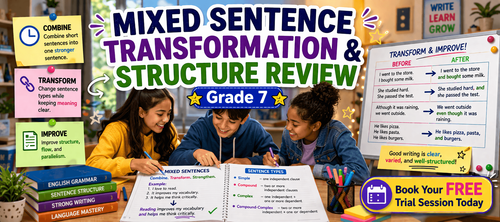

Build Better Sentences with This English Grammar Worksheet for Grade 7 on Mixed Sentence Transformation & Structure Review
Learning grammar becomes more interesting when students do not just read rules but actually change, correct, and rebuild sentences on their own. This English grammar worksheet for Grade 7 on Mixed Sentence Transformation & Structure Review gives students a full practice set where they identify clauses, choose correct transformed sentences, rewrite incorrect structures, complete a grammar passage, and write a short paragraph. Each activity is designed to make learners think carefully about how English sentences are formed and how one sentence pattern can be changed into another without losing meaning.
For Grade 7 students, this topic is useful because it combines many grammar areas into one strong revision practice. Students observe verbs, clauses, conjunctions, voice, reported speech, conditionals, and sentence correction all in one worksheet. By attempting these tasks, they become more confident in handling school grammar exercises and sentence editing questions.
Download these English grammar worksheets and practice regularly to strengthen your language skills and build a strong foundation. You can also book a free trial to get expert guidance and improve your reading, writing, and comprehension abilities. The worksheets are designed in a simple and structured way to help K–8 students learn grammar concepts easily and use them confidently in everyday communication.
What Is the Topic?
Mixed Sentence Transformation & Structure Review is a grammar practice topic where students work with different sentence forms and learn how to recognize, correct, or transform them. In this Grade 7 worksheet, students are expected to identify the main clause and verb, choose the correct transformed sentence, apply grammar rules to rewrite wrong sentences, complete a contextual paragraph, and express their own ideas in paragraph writing.
This topic teaches students that English grammar is not only about memorizing one rule. It is also about understanding how sentence parts connect together. Students learn to observe whether a sentence is active or passive, direct or indirect, simple or complex, correct or incorrect. They also learn that one small change in tense, conjunction, or verb form can completely improve sentence accuracy.
What’s in This Worksheet?
1. The worksheet begins with a sentence structure identification task where students identify the main clause and circle the verb in each sentence.
2. The second part contains multiple choice questions where students choose the correct passive transformation, reported speech form, conditional transformation, complex sentence form, active transformation, indirect question form, compound sentence form, past perfect transformation, transformation using although, and imperative transformation.
3. The third section asks students to apply the rule to rewrite each sentence correctly. Different grammar targets such as Past Simple, Present Continuous, Subject Verb Agreement, First Conditional, Reported Speech, Past Perfect, Past Continuous, Passive Voice, Present Simple Negative, and Conjunction Use are included.
4. The fourth section includes a paragraph with blanks. Students read the passage and fill the blanks with suitable words.
5. The final section is a paragraph writing activity on How I Improved My Grammar Skills using sentence transformations.
6. Because the worksheet contains objective, correction-based, contextual, and writing-based tasks together, it gives full revision support and helps in exam preparation.
Definitions, Examples, Techniques, and Tips
Sentence transformation means changing a sentence into another correct form. In this worksheet, students see examples such as passive transformation, reported speech form, conditional transformation, and imperative transformation.
Main clause identification is another important part of this worksheet. Students first locate the independent part of the sentence before understanding how the dependent clause supports it.
Sentence correction technique is practiced through rewrite tasks. Students are shown an incorrect sentence and a target grammar area. Then they must rewrite the sentence correctly by applying that exact grammar rule.
Contextual grammar practice is used in the fill in the blanks paragraph. Instead of solving isolated sentences, students use suitable words inside a complete classroom-based passage.
Writing reflection is included through the final paragraph writing task. This gives students a chance to use their understanding in their own words.
A useful technique while solving this worksheet is to read each sentence slowly, identify the verb, check the tense, and then notice whether the sentence needs voice change, clause correction, or agreement correction.
Why Is It Important to Learn This?
Mixed sentence transformation is important because students do not face only one grammar type in school exams. They are often asked to identify mistakes, choose correct forms, rewrite structures, and improve sentence quality. This worksheet trains them for all these situations.
It also improves writing because students begin noticing how better sentence construction makes writing clearer. When students know how to change voice, fix tense, or join clauses, their paragraph writing and answer writing become stronger.
This topic also improves speaking confidence because students become more aware of correct sentence patterns while speaking in class.
Where Will This Knowledge Help You?
Students will use this knowledge in grammar tests where sentence correction and rewriting questions are common.
It helps in school writing tasks because students can produce more accurate and varied sentence structures.
It supports paragraph writing because students learn how to connect ideas correctly.
It helps during class participation when students answer orally using grammatically improved sentences.
It also helps during revision because many grammar rules are reviewed together in one worksheet.
How to Use This Worksheet?
1. Start by attempting each question independently. Read every sentence carefully before marking or rewriting.
2. In identification and MCQ sections, check verbs, clause links, and sentence patterns before selecting the answer.
3. In rewriting sections, focus on the grammar target written beside each sentence and correct only after understanding the rule.
4. While solving the passage blanks, read the full paragraph first so that the words fit naturally.
5. Attempt the paragraph writing task in complete sentences using your own grammar learning experience.
6. After solving, compare your work with the solutions given below. The solutions follow the exact worksheet order, so students should compare answers carefully.
7. Correct mistakes and practice the same sentence forms regularly for improvement.
Important Tips and Tricks
1. Always identify the main verb before transforming any sentence.
2. In passive and active voice questions, check who is doing the action and who is receiving it.
3. In reported speech, tense consistency must be observed carefully.
4. In conditionals, both parts of the sentence should be grammatically connected.
5. While rewriting incorrect sentences, do not rush. First identify what grammar target is mentioned.
6. In fill in the blanks passages, read the complete context instead of solving blank by blank.
7. In writing-based tasks, use correct tense and clear sentence joining to score better marks.
8. Examiners expect students to not only know the rule but also apply it correctly in complete sentence form.
Complete Answer Key
Exercise No. 1
Identify the main clause and circle the verb in each sentence.
1. Main clause: Riya rewrote the sentence; Verb: rewrote
2. Main clause: Meera combined the clauses; Verb: combined
3. Main clause: The boy rewrote the sentence; Verb: rewrote
4. Main clause: The students improved their answers; Verb: improved
5. Main clause: Asha corrected the error; Verb: corrected
6. Main clause: Ravi changed the voice; Verb: changed
7. Main clause: The class revised the rules; Verb: revised
8. Main clause: The teacher explained the rule; Verb: explained
9. Main clause: Raj transformed the sentence; Verb: transformed
10. Main clause: The girl joined the clauses; Verb: joined
Exercise No. 2
Choose the correct option that best suits the sentence.
1. c)
2. b)
3. b)
4. a)
5. c)
6. b)
7. a)
8. c)
9. a)
10.a)
Exercise No. 3
Apply the rule to rewrite each sentence correctly.
1. Ravi wrote the essay yesterday.
2. They are finishing the homework.
3. If he studies he will pass.
4. She knows the answer clearly.
5. He said he was ready yesterday.
6. She had written the letter before class.
7. We were practicing transformation rules.
8. The essay was written by Meera.
9. Asha does not complete the task.
10. Although she was tired she worked.
Exercise No. 4
Read the passage and fill the blanks with suitable words.
1. transformed
2. changed
3. joined
4. explained
5. noted
6. converted
7. corrected
8. felt
Exercise No. 5
I improved my grammar skills by practicing sentence transformations every day. First, I learned how to change active voice into passive voice and direct speech into indirect speech. Then I practiced joining simple sentences to make complex and compound sentences. My teacher also helped me correct mistakes in tense and subject-verb agreement. At first, I found sentence rewriting difficult, but regular practice made it easier. Now I can understand sentence patterns better and write more correct English sentences with confidence.
This English grammar worksheet for Grade 7 on Mixed Sentence Transformation & Structure Review is a useful way to build sentence confidence step by step. With regular practice, students can become faster at identifying grammar mistakes, rewriting structures, and using correct English in both exams and writing work. Keep practicing these sentence patterns and grammar transformations to become a more confident Grade 7 learner.