
Class 7 Understanding Idioms in Context | English Grammar PDF
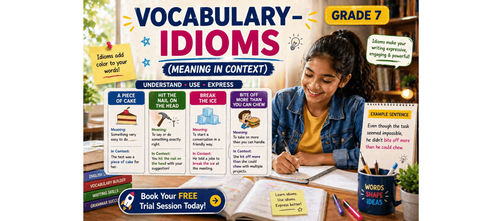

Grade 7 English Grammar Worksheet - Understanding Idioms in Context
Understanding idioms and how they fit within different contexts is a crucial skill for effective communication. Idioms add color to language, making conversations and writing more engaging. This Grade 7 worksheet will help students grasp the meanings of various idioms and understand how to use them correctly based on context.
Download these English grammar worksheets and practice regularly to strengthen your language skills and build a strong foundation. You can also book a free trial to get expert guidance and improve your reading, writing, and comprehension abilities. The worksheets are designed in a simple and structured way to help K–8 students learn grammar concepts easily and use them confidently in everyday communication. Book a free trial!
### What is the topic?
This worksheet focuses on **understanding idioms in context**. Idioms are phrases that have meanings different from the literal meanings of the words. For example, "hit the sack" means to go to sleep, not literally hitting a sack. Understanding idioms in context helps you to apply them correctly in conversations and writing, enhancing your communication skills.
By practicing idioms, students will learn to identify their meanings, match idioms to the appropriate situations, and use them accurately to express ideas more vividly.
### What’s in this worksheet?
The worksheet consists of various exercises to help you learn how to use idioms correctly in different contexts:
1. **True or False**: Assess your understanding of common idioms and their meanings.
2. **Sort the Words**: Match idioms with their correct meanings.
3. **Fill in the Blanks**: Complete idiomatic expressions by selecting the right words.
4. **Multiple Choice Questions**: Identify the correct meaning of idioms based on context.
5. **Sentence Rewriting**: Rephrase sentences using idioms to make them more creative and engaging.
These exercises will help you not only understand idioms but also use them effectively in both written and spoken English.
### Definitions, examples, techniques, and tips
**Definitions**:
- **Idiom**: A group of words whose meaning is different from the meanings of the individual words. For instance, "kick the bucket" means to die, not literally kicking a bucket.
**Examples**:
- "Hit the sack" means to go to sleep.
- "Break a leg" means to wish someone good luck, especially before a performance.
- "Piece of cake" means something that is very easy to do.
**Techniques**:
- To correctly use idioms, understand the context in which they are used. Some idioms work well in casual conversations but may not be suitable for formal writing.
- Don't overuse idioms. While they can make your writing colorful, using too many may confuse your reader.
**Quick Learning Tip**:
Visualize the idiom to remember it better. For example, "spill the beans" can be imagined as accidentally dropping a can of beans and revealing a secret.
### Why is it important to learn this?
Learning idioms and understanding their meanings in different contexts makes your writing more interesting and creative. Idioms can express complex ideas in a simple way and make your communication more engaging. Whether you're writing an essay, telling a story, or having a conversation, idioms can add depth and personality to your words.
In exams, using idioms correctly can help you stand out, as it shows that you have a good grasp of the English language and its nuances.
### Where will this knowledge help you?
**Exams**:
Idiomatic expressions can be a valuable addition to your writing in exams, as they help you communicate ideas clearly and express emotions effectively.
**Writing tasks**:
In both creative and descriptive writing tasks, idioms add flavor and creativity to your work. Idioms help you avoid being repetitive and improve your storytelling skills.
**Class participation**:
When speaking in class, using idioms correctly can make your conversations more lively and help you communicate more effectively with your peers and teachers.
### How to use this worksheet?
1. **Attempt independently first**: Read each question and try to answer on your own.
2. **Review answers carefully**: Once you've completed the exercises, go through your answers to make sure they're correct.
3. **Correct mistakes**: If you made any mistakes, look up the meaning of the idiom and understand how it fits in the context.
4. **Practice regularly**: Idioms require practice to master. Try to incorporate them into your everyday conversations or writing.
Remember, the solutions follow the exact worksheet order. Compare your answers with the provided solutions to ensure you understand each idiom's usage.
### Important tips and tricks
1. **Common mistakes**: The most common mistake is using idioms incorrectly in sentences. Always ensure the idiom fits the context.
2. **What examiners expect**: Examiners look for clarity and creativity in your writing. Using idioms appropriately can show that you can express ideas in an engaging way.
3. **How to score full marks**: Use idioms that fit the situation naturally. Overusing them or using them incorrectly will hurt your score.
4. **How to approach activity-based or writing-based tasks**: When rewriting sentences with idioms, ensure the idiom fits the tone of the sentence and adds value to the message.
### Complete Answer Key
#### Exercise 1 – True/False
1. True
2. False
3. True
4. False
5. False
6. True
7. False
8. False
9. False
10. False
#### Exercise 2 – Sort the idioms into their meanings under each column
- **Reveal a secret**: Spill the beans
- **Go to sleep**: Hit the sack
- **Start a conversation**: Break the ice
- **Easy**: Piece of cake
- **Work late into the night**: Burn the midnight oil
- **Endure a painful situation**: Bite the bullet
- **Deceive someone**: Pull someone's leg
- **Good luck**: Break a leg
- **Tell a secret accidentally**: Let the cat out of the bag
#### Exercise 3 – Match the idioms with their correct meaning
1. Spill the beans → Reveal a secret
2. Break a leg → Good luck
3. Hit the sack → Go to sleep
4. Piece of cake → Easy
5. Bite the bullet → Endure a painful situation
6. Under the weather → Feeling sick
7. Pull someone's leg → Deceive someone
8. Hit the books → Study hard
9. Kick the bucket → Die
10. Break the ice → Start a conversation
#### Exercise 4 – Choose the option with the correct meaning of the idiom
1. Spill the beans means: **b) Reveal a secret**
2. Break a leg means: **a) Good luck**
3. Piece of cake means: **a) Easy**
4. Under the weather means: **b) Feeling sick**
5. Kick the bucket means: **c) Die**
#### Exercise 5 – Rewrite each sentence using idioms
1. She revealed the secret during the meeting. → She **spilled the beans**.
2. He went to sleep after a long day of work. → He **hit the sack**.
3. She was feeling sick and couldn't attend class. → She was **under the weather**.
4. They studied hard for the upcoming exam. → They **hit the books**.
5. He made it through the difficult situation. → He **bit the bullet**.
6. She told me something unbelievable. → She **let the cat out of the bag**.
7. We had a great conversation at the party. → We **broke the ice**.
8. He was very lucky during the competition. → He **broke a leg**.
9. He made a joke at my expense. → He **pulled my leg**.
10. She had an easy task to complete. → It was a **piece of cake** for her.
### Conclusion
Mastering idioms and using them correctly in various contexts will not only enhance your writing and speaking but also help you stand out in exams and class participation. Keep practicing idioms, and soon they will become a natural part of your vocabulary.
Book a free trial!