
Class 7 Using Idioms in Writing – Worksheet with Examples
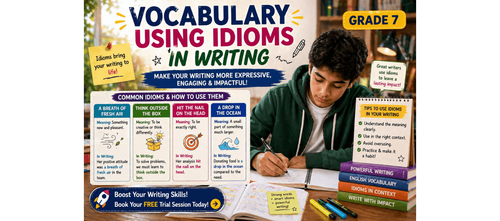

Grade 7 English Grammar Worksheet - Effectively Using Idioms in Writing
Idioms are a key part of the English language and can make your writing more vivid, interesting, and expressive. Whether you're describing a feeling, a situation, or even an action, idioms can convey a deeper meaning that regular language sometimes misses. In Grade 7, students are introduced to the concept of using idioms in writing. This worksheet will help you practice and master the art of using idiomatic expressions in various writing tasks.
Download these English grammar worksheets and practice regularly to strengthen your language skills and build a strong foundation. You can also book a free trial to get expert guidance and improve your reading, writing, and comprehension abilities. The worksheets are designed in a simple and structured way to help K–8 students learn grammar concepts easily and use them confidently in everyday communication. Book a free trial!
### What is the topic?
In this worksheet, the focus is on **using idioms in writing**. Idioms are phrases where the meaning cannot be understood from the individual meanings of the words. For example, "hit the sack" means to go to bed, not literally hitting a sack.
Students will learn how to incorporate idiomatic expressions into their writing to make their work more engaging. By practicing idioms, students not only enhance their vocabulary but also improve their ability to express themselves clearly and creatively. Understanding idioms is an essential skill for both writing and speaking in English.
### What’s in this worksheet?
This worksheet contains several exercises to help you understand and use idioms effectively in your writing:
1. **True or False**: Test your understanding of idioms and their correct usage.
2. **Sort the Words**: Match idioms to the corresponding situations to understand their meanings.
3. **Fill in the Blanks**: Complete idiomatic expressions by choosing the right words.
4. **Multiple Choice Questions**: Select the correct idiom to complete sentences based on context.
5. **Sentence Rewriting**: Use idioms to rewrite sentences, making them more creative and expressive.
By completing these exercises, students will develop a strong understanding of idiomatic expressions and how to use them correctly in various contexts.
### Definitions, examples, techniques, and tips
**Definitions**:
- **Idiom**: A group of words whose meaning is different from the meanings of the individual words. For example, "break the ice" means to start a conversation or make people feel more comfortable, not to literally break ice.
**Examples**:
- "Hit the sack" means to go to bed.
- "Blow off steam" means to release pent-up energy or emotion, typically through talking or physical activity.
- "Spill the beans" means to reveal a secret.
**Techniques**:
- To effectively use idioms in your writing, make sure they fit the context. Choose idioms that align with the emotion or action you are describing.
- Avoid overusing idioms in formal writing. They are more suited for informal and creative writing.
**Quick Learning Tip**:
To remember idioms, try to visualize the expression. For example, "on cloud nine" can be visualized as floating happily on a cloud.
### Why is it important to learn this?
Understanding and using idioms can significantly improve your writing by making it more engaging and expressive. Idioms can add color to your work, help convey emotions effectively, and make your writing feel more natural and less formal. They can also enhance your speaking skills, especially in casual conversations where idioms are commonly used.
In academic writing, while idioms should be used sparingly, they can help bring your points across in a more vivid way. For instance, saying "The news left me jumping out of my skin" is much more expressive than just stating "I was very surprised."
### Where will this knowledge help you?
**Exams**:
In exams, idiomatic expressions can help you stand out by showcasing your grasp of the English language. Using idioms correctly in writing tasks will make your responses more dynamic.
**Writing tasks**:
Idioms are an excellent tool for creative writing assignments. Whether you're writing a story, a letter, or even an essay, idioms can make your language more compelling.
**Class participation**:
When speaking in class, using idioms correctly can enhance your ability to communicate effectively. It will help you connect better with others, especially in informal settings.
### How to use this worksheet?
1. **Attempt independently first**: Read each question carefully and try to answer on your own.
2. **Review answers carefully**: Once you've finished, go through your answers to check for mistakes.
3. **Correct mistakes**: Identify where you went wrong and try to understand the correct usage.
4. **Practice regularly**: Idioms require practice to master. Make it a habit to incorporate them into your daily writing or speaking.
Remember, the solutions follow the exact worksheet order. Compare your answers with the provided solutions and make sure you understand each idiom's meaning and context.
### Important tips and tricks
1. **Common mistakes**: One of the most common mistakes when using idioms is misapplying them. Ensure that the idiom fits the context of the sentence.
2. **What examiners expect**: Examiners appreciate creativity but expect idioms to be used correctly. Misusing idioms will detract from your answer.
3. **How to score full marks**: Use idioms naturally, without forcing them into sentences. Make sure they fit the tone and context of the writing.
4. **How to approach activity-based or writing-based tasks**: If given a writing task that asks you to incorporate idioms, ensure that each idiom you use fits the theme of the writing.
### Complete Answer Key
#### Exercise 1 – True/False
1. False
2. True
3. True
4. False
5. False
6. True
7. False
8. True
9. False
10. False
#### Exercise 2 – Sort the situation into its matching idiom
- Nervous → Butterflies in my stomach
- Calm → Keep my cool
- Sadness → Down in the dumps
- Happiness → On cloud nine
- Fear → Frozen in place
- Surprise → Jump out of my skin
#### Exercise 3 – Choose the correct word from the pair to complete the idiom
1. Under the **mat**
2. Hit the **snooze button**
3. Keep my **cool**
4. Go the **distance**
5. Blow off the **steam**
6. Burn the **fire**
7. Let the cat **out**
8. Break the **ice**
9. Edge of my **seat**
10. Head in the **clouds**
#### Exercise 4 – Choose the correct option to complete the sentence
1. I was so excited, I felt like I had **butterflies** in my stomach.
2. After the long run, I had to **blow off steam**.
3. He was **on cloud nine** when he heard the news.
4. After the meeting, she decided to **keep her cool**.
5. The news was so shocking, he was **jumping out of his skin**.
#### Exercise 5 – Rewrite each sentence using idioms
1. He felt nervous before the exam, but he **kept his cool**.
2. She was extremely happy after hearing the good news. → She was **on cloud nine**.
3. He was so excited to meet his friends after a long time. → He was **jumping out of his skin**.
4. After the meeting, he felt so relieved and relaxed. → He **blew off steam**.
5. She was very sad when she heard about her friend's illness. → She was **down in the dumps**.
6. He worked really hard to finish his project before the deadline. → He **went the distance**.
7. After running for an hour, he was very tired. → He **hit the sack**.
8. She was completely focused during the presentation. → She was **on the edge of her seat**.
9. He was so surprised when he saw the gift. → He **jumped out of his skin**.
10. He felt very calm after meditating for 30 minutes. → He was **keeping his cool**.
### Conclusion
Using idioms in your writing can add flair and make your communication more interesting and expressive. By practicing these idioms in various exercises, you're not just learning new expressions—you're also improving your overall writing and speaking skills. Keep practicing, and soon you'll be able to use idioms naturally in any context.
Book a free trial!