
Class 7 Word Precision in Writing Contexts – Practice Worksheet
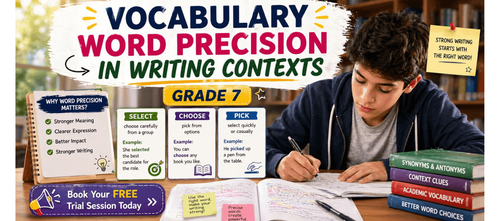

Vocabulary - Word Precision in Writing Contexts: English Grammar Worksheet for Grade 7
Precision in word choice plays a critical role in shaping clear and effective writing. This Grade 7 English grammar worksheet on word precision in writing contexts will help students understand how to use the right words to convey their message with accuracy. Whether in academic writing, storytelling, or everyday communication, choosing precise words ensures your writing is both engaging and effective.
Download these English grammar worksheets and practice regularly to strengthen your language skills and build a strong foundation. You can also book a free trial to get expert guidance and improve your reading, writing, and comprehension abilities. The worksheets are designed in a simple and structured way to help K–8 students learn grammar concepts easily and use them confidently in everyday communication. Book a free trial!
![Class 7 Vocabulary Worksheet on Precision in Word Choice [Free PDF].png](https://cdn5.planetspark.in/media/Class_7_Vocabulary_Worksheet_on_Precision_in_Word_Choice_Free_PDF_44d052da06.png)
## What is the topic?
This worksheet focuses on **word precision in writing contexts**. Students will learn the importance of choosing specific, clear, and accurate words to improve the effectiveness of their writing. By using the most appropriate vocabulary, students will reduce ambiguity and enhance the clarity of their writing.
The exercises are designed to help students practice selecting the most fitting word in different writing situations, ensuring that their writing is clear, detailed, and free from vague language.
## What’s in this worksheet?
This worksheet contains a variety of exercises that help students practice and reinforce the use of precise vocabulary in writing. The activities include:
1. **True or False:** Evaluate statements to determine whether the use of specific vocabulary is correct.
2. **Sort the Words:** Sort word pairs into precise and vague categories.
3. **Fill in the Blanks:** Complete sentences using precise vocabulary.
4. **Multiple Choice Questions:** Choose the most precise word for a given context.
5. **Sentence Rewriting:** Rewrite sentences using more precise vocabulary.
These activities allow students to practice identifying and using precise language in various contexts, which will enhance their writing skills.
## Definitions, examples, techniques, and tips
- **Word precision** refers to the use of specific, accurate, and clear words in writing, which improves communication and reduces vagueness.
- **Example:**
- **Vague vocabulary:** "The thing was big."
- **Precise vocabulary:** "The object was enormous."
- **Technique:** Focus on using specific nouns, verbs, and adjectives that clearly describe the action or object. For example, instead of using “help,” try “assist” in more formal writing.
- **Quick learning tip:** To practice precision, try replacing vague words with more specific alternatives. For example, replace “go” with “travel” or “move” depending on the context.
## Why is it important to learn this?
Using precise vocabulary is essential for creating clear, effective, and impactful writing. It ensures that readers understand your message exactly as intended, without any confusion or ambiguity.
- **Writing:** Precision helps make your writing more engaging and informative, especially when presenting arguments or describing complex ideas.
- **Reading comprehension:** Recognizing precise language helps students understand texts more easily and accurately.
- **Professional communication:** In both academic and professional settings, using precise vocabulary demonstrates a high level of communication skill.
This skill is particularly important in exams, where clarity and specificity in writing can make a significant difference in grades.
## Where will this knowledge help you?
Knowledge of word precision will help students in various academic and real-world applications:
- **Exams:** Precise vocabulary is essential in essay writing and reading comprehension sections of exams.
- **Writing tasks:** Whether writing stories, essays, or reports, choosing the right words will make your writing more convincing and clear.
- **Class participation:** Clear and precise language helps in both verbal and written class activities, including presentations and debates.
## How to use this worksheet?
Here’s how to make the most out of this worksheet:
1. **Attempt independently first:** Try solving the exercises on your own to gauge your current understanding of word precision.
2. **Review answers carefully:** After completing the exercises, compare your answers with the answer key to understand your mistakes.
3. **Correct mistakes:** If you used vague vocabulary, replace it with more specific terms in your corrected answers.
4. **Practice regularly:** Revisit the exercises to strengthen your understanding of using precise vocabulary in writing.
The solutions follow the exact worksheet order, so compare your answers carefully to enhance your learning.
## Important tips and tricks
Here are some key tips to master word precision:
1. **Common mistakes:** Often, students use vague words like "thing" or "stuff" instead of more specific terms like "object" or "material." Avoid these general terms in academic or formal writing.
2. **What examiners expect:** In exams, examiners expect students to use precise vocabulary that fits the context and conveys the message clearly. Using vague words can lead to loss of marks.
3. **How to score full marks:** To achieve high marks, ensure your vocabulary is specific, clear, and appropriate for the context. Avoid overusing common words that can be replaced with more precise terms.
4. **Approaching activity-based tasks:** When asked to rewrite sentences, think about the context and choose the most fitting word to replace vague or general terms.
## Complete Answer Key
**Exercise No. 1 - True or False**
1. True
2. False
3. True
4. True
5. False
6. False
7. True
8. False
9. False
10. True
**Exercise No. 2 - Sort the word pairs into vague and precise**
- **Vague:**
- Thing/Object
- Stuff/Materials
- Bad/Poor
- Go/Travel
- Big/Enormous
- Make/Create
- Walk/Stroll
- **Precise:**
- Ask/Inquire
- Work/Operate
- Same/Similar
- Help/Assist
- Look/Glance
- Smart/Intelligent
- Call/Contact
**Exercise No. 3 - Choose the precise word from the pair**
1. Things/Materials
2. Clutter/Object
3. Form/Create
4. Roam/Travel
5. Filthy/Poor
6. Push/Assist
7. Position/Operate
8. Fair/Excellent
9. Spend/Purchase
10. Assist/Inquire
**Exercise No. 4 - Choose the correct option to complete the sentence**
1. Assist
2. Inquire
3. Create
4. Help
5. Purchase
6. Present
7. Create
8. Perform
9. Support
10. Create
**Exercise No. 5 - Rewrite the sentence using precise vocabulary**
1. He made an object for the project.
2. She went to the marketplace.
3. He operated on the task efficiently.
4. They asked questions during the discussion.
5. He purchased materials for the task.
6. She assisted with the research.
7. They completed the task efficiently.
8. They created the report after the meeting.
9. She operated the device efficiently.
10. He created a new design for the presentation.
Book a free trial!