
Class 7 Worksheet on High-Level Grammar Errors [Free PDF]
![Class 7 Worksheet on High-Level Grammar Errors [Free PDF]](https://cdn5.planetspark.in/media/small_Class_7_Worksheet_on_Identifying_High_Level_Errors_d9a689dd56.png)

Mastering Identifying High-Level Errors in Text: English Grammar Worksheet for Grade 7 Students
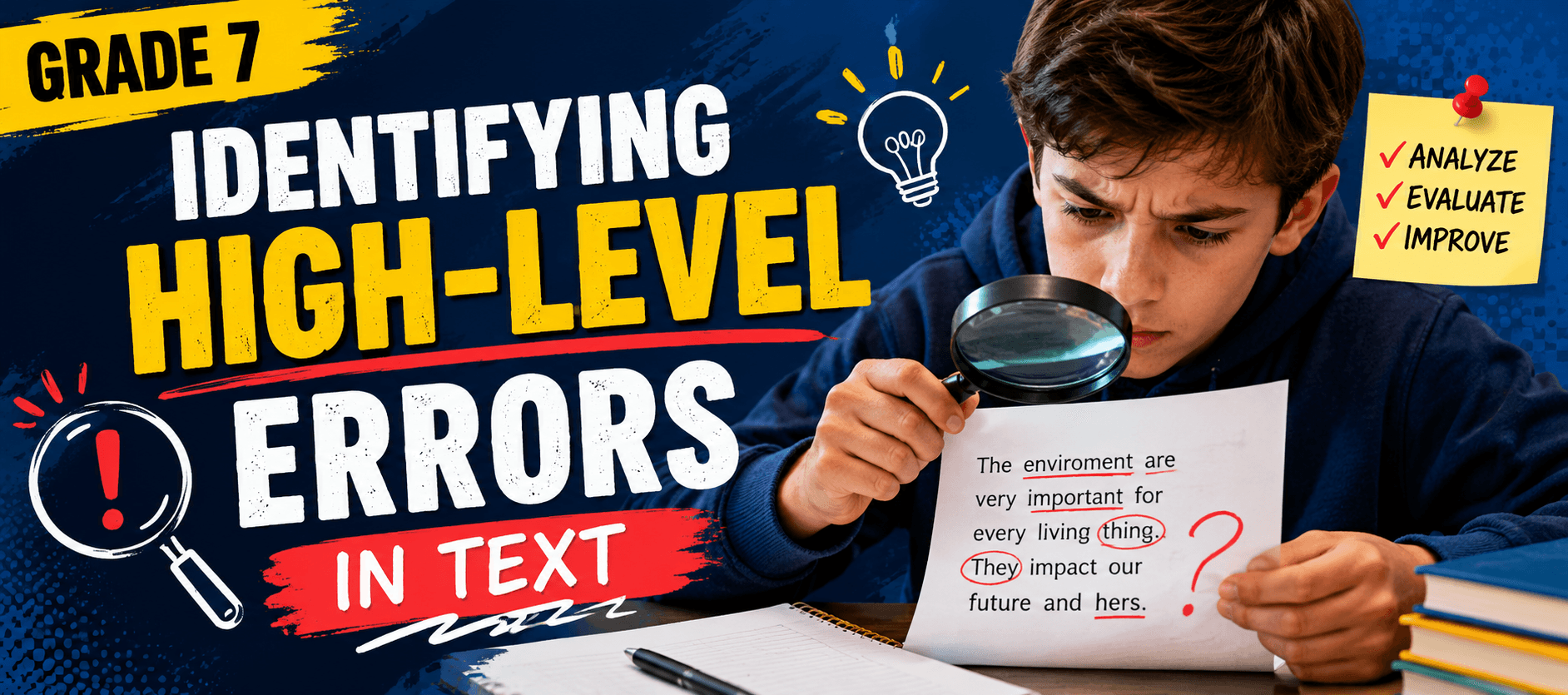
Understanding grammar mistakes and improving sentence clarity are important skills for every student. This Grade 7 English grammar worksheet on Identifying High-Level Errors in Text helps students learn how to spot common mistakes in sentences and improve their overall language accuracy. Students often make errors related to subject-verb agreement, grammar, punctuation, spelling, and word order. Learning to identify these mistakes helps build stronger writing and speaking skills.
This English grammar worksheet for Grade 7 gives students practice through multiple-choice questions, fill in the blanks, true and false statements, underlining errors, and sentence rewriting activities. The exercises encourage students to carefully read sentences and identify different types of language errors. By practicing regularly, students can become more confident in editing and improving written text.
Download these English grammar worksheets and practice regularly to strengthen your language skills and build a strong foundation. You can also book a free trial to get expert guidance and improve your reading, writing, and comprehension abilities. The worksheets are designed in a simple and structured way to help K–8 students learn grammar concepts easily and use them confidently in everyday communication. Book a free trial!
What Is the Topic?
Identifying High-Level Errors in Text is an important grammar topic that helps students recognize mistakes in written sentences. In this Grade 7 English grammar worksheet, students learn to identify problems related to subject-verb agreement, grammar, punctuation, spelling, structure, clarity, and word order.
The worksheet focuses on understanding how incorrect sentence construction can affect meaning and readability. Students are expected to learn how to detect errors, understand why they are incorrect, and improve sentence clarity through editing and rewriting activities.
The topic also helps students become more careful readers and writers. By practicing error identification, students learn how proper grammar and sentence structure improve communication.
What’s in This Worksheet?
1. Multiple Choice Questions
Students identify the type of error in different sentences. The options include subject-verb agreement, grammar, spelling, punctuation, meaning, and word order.
2. Fill in the Blanks
Students complete sentences using words from a word bank. This activity strengthens understanding of grammar-related terms.
3. True and False
Students read statements related to grammar and sentence structure and decide whether they are true or false.
4. Underline the Words
Students underline the incorrect words in sentences. This helps improve error detection skills.
5. Sentence Writing
Students rewrite sentences by editing grammar, clarity, or punctuation mistakes.
6. Grammar Skills Practice
The worksheet supports practice in identifying grammatical structure, correcting errors, and improving sentence clarity.
7. Exam Preparation Support
These exercises help students prepare for grammar-based school assessments and improve editing skills.
Definitions, Examples, Techniques, and Tips
Definitions
Subject-Verb Agreement
This refers to ensuring the subject and verb match in form.
Grammar
Grammar is the rule governing sentence construction.
Clarity
Clarity improves the clarity of the sentence.
Editing
Editing refers to fixing punctuation mistakes.
Structure
Structure ensures proper grammatical structure.
Spelling
Spelling occurs when words are misspelled.
Examples
“She don’t like to play soccer.”
This sentence includes a subject-verb agreement error.
“They was playing at the park yesterday.”
This sentence contains a subject-verb agreement problem.
“Running down the street, the car nearly hit him.”
This sentence includes a meaning-related issue.
“The teacher were happy with the results.”
This sentence contains a grammar error related to subject-verb agreement.
“He was quickly running to the store.”
This sentence focuses on word order and grammar.
Quick Learning Tips
1. Read sentences carefully before choosing the error type.
2. Pay attention to whether the subject and verb agree.
3. Look for incorrect word order or punctuation mistakes.
4. Check whether the sentence meaning is clear.
5. Practice rewriting incorrect sentences to improve editing skills.
Why Is It Important to Learn This?
Learning to identify high-level errors in text is important because grammar mistakes can change sentence meaning and reduce clarity. Students who understand grammar rules can communicate ideas more clearly in both speaking and writing.
This topic also helps students become better editors. By identifying problems in sentence structure, punctuation, and grammar, students learn how to improve the quality of their work.
Strong grammar skills are useful in school assignments, tests, classroom writing, and daily communication. Practicing these skills regularly helps students gain confidence and accuracy.
Where Will This Knowledge Help You?
Students can use these grammar skills in many situations.
1. School Exams
Grammar and editing questions are common in English assessments.
2. Writing Tasks
Students can improve essays, paragraphs, and assignments by correcting errors.
3. Reading Activities
Understanding sentence structure helps students read more carefully and identify mistakes.
4. Classroom Participation
Students become more confident while answering grammar questions in class.
5. Everyday Communication
Correct grammar improves both written and spoken communication.
How to Use This Worksheet?
1. Read each question carefully before answering.
2. Attempt all exercises independently first.
3. Follow the worksheet order while solving the activities.
4. Compare your responses carefully with the solutions.
5. Review grammar mistakes and understand the correct structure.
6. Practice rewriting incorrect sentences regularly.
7. Use the multiple-choice and true-false exercises to strengthen grammar understanding.
8. The solutions follow the exact worksheet order, so students should compare answers carefully.
Important Tips and Tricks
1. Always check whether the subject and verb agree in number.
2. Read sentences slowly to identify spelling and punctuation mistakes.
3. Word order errors can make sentences unclear, so focus on sentence arrangement.
4. Grammar errors are important in all forms of writing, not only formal writing.
5. Underline the incorrect part of the sentence before rewriting it.
6. In rewriting activities, improve grammar, punctuation, and clarity carefully.
7. Multiple-choice questions often test understanding of grammar categories, so read all options before choosing.
8. Practice identifying common errors like “don’t” instead of “doesn’t” or “was” instead of “were.”
9. Improve sentence clarity by checking meaning and structure together.
10. Regular editing practice helps students score better in grammar exercises and exams.
Complete Answer Key
Exercise No. 1
Identify and Choose the error in given sentence.
1. She don’t like to play soccer.
a) Subject-Verb Agreement
2. She can’t go to the party because she is sick.
a) No Error
3. Running down the street, the car nearly hit him.
c) Meaning
4. The teacher were happy with the results.
a) Subject-Verb Agreement
5. They was playing at the park yesterday.
a) Subject-Verb Agreement
6. He can do better in school, but he doesn't try.
b) Grammar
7. She don’t know how to swim.
a) Subject-Verb Agreement
8. He was quickly running to the store.
a) Word Order
9. They doesn’t have the answer.
a) Subject-Verb Agreement
10. The boy was playing soccer, he didn't knew the rules.
b) Verb tense
Exercise No. 2
Fill in the blanks with the correct word from the bank.
1. Subject-Verb Agreement
2. Errors
3. Spelling
4. Grammar
5. Structure
6. Clarity
7. Subject-Verb Agreement
8. Grammar
9. Editing
10. Structure
Exercise No. 3
Tick the box True if the statement is correct or false if not.
1. Subject-verb agreement is important in English.
True
2. Spelling mistakes are more important than grammar errors.
False
3. Word choice errors make sentences unclear.
True
4. Grammar errors affect the meaning of the sentence.
True
5. Word order errors affect sentence clarity.
True
6. Spelling errors are easy to identify.
True
7. Word choice issues are harder to detect.
True
8. Grammar mistakes are only important in formal writing.
False
9. Subject-verb agreement errors are common.
True
10. Structural errors make the text difficult to follow.
True
Exercise No. 4
Underline the errors in each sentence.
1. She don't like coffee.
2. The teacher were upset.
3. He can't find his books.
4. They was late for class.
5. She can’t plays the piano.
6. Is this the correct way to do it?
7. She don’t have the right answer.
8. He run to the bus every day.
9. They don’t care about the homework.
10. She can’t to swim.
Exercise No. 5
Rewrite the sentence by editting to improve clarity, grammar, or punctuation.
1. He runs fast.
2. They were going to the store.
3. He doesn’t know the answer.
4. She has a nice bike.
5. We were planning to go to the beach.
6. She doesn’t want to go.
7. They are playing football.
8. He was at the park.
9. He likes soccer, but he doesn’t play it often.
10. Answers may vary..
Practicing this Grade 7 English grammar worksheet on Identifying High-Level Errors in Text can help students become more confident in spotting and correcting mistakes. Regular practice improves grammar understanding, sentence clarity, and editing skills. By carefully completing activities like multiple-choice questions, fill in the blanks, true and false statements, underlining errors, and sentence rewriting, students can strengthen their language abilities and perform better in school tasks and exams.
Book a free trial!