
Class 8 Grammar Worksheet: Narrative Grammar Practice

Build Strong Storytelling Skills with This Grade 8 English Grammar Worksheet on Grammar in Narrative Composition
Stories become more interesting when they use strong grammar, descriptive words, emotions, and meaningful details. Narrative writing helps students express ideas clearly while making their stories engaging and creative. This Grade 8 English grammar worksheet on Grammar in Narrative Composition gives students an excellent opportunity to improve their grammar skills through fun and structured narrative-based exercises.
In this worksheet, students practice choosing suitable words, completing narrative sentences, identifying descriptive language, and writing short narrative sentences. The activities are designed to help Grade 8 learners understand how grammar supports storytelling and improves communication. By solving these exercises, students learn how to make narratives more descriptive, suspenseful, meaningful, and expressive.
Download these English grammar worksheets and practice regularly to strengthen your language skills and build a strong foundation. You can also book a free trial to get expert guidance and improve your reading, writing, and comprehension abilities. The worksheets are designed in a simple and structured way to help K–8 students learn grammar concepts easily and use them confidently in everyday communication.
What Is the Topic?
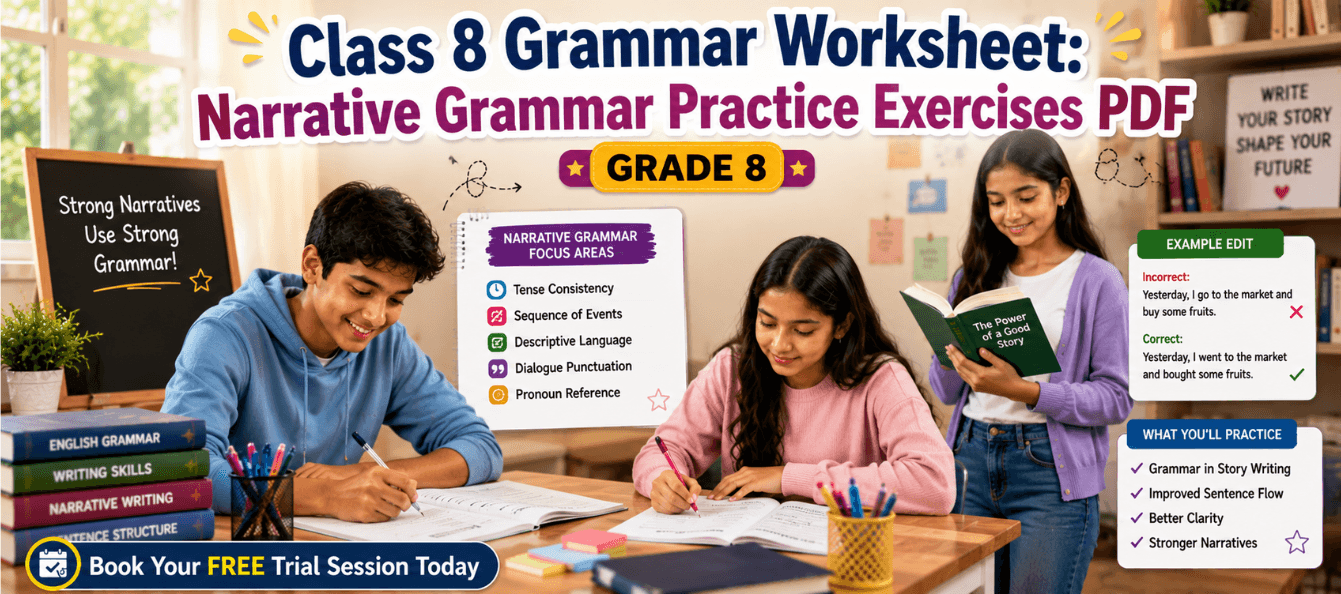
Grammar in Narrative Composition focuses on using grammar correctly while writing stories and descriptive passages. In narrative writing, students learn how to build scenes, describe characters, create emotions, and make stories more interesting using suitable vocabulary and sentence structures.
This Grade 8 English grammar worksheet helps students understand how descriptive words, dialogue, emotions, settings, and narrative details improve storytelling. Students are expected to learn how to choose appropriate words, identify descriptive language, complete narrative-based sentences, and create meaningful narrative sentences of their own.
The worksheet also encourages students to notice how words like suspenseful, meaningful, mysterious, crowded, and whispering help create mood and atmosphere in stories. Through regular practice, students become more confident in writing clear and engaging narratives.
What’s in This Worksheet?
1. Multiple Choice Questions
Students complete narrative sentences by selecting the most suitable descriptive word from the given options.
2. Fill in the Blanks
Students use a word bank to complete narrative sentences correctly.
3. True and False
Students read narrative-related statements and identify whether each statement is true or false.
4. Underline the Words
Students identify descriptive words used in narrative sentences.
5. Sentence Writing
Students write clear narrative sentences based on given prompts.
6. Vocabulary Development
The worksheet introduces descriptive and narrative-related vocabulary such as mysterious, suspenseful, memorable, heartening, adventurous, and whispering.
7. Narrative Grammar Practice
Students practice grammar skills connected to storytelling, sentence structure, emotions, and descriptive writing.
8. Exam-Oriented Learning
The exercises help students prepare for school grammar tests, narrative writing activities, and classroom assignments.
Definitions, Examples, Techniques, and Tips
Narrative Composition
Narrative composition is a form of writing that tells a story using characters, settings, emotions, and events.
Descriptive Words
Descriptive words help readers imagine scenes clearly. Words such as mysterious, colourful, dusty, playful, crowded, and whispering make sentences more vivid.
Dialogue in Narratives
Dialogue helps show conversations and emotions in stories. The worksheet includes prompts that encourage students to include dialogue in narrative sentences.
Building Mood and Atmosphere
Narrative writing often uses weather, emotions, and descriptive details to create mood. Sentences about monsoon, rainy evenings, shadows, and dark tunnels help students understand this technique.
Using Narrative Vocabulary
The worksheet introduces words such as suspenseful, meaningful, adventurous, fearlessly, and heartening. These words improve the quality of storytelling.
Sentence Formation Practice
Students practice writing short narrative sentences using prompts like campfire, lantern, midnight, whisper, and journey.
Identifying Descriptive Language
The underline-the-words section helps students recognize descriptive adjectives within sentences.
True and False Understanding
Students learn important narrative concepts such as the role of characters, conflict, setting, dialogue, emotions, and tense usage.
Why Is It Important to Learn This?
Learning grammar in narrative composition helps students become stronger writers and communicators. Narrative grammar improves sentence clarity, storytelling ability, and vocabulary usage.
This topic also helps students:
- Express ideas creatively
- Describe scenes more clearly
- Use suitable words in storytelling
- Improve writing confidence
- Understand emotions and mood in stories
Narrative grammar is useful because stories are an important part of school writing tasks. Students often write personal experiences, imaginative stories, and descriptive paragraphs in exams and classroom activities. Strong grammar makes these narratives more effective and enjoyable to read.
Understanding descriptive words and sentence structure also helps students improve reading comprehension and speaking skills. Students become more confident while participating in class discussions, creative writing activities, and presentations.
Where Will This Knowledge Help You?
Students can use narrative grammar skills in many academic and practical situations.
1. School Exams
Narrative writing questions are common in English grammar and composition exams.
2. Creative Writing Tasks
Students can write better stories, paragraphs, and descriptive essays.
3. Classroom Activities
Narrative grammar helps students participate confidently in storytelling and speaking exercises.
4. Vocabulary Improvement
Learning descriptive words improves overall language skills.
5. Reading Comprehension
Students understand stories more effectively when they recognize mood, setting, and descriptive language.
6. Daily Communication
Narrative skills help students explain experiences, events, and ideas clearly.
7. Writing Competitions
Strong storytelling grammar supports performance in essay writing and creative writing competitions.
How to Use This Worksheet?
1. Read Every Question Carefully
Understand each narrative sentence before selecting or writing an answer.
2. Attempt the Worksheet Independently
Try solving all sections on your own before checking answers.
3. Use Context Clues
Look for words and ideas in the sentence that help identify the correct answer.
4. Review Descriptive Words
Pay attention to adjectives and mood-building words used in the exercises.
5. Practice Sentence Writing Regularly
Use the prompts to create meaningful and grammatically correct narrative sentences.
6. Compare Answers Carefully
The solutions follow the exact worksheet order, so students should compare answers carefully.
7. Correct Mistakes
Review incorrect answers and understand why another word fits better in the sentence.
8. Revise Frequently
Regular grammar practice improves storytelling confidence and writing quality.
Important Tips and Tricks
1. Focus on Descriptive Words
Words like mysterious, whispering, crowded, and suspenseful make narratives more interesting.
2. Understand the Mood of the Sentence
Choose words that match the emotion or atmosphere of the narrative.
3. Read the Entire Sentence First
Reading carefully helps identify the most suitable word or phrase.
4. Avoid Random Word Choices
Each word should fit the meaning of the narrative sentence properly.
5. Practice Vocabulary
Narrative writing becomes stronger when students know more descriptive words.
6. Use Clear Sentences
While writing narrative sentences, students should keep sentences meaningful and easy to understand.
7. Pay Attention to Grammar
Correct sentence structure improves clarity and readability.
8. Identify Descriptive Adjectives
Exercises that ask students to underline words usually focus on adjectives or descriptive language.
9. Understand Narrative Features
Narratives often include characters, emotions, settings, dialogue, and conflict.
10. Attempt Writing Tasks Creatively
For sentence-writing activities, students should write meaningful and grammatically correct responses.
Complete Answer Key
Exercise No. 1
1. uncertain
2. mysterious
3. thoughtful
4. descriptive
5. whispering
6. memorable
7. crowded
8. lengthening
9. waterproof
10. satisfying
Exercise No. 2
1. flashbacks
2. suspenseful
3. meaningful
4. fearlessly
5. heartening
6. reluctantly
7. friendships
8. carefully
9. misfortune
10. adventurous
Exercise No. 3
1. True
2. False
3. True
4. True
5. False
6. False
7. True
8. False
9. True
10. False
Exercise No. 4
1. heavy
2. dusty
3. colourful
4. tired
5. bright
6. crowded
7. noisy
8. clean
9. playful
10. rainy
Exercise No. 5
1. The monsoon brought heavy rain to the village.
2. “Did you hear that sound?” Riya whisper asked nervously.
3. The school festival was filled with music, dance, and colourful decorations.
4. Their journey through the forest became more exciting at night.
5. The old lantern glowed brightly in the dark room.
6. At midnight, the streets became silent and empty.
7. The campfire crackled loudly as the children sang songs around it.
8. The brave traveler crossed the river during the storm.
9. “We must leave before sunset,” said Ravi to his friends.
10. The rainy evening made the entire town look calm and peaceful.
This Grade 8 English grammar worksheet on Grammar in Narrative Composition is a helpful resource for improving storytelling grammar, descriptive writing, and sentence-building skills. By practicing these narrative exercises regularly, students can become more confident writers and communicators. The activities support vocabulary growth, creative thinking, and stronger grammar understanding, making narrative writing easier and more enjoyable for Grade 8 learners.