
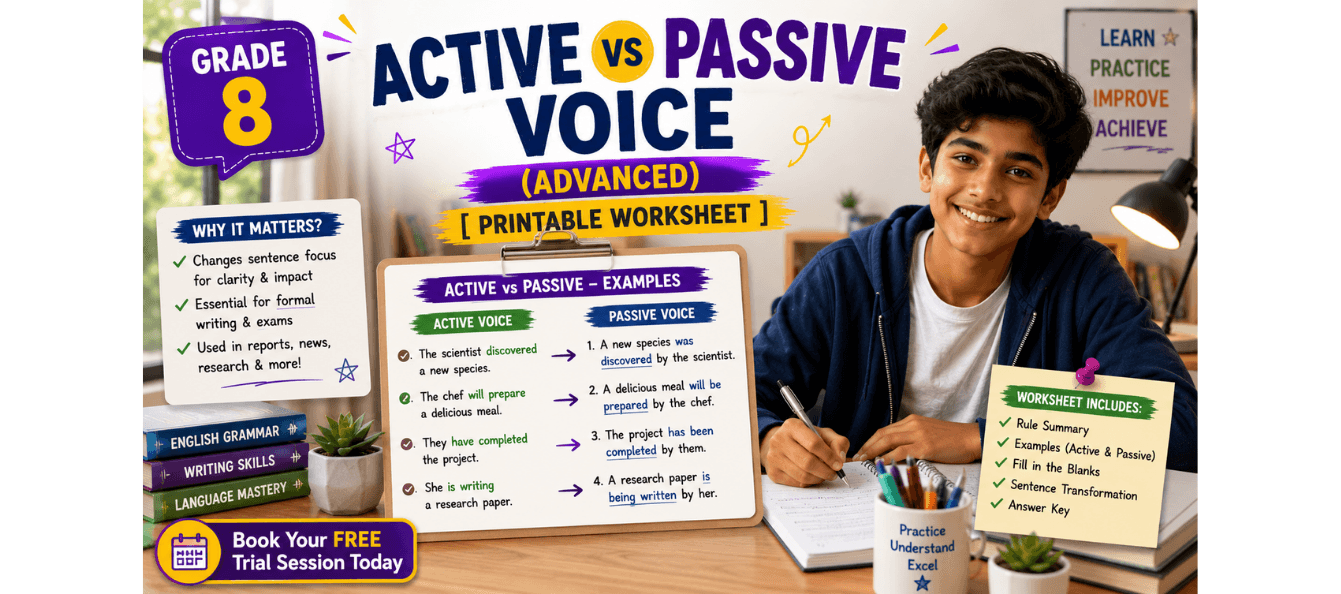
Grade 8 Active vs Passive Voice (Advanced) [Printable Worksheet]
![Grade 8 Active vs Passive Voice (Advanced) [Printable Worksheet]](https://cdn5.planetspark.in/media/small_5_133438c9a6.png)

Grade 8 English Grammar Worksheet on Active vs Passive Voice (Advanced)
Have you ever read a science textbook and noticed how the sentences sound different from everyday speech? You might read "The experiment was conducted by researchers" instead of "Researchers conducted the experiment." Both sentences describe the same event, but they use different voices. Understanding the difference between active and passive voice is one of the most important grammar skills in Grade 8, and it directly affects how clearly you communicate in writing. This blog will guide you through the complete concept of active and passive voice and share a carefully designed advanced worksheet by Archita Srivastava covering multiple choice questions, fill in the blanks, true and false, agent and verb identification, and sentence writing.
Download these English grammar worksheets and practice regularly to strengthen your language skills and build a strong foundation. You can also book a free trial to get expert guidance and improve your reading, writing, and comprehension abilities. The worksheets are designed in a simple and structured way to help K–8 students learn grammar concepts easily and use them confidently in everyday communication.
What Is Active vs Passive Voice?
Active and passive voice are two different ways of constructing a sentence. The choice depends on what you want to emphasise and the tone you set.
In active voice, the subject performs the action. The doer comes first, followed by the verb and the receiver. For example, "The teacher explained the chapter" is in active voice because "the teacher" performs the action. Active voice is direct, energetic, and easy to understand. It is preferred for most writing because it makes sentences shorter and clearer.
In passive voice, the focus shifts to the receiver. The subject receives the action instead of performing it. The structure uses a form of "to be" followed by a past participle. For example, "The chapter was explained by the teacher" is passive because "the chapter" receives the action. Passive voice is useful when the doer is unknown, unimportant, or obvious.
Knowing when to use each voice is a mark of advanced writing skill, and this worksheet is designed to challenge your understanding of both voices.
What's in This Worksheet?
This Grade 8 English grammar worksheet by Archita Srivastava includes five carefully designed exercises that test every aspect of your understanding of active and passive voice:
1. Multiple choice questions that test your conceptual knowledge of active and passive voice, including the focus of passive voice, the types of verbs used in passive sentences, identification of correct passive forms, and the role of subjects and receivers.
2. Fill in the blanks exercise with a word bank of past participle verbs such as maintained, inaugurated, discovered, demolished, recognised, celebrated, performed, constructed, investigated, and appreciated, challenging you to select the correct verb for each passive sentence.
3. True and false statements that check your conceptual clarity about the rules, advantages, and limitations of active and passive voice, including when each voice is preferred, common misconceptions, and tense accuracy.
4. Underline the agent and circle the main verb exercise that builds your analytical reading skills by asking you to identify the agent (the doer of the action) and the main verb (the past participle) within passive sentences.
5. Sentence writing tasks where you convert between active and passive voice on a variety of topics including letters, cricket, school events, forts, monsoons, festivals, train journeys, village life, and school assemblies.
Definitions, Examples, Techniques, and Tips
The subject in an active voice sentence is the performer. For example, in "Aarav submitted the project on time," the subject "Aarav" is doing the action. The verb follows the subject, and the object receives the action. Active sentences are straightforward and dynamic.
The subject in a passive voice sentence is the receiver. For example, in "The project was submitted by Aarav," the subject "the project" receives the action. The passive structure uses a form of the auxiliary verb "be" combined with a past participle. The doer is introduced using "by" and is called the agent.
The agent in a passive sentence is the person or thing that performs the action. In "The homework was done by Anjali," the agent is "Anjali." Not all passive sentences include an agent. In "The trees were planted on that day," there is no agent mentioned because the focus is purely on the action and not on who performed it.
A simple technique for converting active to passive is to move the object of the active sentence to the subject position, use the appropriate form of "be" matching the tense, add the past participle of the main verb, and optionally add "by" followed by the original subject. For example, "Rahul wrote a letter" becomes "A letter was written by Rahul."
A useful technique for converting passive to active is to identify the agent after "by" and make it the subject, then use the appropriate form of the original verb. For example, "The cake was baked by Nisha" becomes "Nisha baked the cake." If there is no agent, you may need to supply a general subject such as "someone" or "they."
Why Is It Important to Learn This?
Learning to distinguish between active and passive voice is essential for several reasons. First, it is one of the most frequently tested topics in Grade 8 English grammar examinations, and a strong command of this topic helps you secure marks consistently.
Second, choosing the right voice makes your writing clearer. Active voice is direct and engaging, while passive voice shifts focus appropriately. Knowing when to use each voice separates good writers from excellent writers.
Third, understanding voice is critical for reading comprehension. Science textbooks, news reports, and formal documents contain many passive sentences, and recognising voice helps you understand who is doing what.
Fourth, this knowledge builds a foundation for advanced grammar topics such as reported speech, sentence transformation, and complex sentence structures.
Where Will This Knowledge Help You?
This knowledge will help you across many areas of your academic life and beyond. In school, every English grammar exam includes questions on active and passive voice, and this worksheet targets the types that appear most frequently in Grade 8 assessments.
In reading comprehension, passages often mix both voices. Identifying which voice is used helps you extract key information faster and answer questions more accurately.
In writing assignments, whether you are writing a story, an essay, or a science report, choosing the right voice makes your writing more professional. Stories benefit from active voice, while science reports often require passive voice.
In competitive exams such as Olympiads and entrance tests, voice is a recurring topic. Questions on sentence transformation and error detection frequently test your understanding.
In daily communication, knowing how to use both voices makes your emails, presentations, and descriptions more polished and adaptable.
How to Use This Worksheet?
Follow these simple steps to get the most out of this worksheet:
1. Read through the definitions and explanations above so that you understand the basic rules of active and passive voice before you begin.
2. Start with the multiple choice questions. Read each question carefully, think about the rules of voice, and choose the best option.
3. Move on to the fill in the blanks. Use the word bank provided and think about which past participle best fits the meaning and context of each passive sentence.
4. Attempt the true and false exercise next. Read each statement and decide whether it is correct or incorrect based on your understanding of active and passive voice rules.
5. For the agent and verb identification exercise, read each passive sentence carefully, underline the agent (the doer after "by"), and circle the main verb (the past participle). Some sentences may not have an agent.
6. Complete the sentence writing tasks last. Convert between active and passive voice on the given topics, paying attention to correct verb forms, tenses, and sentence structure.
7. After finishing all exercises, check your answers using the complete answer key provided at the end of this blog.
8. Review any mistakes you made and try to understand why the correct answer is right. This is the most important step for long-term learning.
Important Tips and Tricks
Here are some tips and tricks to remember when working with active and passive voice:
1. In passive voice, always look for a form of "be" (am, is, are, was, were, been, being) followed by a past participle. This combination is the clearest signal that a sentence is in passive voice.
2. Active voice is generally preferred for directness and clarity. If a sentence sounds wordy or unclear, try converting it to active voice by identifying the agent and making it the subject.
3. Not every passive sentence has an agent. If the doer is unknown, unimportant, or obvious from context, the "by" phrase is often omitted. For example, "The match was abandoned after rain" does not mention who abandoned it.
4. When converting between voices, pay close attention to the tense. The tense must remain the same. If the original sentence is in past simple passive, the active version must also be in past simple active.
5. Watch out for tense errors in passive sentences. A common mistake is mixing present and past tense markers. For example, "The match is won by our team yesterday" is incorrect because "is" (present) does not match "yesterday" (past). It should be "was won."
6. In true or false questions, pay close attention to absolute words like "always" or "never." These absolutes often signal a false statement because grammar rules usually have exceptions.
7. Passive voice is not wrong. It is a legitimate and necessary tool in English, especially in science writing, formal reports, and situations where the receiver of the action is more important than the doer.
8. Practice converting sentences back and forth between active and passive voice regularly. The more you practise, the faster and more accurately you will be able to identify and use both voices.
Complete Answer Key
Exercise 1 – Multiple Choice Questions
1. b) receiver
2. a) decorated
3. c) directness
4. a) constructed
5. b) auxiliary
6. c) abandoned
7. a) recipient
8. b) appreciated
9. c) performer
10. a) distributed
Exercise 2 – Fill in the Blanks
1. constructed
2. discovered
3. appreciated
4. celebrated
5. demolished
6. inaugurated
7. investigated
8. performed
9. maintained
10. recognised
Exercise 3 – True or False
1. True
2. False
3. True
4. False
5. True
6. False
7. False
8. True
9. True
10. False
Exercise 4 – Underline the Agent and Circle the Main Verb
1. Underline: by Anjali | Circle: done
2. Underline: by Aarav | Circle: read
3. Underline: by our team | Circle: won
4. Underline: by Rohan | Circle: sent
5. Underline: by the artist | Circle: given
6. Underline: by Nisha | Circle: baked
7. Underline: by a musician | Circle: made
8. Underline: on that day | Circle: planted
9. Underline: on Monday | Circle: sent
10. Underline: by the principal | Circle: given
Exercise 5 – Rewritten Sentences
Answers may vary.
1. A letter was written by Rahul to his grandfather last week.
2. The annual day celebration was organised by the students and teachers with great enthusiasm.
3. The batsman hit a six over the boundary in the final over of the cricket match.
4. The old machine was used by the factory workers until it broke down completely.
5. The ancient fort was built by the kings of Jaipur several centuries ago.
6. The fields were flooded by heavy monsoon rains that lasted for three continuous days.
7. People across India celebrate the festival of lights by lighting diyas and sharing sweets.
8. The train was delayed by two hours due to heavy fog on the railway tracks.
9. The village market is visited by hundreds of people every Sunday for fresh vegetables and fruits.
10. The school captain addressed the assembly and reminded everyone about the upcoming sports day.
Mastering active and passive voice is a skill that will serve you throughout your academic career. Whether you are writing a science report that requires passive voice, crafting a story that demands active voice, or simply expressing yourself more clearly, understanding both voices gives you greater control over your language. This advanced worksheet by Archita Srivastava provides Grade 8 students with a thorough practice session covering every dimension of active and passive voice, from recognising voice in multiple choice format to converting sentences on diverse and engaging topics. Work through each exercise carefully, review your answers, and keep practising until switching between voices becomes second nature. Strong grammar is the backbone of confident communication.