
Grade 8 Advanced Phrases (Participial, Gerund, Infinitive) [Free PDF]
![Grade 8 Advanced Phrases (Participial, Gerund, Infinitive) [Free PDF]](https://cdn5.planetspark.in/media/small_15_55fe321a71.png)

Grade 8 English Grammar Worksheet on Advanced Phrases — Participial, Gerund, and Infinitive Phrases
Have you ever noticed how some words in a sentence act like verbs but do not actually behave like main verbs? These special verb forms are called verbals, and they create what we know as phrases. In Grade 8, students explore three important types of advanced phrases: participial phrases, gerund phrases, and infinitive phrases. Understanding these phrases will completely change the way you read and write English sentences, making your communication much more precise and expressive.
Download these English grammar worksheets and practice regularly to strengthen your language skills and build a strong foundation. You can also book a free trial to get expert guidance and improve your reading, writing, and comprehension abilities. The worksheets are designed in a simple and structured way to help K–8 students learn grammar concepts easily and use them confidently in everyday communication.
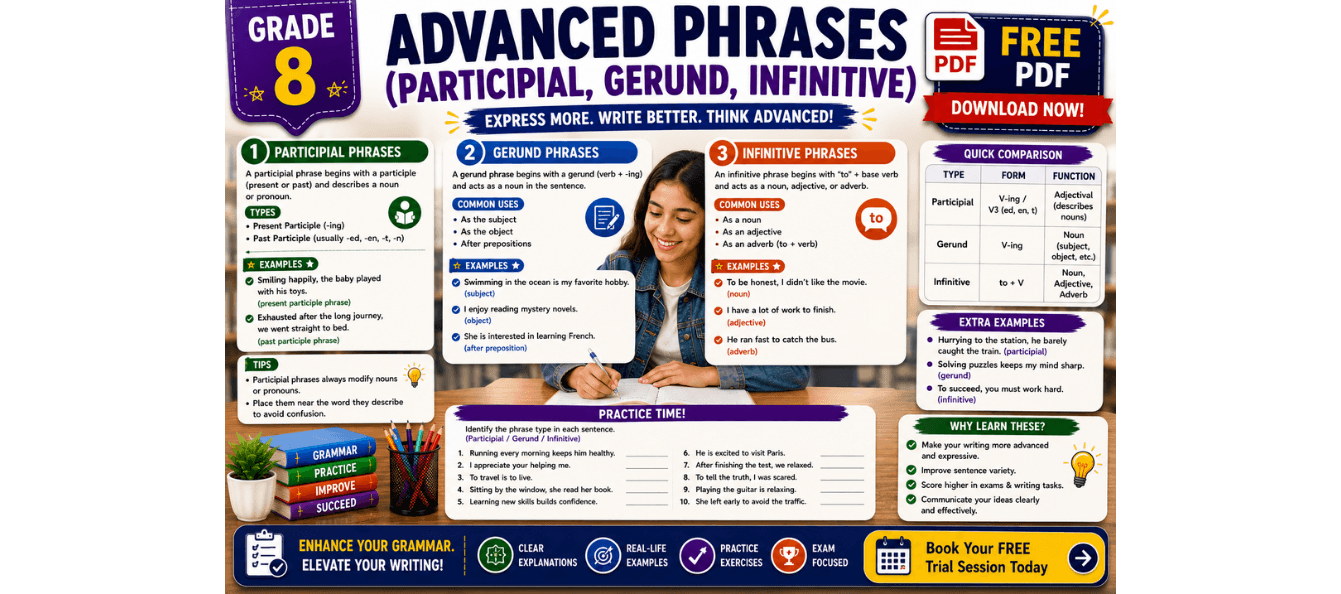
What Is the Topic?
Advanced phrases are groups of words that include a verbal — a word formed from a verb but used in a different role. There are three main types of advanced phrases that Grade 8 students learn:
A participial phrase contains a present or past participle along with its related words. A participle is a verb form that can function as an adjective in sentences. For example, in the phrase "the crying baby," the word "crying" is a participle because it describes the baby. Participles modify nouns in a manner like adjectives do. Perfect participles use having plus the past participle, such as "having finished" or "having done."
A gerund phrase contains a gerund along with any related words. A gerund is a verb form ending in -ing that functions as a noun in the sentence. For example, in "Swimming in the river is fun," the word "swimming" is a gerund because it acts as the subject of the sentence. Gerunds and infinitives can both function as complement in a sentence.
An infinitive phrase begins with the word "to" followed by a base verb. The word "to" before a verb creates an infinitive. For example, in "To succeed in life is my goal," the phrase "to succeed in life" is an infinitive phrase. Infinitives can serve as adjectives, nouns, or adverbs depending on how they are used in the sentence.
A verb form that cannot serve as a main verb is called an infinitive or participle or gerundive — these are all verbals that rely on a main verb to form a complete sentence.
What Is in This Worksheet?
This worksheet by Archita Srivastava is carefully designed to help Grade 8 students practise and master advanced phrases. Here is what you will find inside:
1. Multiple choice questions that test your understanding of participial phrases, gerund phrases, and infinitive phrases, including their functions and forms.
2. Fill in the blanks exercises where students use a word bank of verbal forms to complete ten different sentences about everyday situations.
3. True and false questions that check whether students can correctly identify the properties, rules, and behaviours of gerunds, participles, and infinitives.
4. Underline the words activity where students must identify the phrase type and circle the main verb in each sentence.
5. Sentence writing tasks that ask students to create original sentences using gerunds, participles, infinitives, perfect participles, and more on various topics like cricket, Diwali, school, and the monsoon.
Each section builds on the previous one, giving students a complete and thorough practice experience with advanced phrases.
Definitions, Examples, Techniques, and Tips
Here are the key definitions and examples taken directly from this worksheet:
A participle is a verb form that functions as an adjective. Example: "The crying baby" uses a participle phrase to describe the baby. Participles modify nouns in a manner like adjectives do.
A gerund is a verb ending in -ing that functions as a noun. Example: "Swimming in the river is fun" — here, "Swimming" is the gerund subject.
An infinitive is a verbal phrase beginning with "to." Example: "To succeed in life" is an example of an infinitive phrase.
A perfect participle uses "having" plus the past participle. Example: "Having finished the work, she left" is an example of a participle phrase.
Gerund and participle can look identical in form (both ending in -ing), but they serve different purposes. A gerund functions as a noun, while a participle functions as an adjective.
Verbal phrases improve sentence conciseness in writing. This means they help you express more ideas in fewer words, making your writing sharper and more effective.
Infinitives can serve as adjectives, and they always begin with the word "to." For example, "To win one must work hard."
Gerunds can appear after prepositions, such as "She is good at painting."
Why Is It Important to Learn This?
Learning advanced phrases is essential for Grade 8 students because it directly improves both writing and speaking skills. When you understand how participles, gerunds, and infinitives work, you can add variety and depth to your sentences. Instead of writing simple, short sentences, you can combine ideas using phrases that make your writing more engaging and professional.
In academic writing, using verbal phrases shows a stronger command of the English language. Teachers and examiners look for sentences that demonstrate an understanding of grammar beyond the basics. Knowing how to use participial, gerund, and infinitive phrases helps you craft better essays, stories, and reports.
These phrases also improve reading comprehension. When you encounter complex sentences in textbooks or novels, recognizing verbal phrases helps you break down the sentence and understand its meaning more quickly. This is a critical skill for Grade 8 and beyond.
Where Will This Knowledge Help You?
The knowledge of advanced phrases will help you in many practical situations throughout your academic life and beyond:
1. Essay writing: Using gerund and infinitive phrases allows you to write more complex and interesting sentences.
2. Storytelling: Participial phrases help you add descriptive details to your narratives, making your stories more vivid.
3. Reading comprehension: Understanding phrases helps you decode complex sentences in novels, textbooks, and news articles.
4. Grammar exams: Most Grade 8 and competitive exams include questions on participles, gerunds, and infinitives.
5. Public speaking: Using varied sentence structures makes your speeches more polished and impactful.
6. Creative writing: Phrases give you more tools to express emotions, actions, and descriptions effectively.
7. Everyday communication: Knowing the difference between a gerund and a participle helps you speak more accurately and confidently.
How to Use This Worksheet?
Follow these simple steps to get the most out of this worksheet:
1. Start with the multiple choice questions. Read each question carefully and think about what type of verbal phrase is being described or used.
2. Move on to the fill in the blanks section. Use the word bank provided to choose the correct verbal form for each sentence. Think about whether the sentence needs a gerund, participle, or infinitive.
3. Attempt the true and false questions. Read each statement carefully and decide whether it is correct or incorrect based on the rules of verbal phrases.
4. Complete the underline activity. For each sentence, underline the phrase type and circle the main verb. This will help you identify how phrases work within a complete sentence.
5. Finish with the sentence writing tasks. Create original sentences using the specific type of phrase mentioned in each question. Be creative and make sure your sentences are grammatically correct.
6. After completing all sections, check your answers using the complete answer key provided at the end. The solutions follow the worksheet order exactly, so you can easily match your responses.
Important Tips and Tricks
Keep these important tips in mind while working on this worksheet:
1. Remember that a gerund always functions as a noun, while a participle always functions as an adjective. Even though both can end in -ing, their roles are different.
2. An infinitive always begins with "to" followed by a base verb. If you see "to" before a verb, it is an infinitive phrase.
3. Perfect participles use the structure "having" plus a past participle. Look for "having" as a signal word for perfect participles.
4. Verbal phrases improve sentence conciseness. Use them to make your writing sharper and avoid wordy sentences.
5. Gerunds can appear after prepositions. If you see a preposition followed by an -ing word, it is most likely a gerund.
6. Infinitives can serve different functions — as nouns, adjectives, or adverbs. Pay attention to how the infinitive phrase is used in the sentence.
7. Common mistakes include confusing gerunds with participles and forgetting that not every -ing word is a gerund. Always check the function of the word in the sentence.
8. Examiners expect students to identify phrase types correctly and use them appropriately in writing. Practise regularly to build confidence.
Complete Answer Key
The complete answer key for this Grade 8 English grammar worksheet on advanced phrases is given below. All answers follow the exact order of the worksheet.
Exercise 1 — Multiple Choice Questions
Q1 = b) adjective
Q2 = a) infinitive
Q3 = c) participle
Q4 = a) infinitive
Q5 = b) participle
Q6 = c) complement
Q7 = a) adjectives
Q8 = b) infinitive
Q9 = c) conciseness
Q10 = a) infinitive
Exercise 2 — Fill in the Blanks
1. Travelling to Mumbai takes hours.
2. Performing on stage was a great joy.
3. Believing in yourself is key.
4. Achieving marks needs real effort.
5. Realising his error, Aarav said sorry.
6. Practising the piano helped Nisha.
7. Listening to music helps me rest.
8. Wondering about the test kept him up.
9. Expecting a win fired up the team.
10. Arriving early gave us time.
Exercise 3 — True and False
1. True
2. True
3. True
4. False
5. True
6. True
7. True
8. True
9. False
10. True
Exercise 4 — Underline the Phrase Type and Circle the Main Verb
1. Swimming in the river is fun. (Gerund phrase, main verb: is)
2. To win one must work hard. (Infinitive phrase, main verb: must)
3. Walking in rain, she got ill. (Participial phrase, main verb: got)
4. Rahul wants to be a doctor. (Infinitive phrase, main verb: wants)
5. Having done the work, she left. (Participial phrase, main verb: left)
6. Reading daily is a good habit. (Gerund phrase, main verb: is)
7. The teacher asked us to read. (Infinitive phrase, main verb: asked)
8. Excited by it, Aarav ran. (Participial phrase, main verb: ran)
9. To reach on time, we left. (Infinitive phrase, main verb: left)
10. Painting took Nisha all day. (Gerund phrase, main verb: took)
Exercise 5 — Rewrite
Answers may vary.
1 Reading books improves our knowledge.
2 Hearing the loud noise, the children ran out of the classroom.
3 Sneha went to the market to buy fresh vegetables.
4 Having completed the homework, Anjali went out to play.
5 Pooja is fond of dancing in cultural programmes.
6 Rahul joined the coaching centre to improve his cricket skills.
7 Playing cricket every evening keeps Aarav healthy and active.
8 Celebrating Diwali with family, Diya lit colourful diyas all around the house.
9 Our class arranged a science exhibition to display our projects.
10 Walking in the rain during the monsoon is a wonderful experience.
Mastering advanced phrases is an important step for every Grade 8 student. When you understand how participial phrases, gerund phrases, and infinitive phrases work, you gain the ability to write clearer, more expressive, and more professional English sentences. This worksheet gives you plenty of practice to strengthen your skills and build a solid grammar foundation. Keep practising with these exercises, review the answer key to learn from your mistakes, and you will see improvement in both your writing and reading abilities. Advanced phrases are not as difficult as they seem — once you understand the rules, they become a powerful tool in your English language toolkit.