
Grade 8 Inversion in Sentences [With Examples and Answers]
![Grade 8 Inversion in Sentences [With Examples and Answers]](https://cdn5.planetspark.in/media/small_2_3da746bf71.png)

Grade 8 English Grammar Worksheet on Inversion in Sentences With Answer Key
Have you ever noticed how some sentences sound more dramatic and powerful than others? In Grade 8 English, one of the most interesting grammar topics that creates this effect is inversion in sentences. Instead of following the usual subject-verb pattern, inversion flips the order to place emphasis on certain words. This technique is widely used in formal writing, literature, and competitive exams to make language more expressive and impactful. If you want to master this unique sentence structure and stand out in your writing, this worksheet is exactly what you need.
Download these English grammar worksheets and practice regularly to strengthen your language skills and build a strong foundation. You can also book a free trial to get expert guidance and improve your reading, writing, and comprehension abilities. The worksheets are designed in a simple and structured way to help K-8 students learn grammar concepts easily and use them confidently in everyday communication.
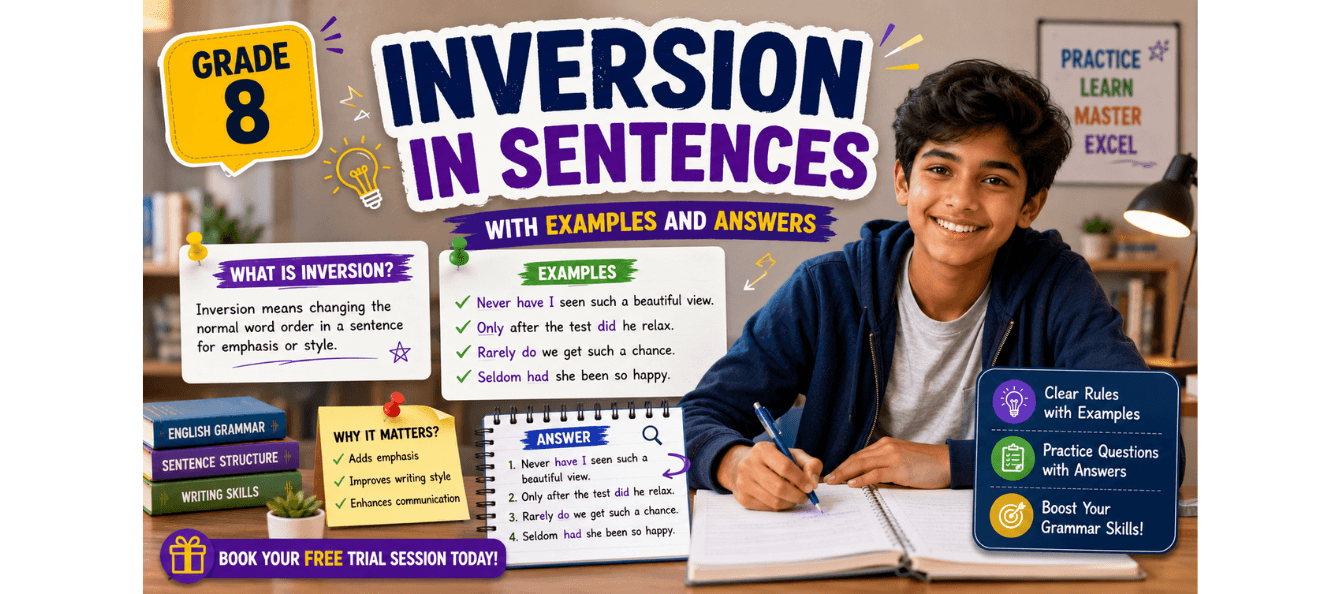
What Is Inversion in Sentences?
Inversion is a grammatical structure where the normal order of words in a sentence is reversed. In a standard English sentence, the subject comes before the verb. However, in inversion, the verb or an auxiliary verb is placed before the subject. This change usually happens after certain negative or restrictive adverbs such as never, seldom, rarely, scarcely, hardly, little, and under no circumstances.
For example, instead of saying "I have never seen such a beautiful monument," an inverted sentence would say "Never have I seen such a beautiful monument." The meaning remains the same, but the inverted version sounds more formal and emphatic.
Students learn that inversion often follows a negative adverb. Phrases like "Never have I," "Little did she know," and "Seldom do we" are all examples of inversion. Inversion after rarely requires an auxiliary verb, and inverted sentences change the standard word order. Inversion also adds a sense of formality to writing, making it an excellent tool for advanced composition.
What's in This Worksheet?
This Grade 8 English grammar worksheet on inversion in sentences has been designed by Archita Srivastava and covers a wide variety of question types. Here is what students will find inside:
1. Multiple choice questions that test understanding of inversion rules and vocabulary related to the topic.
2. Fill in the blanks with a provided word bank to help students practise placing the correct verb form in inverted sentences.
3. True and false questions that check whether students can identify correct and incorrect inverted sentence structures.
4. Underline the words activity where students identify the inverted element and circle the subject in each sentence.
5. Sentence writing tasks where students create their own inverted sentences using specific words and themes.
The worksheet is structured to gradually build confidence, starting with recognition and moving towards independent sentence construction.
Definitions, Examples, Techniques, and Tips
Inversion is a form of reversal in sentence construction. It changes the standard word order by placing the auxiliary verb or the main verb before the subject. This technique is used for emphasis and to add a formal tone to writing.
Key terms and examples from the worksheet include:
Negative adverb: Words such as never, seldom, rarely, scarcely, and hardly that trigger inversion when placed at the beginning of a sentence.
Auxiliary verb: A helping verb such as do, does, did, has, have, had, or will that is required after certain adverbs in inversion. For instance, "Seldom do we hear such melodious music."
Parallel clause: After "Not only," the inverted clause is followed by a parallel construction to maintain balance. For example, "Not only was the view beautiful but also grand."
Emphasis: Inversion is primarily used to add emphasis to a statement. "Little did she know" uses inversion for emphasis rather than excitement or elimination.
Formality: Inversion adds a sense of formality to writing, which is why it is commonly found in speeches, essays, and literature.
Restrictive adverbs: Phrases like "Under no circumstances" and "At no time" trigger inversion immediately, meaning the verb-subject swap happens right after the phrase.
Why Is It Important to Learn This?
Learning inversion is important for several reasons. First, it helps students understand advanced sentence structures that appear frequently in literature, newspapers, and academic writing. Recognising inverted sentences improves reading comprehension, especially in texts that use formal or dramatic language.
Second, inversion allows students to add variety and emphasis to their own writing. Instead of relying on the same sentence patterns, they can use inversion to make key points stand out. This skill is particularly valuable in essay writing, debates, and competitive exams where expressive and formal language is rewarded.
Third, understanding inversion deepens a student's overall grasp of English grammar. It requires knowledge of subject-verb agreement, auxiliary verbs, and adverb placement, all of which are fundamental grammar concepts.
Where Will This Knowledge Help You?
The knowledge of inversion in sentences will help students in many practical situations. In school examinations, inversion-based questions frequently appear in grammar sections and reading comprehension passages. Students who can identify and construct inverted sentences will score better in these areas.
In competitive exams and Olympiads, inversion is a commonly tested topic. Questions often ask students to identify errors in inverted sentences or to rewrite sentences using inversion. A strong understanding of this topic gives students a clear advantage.
In everyday writing, such as speeches, formal letters, articles, and essays, inversion adds a polished and sophisticated tone. It shows that the writer has a strong command over the language and can use advanced structures effectively.
How to Use This Worksheet?
Follow these steps to make the most of this inversion worksheet:
1. Read through all the questions carefully before attempting any answers. This will give you an overview of the topic.
2. Start with the multiple choice questions to test your basic understanding of inversion rules and related vocabulary.
3. Move on to the fill in the blanks section. Use the word bank provided and think about which verb fits best in each inverted sentence.
4. Attempt the true and false questions next. Pay close attention to the position of the subject and the auxiliary verb in each sentence.
5. For the underline the words activity, identify the inverted element in each sentence and circle the subject. This will strengthen your ability to spot inversion in any sentence.
6. Finally, try the sentence writing tasks. These require you to create your own inverted sentences, which is the best way to demonstrate your understanding.
The solutions provided at the end follow the same order as the worksheet, so you can check each answer as you go.
Important Tips and Tricks
Here are some important tips to keep in mind while practising inversion:
1. Always look for a negative or restrictive adverb at the beginning of a sentence. Words like never, seldom, rarely, scarcely, hardly, and little almost always signal inversion.
2. Remember that an auxiliary verb is required after the adverb in most inverted sentences. For example, "Seldom do we" is correct, not "Seldom we do."
3. Make sure the subject and verb agree even when the order is inverted. "Never has she" is correct, while "Never have she" is incorrect.
4. Pay attention to phrases like "Under no circumstances" and "At no time." These trigger inversion immediately, meaning the verb comes before the subject right after the phrase.
5. Inversion changes the standard word order, but the meaning of the sentence stays the same. Practise converting regular sentences to inverted ones and vice versa.
6. Examiners expect students to use inversion in formal writing tasks. Practising sentence writing with inversion will help you use it naturally in essays and speeches.
7. Watch out for common errors such as forgetting the auxiliary verb or placing the subject before the verb after a negative adverb.
Complete Answer Key
Multiple Choice Questions:
Q1 = b) negative
Q2 = a) reversal
Q3 = c) inverted
Q4 = a) emphasis
Q5 = b) standard
Q6 = c) immediately
Q7 = a) auxiliary
Q8 = b) auxiliary
Q9 = c) recognize
Q10 = a) formality
Fill in the Blanks:
1. Never had Pooja delivered such a fine speech.
2. Seldom has Anjali performed in the school play.
3. Rarely had Rahul recovered from his illness.
4. Scarcely had the team completed the project.
5. Never had Aarav witnessed such a brave act.
6. Not only had she finished the task but won.
7. Little had the class experienced such a lesson.
8. Seldom has Nisha submitted her work this late.
9. Never had we encountered such heavy rainfall.
10. Not only was the view beautiful but also grand.
True/False:
1. True
2. False
3. True
4. True
5. False
6. True
7. True
8. True
9. False
10. True
Underline the Inverted Element and Circle the Subject:
1. Never have I seen such a rainbow. (Underline "Never have" and circle "I")
2. Rarely does Rohan miss the bus. (Underline "Rarely does" and circle "Rohan")
3. Seldom did she speak in assembly. (Underline "Seldom did" and circle "she")
4. Not only was he brave but kind. (Underline "Not only was" and circle "he")
5. Hardly had the match begun then. (Underline "Hardly had" and circle "the match")
6. At no time did Aryan give up. (Underline "At no time did" and circle "Aryan")
7. Scarcely had the guests arrived. (Underline "Scarcely had" and circle "the guests")
8. Little do we know about it. (Underline "Little do" and circle "we")
9. Never before has Diya sung. (Underline "Never before has" and circle "Diya")
10. No sooner had the bell rung. (Underline "No sooner had" and circle "the bell")
Sentence Writing:
Answers may vary.
1. The agreement between the two teams was signed by the principal yesterday.
2. The committee has decided to organise the annual function next week.
3. Every student in the class wants to score well in the final examination.
4. Everybody is helping to decorate the hall for the school cultural event.
5. Neither the teacher nor the students were aware of the sudden holiday.
6. A large flock of birds was seen flying over the pink city of Jaipur at dawn.
7. Her collection of rare stamps has been displayed at the national exhibition.
8. The subject of the debate was whether technology helps or harms students.
9. The team of players has practised hard and won the district level tournament.
10. A group of students from our school participated in the science fair last month.
Practising inversion in sentences will give Grade 8 students a powerful tool to make their writing more expressive and formal. This worksheet covers all the essential aspects of inversion, from basic identification to independent sentence construction. By working through each section carefully, students will build a strong command of this advanced grammar topic and feel more confident in their English language skills.