
Grade 8 Sentence Transformation (Simple–Complex–Compound) [Grammar Practice]
![Grade 8 Sentence Transformation (Simple–Complex–Compound) [Grammar Practice]](https://cdn5.planetspark.in/media/small_12_1d9b121819.png)

Grade 8 English Grammar Worksheet on Sentence Transformation (Simple-Complex-Compound)
Have you ever noticed how the same idea can be expressed in different ways? A writer might say "She studied hard and passed the exam," or "Because she studied hard, she passed the exam," or simply "Hard work brought her success." All three sentences carry the same meaning, yet each follows a different structure. This ability to rewrite a sentence from one form to another without changing its meaning is called sentence transformation, and it is one of the most valuable skills a student can develop in Grade 8 English grammar. Sentence transformation helps you move smoothly between simple, complex, and compound sentences, making your writing more versatile and engaging. This blog introduces you to the concept and shares a carefully designed worksheet by Archita Srivastava covering multiple choice questions, fill in the blanks, true and false, conjunction and clause identification, and sentence writing tasks.
Download these English grammar worksheets and practice regularly to strengthen your language skills and build a strong foundation. You can also book a free trial to get expert guidance and improve your reading, writing, and comprehension abilities. The worksheets are designed in a simple and structured way to help K–8 students learn grammar concepts easily and use them confidently in everyday communication.
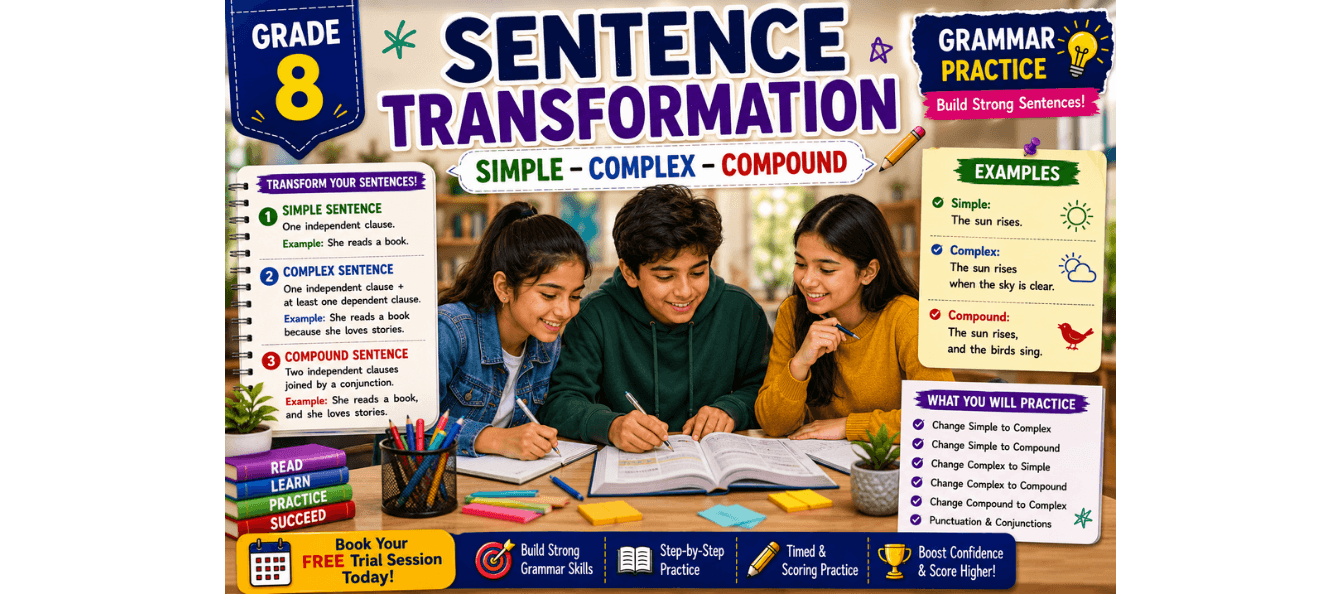
What Is Sentence Transformation (Simple-Complex-Compound)?
Sentence transformation is the process of changing a sentence from one grammatical form to another while preserving its original meaning.
A simple sentence contains one independent clause and expresses a complete thought. For example, "Rahul worked hard" is a simple sentence with one subject and one verb.
A compound sentence contains two or more independent clauses joined by a coordinating conjunction such as and, but, or, so, yet, or for. For example, "Rahul worked hard but he failed" joins two independent ideas with the conjunction "but." Compound sentences allow you to connect equal ideas.
A complex sentence contains one independent clause and at least one dependent clause introduced by a subordinating conjunction such as because, although, when, if, or since. For example, "Although Rahul worked hard, he failed" adds depth to the statement.
Sentence transformation involves converting between these three types. The goal is always to keep the meaning intact while changing the structure.
What's in This Worksheet?
This Grade 8 English grammar worksheet by Archita Srivastava includes five exercises that test every aspect of your understanding of sentence transformation between simple, complex, and compound forms:
1. Multiple choice questions that test your conceptual knowledge of sentence types, conjunctions, clause structure, and the principles of sentence transformation, including identifying independent clauses, coordinating conjunctions, and the purpose of transforming sentences.
2. Fill in the blanks with a word bank containing verbs such as transformed, modified, extended, integrated, expanded, connected, converted, combined, developed, and restructured, challenging you to choose the correct word that fits the context of each sentence about sentence structure.
3. True and false statements that check your clarity about sentence transformation rules, including the nature of clauses, the role of conjunctions, the use of semicolons, and whether transformation preserves original meaning.
4. Underline the conjunction and circle the clauses exercise that builds analytical reading skills by asking you to identify both the coordinating conjunction and the independent clauses within compound sentences.
5. Sentence writing tasks where you transform sentences between simple, complex, and compound forms on topics including school, cricket, monsoon, Diwali, and village life.
Definitions, Examples, Techniques, and Tips
An independent clause is a group of words with a subject and a verb that expresses a complete thought and can stand alone. "Rahul worked hard" is an independent clause because it has the subject "Rahul" and the verb "worked."
A dependent clause is a group of words with a subject and a verb that cannot stand alone. "Because it rained heavily" is a dependent clause because it leaves the reader wondering what happened as a result.
Coordinating conjunctions such as and, but, or, so, yet, and for join independent clauses of equal importance to form compound sentences. A useful memory aid is FANBOYS: For, And, Nor, But, Or, Yet, So.
Subordinating conjunctions such as because, although, when, if, since, unless, and while introduce dependent clauses and connect them to independent clauses to form complex sentences.
To transform a simple sentence into a compound sentence, split the sentence into two independent clauses and join them with a coordinating conjunction. For example, "She studied hard" can become "She studied hard and she passed the exam."
To transform a simple sentence into a complex sentence, add a dependent clause with a subordinating conjunction. For example, "She studied hard" can become "Because she studied hard, she passed the exam."
To transform a compound sentence into a simple sentence, combine the clauses using a phrase or a single verb. For example, "Rahul worked hard but he failed" can become "Despite working hard, Rahul failed."
To transform a complex sentence into a simple sentence, remove the subordinating conjunction and restructure. For example, "When it rained, we went inside" can become "We went inside during the rain."
Why Is It Important to Learn This?
Learning sentence transformation is essential for several reasons. First, it is a frequently tested topic in Grade 8 English grammar examinations. Questions on converting sentences from one form to another appear regularly in school tests and competitive exams, and a strong understanding helps you score well.
Second, sentence transformation makes your writing more versatile. Compound sentences are excellent for showing contrast or addition, while complex sentences are ideal for explaining reasons and conditions.
Third, this skill improves reading comprehension. Novels and textbooks contain a mix of sentence types, and knowing how they work helps you understand relationships between ideas more quickly.
Fourth, sentence transformation lays the groundwork for advanced grammar topics such as active and passive voice, direct and indirect speech, and clause reduction in higher grades.
Where Will This Knowledge Help You?
This knowledge will help you across many areas of your academic life. In school, every English grammar exam includes questions on sentence types and transformation, and this worksheet targets the exact formats that appear most frequently in Grade 8 assessments.
In essay and story writing, compound sentences let you present balanced ideas using "and" or "but," while complex sentences allow you to weave in reasons and contrasts that make your writing more persuasive.
In reading comprehension, recognising sentence types helps you break down long paragraphs into manageable parts and understand how the writer connects ideas.
In competitive exams, sentence transformation questions including error detection and sentence reordering are common, and practising with this worksheet prepares you for those challenges.
How to Use This Worksheet?
Follow these simple steps to get the most out of this worksheet:
1. Read through the definitions and explanations above so that you understand the three sentence types and the basic techniques for transforming between structures before you begin.
2. Start with the multiple choice questions. Read each question carefully, think about the rules of sentence types and conjunctions, and choose the best option from the three given choices.
3. Move on to the fill in the blanks. Use the word bank and think about which word best fits the meaning of each sentence about sentence structure and transformation.
4. Attempt the true and false exercise next. Read each statement and decide whether it is correct based on your understanding of clauses, conjunctions, and sentence transformation rules.
5. For the conjunction and clause identification exercise, read each compound sentence carefully, underline the coordinating conjunction, and circle the two independent clauses. Pay attention to how the conjunction connects the clauses.
6. Complete the sentence writing tasks last. Follow each instruction to transform sentences between simple, complex, and compound forms on the given topics, focusing on correct conjunction usage and proper sentence structure.
7. After finishing all exercises, check your answers using the complete answer key provided at the end of this blog.
8. Review any mistakes and try to understand why the correct answer is right. This is the most important step for long-term learning.
Important Tips and Tricks
Here are some tips and tricks to remember when working with sentence transformation:
1. Always identify the clause structure first. A simple sentence has one independent clause, a compound sentence has two or more independent clauses, and a complex sentence has one independent clause plus at least one dependent clause.
2. Memorise the FANBOYS conjunctions: For, And, Nor, But, Or, Yet, So. These are the only coordinating conjunctions that join independent clauses in compound sentences.
3. Remember that subordinating conjunctions such as because, although, when, if, and since always introduce dependent clauses that need an independent clause to complete the sentence.
4. When transforming sentences, focus on preserving meaning. The whole point is to rewrite a sentence in a different structure without changing what it communicates.
5. Use a comma before a coordinating conjunction when it joins two independent clauses. "Rahul worked hard, but he failed" is correctly punctuated. The comma separates the two complete thoughts and prevents confusion.
6. Use a comma after a dependent clause that begins a sentence. "Although she was tired, she finished her work" is correct. No comma is needed when the dependent clause comes at the end: "She finished her work although she was tired."
7. In true and false questions, watch for statements about what transformation does to meaning. Sentence transformation should preserve the original meaning. Any statement claiming that transformation changes the meaning is false.
8. Practise converting in both directions. Being able to transform a simple sentence into a complex one is important, but being able to transform a complex sentence back into a simple one is equally valuable and shows deeper understanding.
Complete Answer Key
Exercise 1 – Multiple Choice Questions
1. b) independent
2. a) conjunction
3. c) subordinate
4. a) preserves
5. b) coordinating
6. c) subordinate
7. a) connector
8. b) compound sentences
9. c) conciseness
10. a) grammatical structure
Exercise 2 – Fill in the Blanks
1. combined
2. connected
3. developed
4. extended
5. converted
6. restructured
7. integrated
8. transformed
9. modified
10. expanded
Exercise 3 – True or False
1. True
2. False
3. True
4. True
5. True
6. False
7. True
8. True
9. False
10. True
Exercise 4 – Underline the Conjunction and Circle the Clauses
1. Underline: but | Circle: Rahul worked hard, he failed
2. Underline: yet | Circle: She likes tea, she took coffee
3. Underline: or | Circle: We go by bus, we take a train
4. Underline: so | Circle: He was tired, he slept
5. Underline: and | Circle: Anjali sang, Rohan played
6. Underline: but | Circle: I called Pooja, she was out
7. Underline: for | Circle: Aryan ran, he was late
8. Underline: and | Circle: The sky was dark, windy
9. Underline: yet | Circle: She was late, she did all
10. Underline: but | Circle: We waited, no train came
Exercise 5 – Rewritten Sentences
Answers may vary.
1. Because she studied hard, she scored the highest marks in the class.
2. The rain stopped.
3. He was tired, so he went to bed early.
4. She is a good singer, and she performs at every school event.
5. When the curtains rose, the audience cheered loudly for the actors on stage during the school play.
6. He batted well, but his team lost the close cricket match by just five runs.
7. When the monsoon clouds burst open, the entire village celebrated with joy and relief.
8. Because Diwali is a festival of lights, people decorate their homes with diyas and rangoli every year.
9. The village is small, but it has a school, a hospital, and a beautiful temple.
10. Due to heavy rain, the match was cancelled.
Mastering sentence transformation between simple, complex, and compound forms is a skill that will serve you throughout your academic career. Whether you are writing an essay with varied sentence structures, answering grammar questions in an exam, or simply trying to express your ideas more clearly, the ability to shift between sentence types gives you powerful control over your language. This worksheet by Archita Srivastava provides a thorough practice session covering every dimension of sentence transformation, from identifying clause types in multiple choice format to pinpointing conjunctions within compound sentences and writing original transformed sentences on diverse topics. Work through each exercise, review your answers using the answer key, and keep practising until moving between simple, complex, and compound sentences becomes a natural part of your writing. Strong grammar is the backbone of confident communication.