
Grade 8 Degree & Emphasis Transformation [With Examples]
![Grade 8 Degree & Emphasis Transformation [With Examples]](https://cdn5.planetspark.in/media/small_13_34257c186e.png)

Grade 8 English Grammar Worksheet on Degree and Emphasis Transformation
Have you ever noticed how we compare things in everyday life? We say one thing is taller, another is the tallest, and sometimes we just describe something as it is without any comparison at all. In Grade 8, students learn how to change sentences between these different forms of comparison while keeping the meaning exactly the same. This is called degree transformation, and when you add special words like very, extremely, or absolutely to make your point stronger, that is called emphasis transformation. This worksheet gives you a complete set of exercises to master both of these important grammar skills.
Download these English grammar worksheets and practice regularly to strengthen your language skills and build a strong foundation. You can also book a free trial to get expert guidance and improve your reading, writing, and comprehension abilities. The worksheets are designed in a simple and structured way to help K-8 students learn grammar concepts easily and use them confidently in everyday communication.
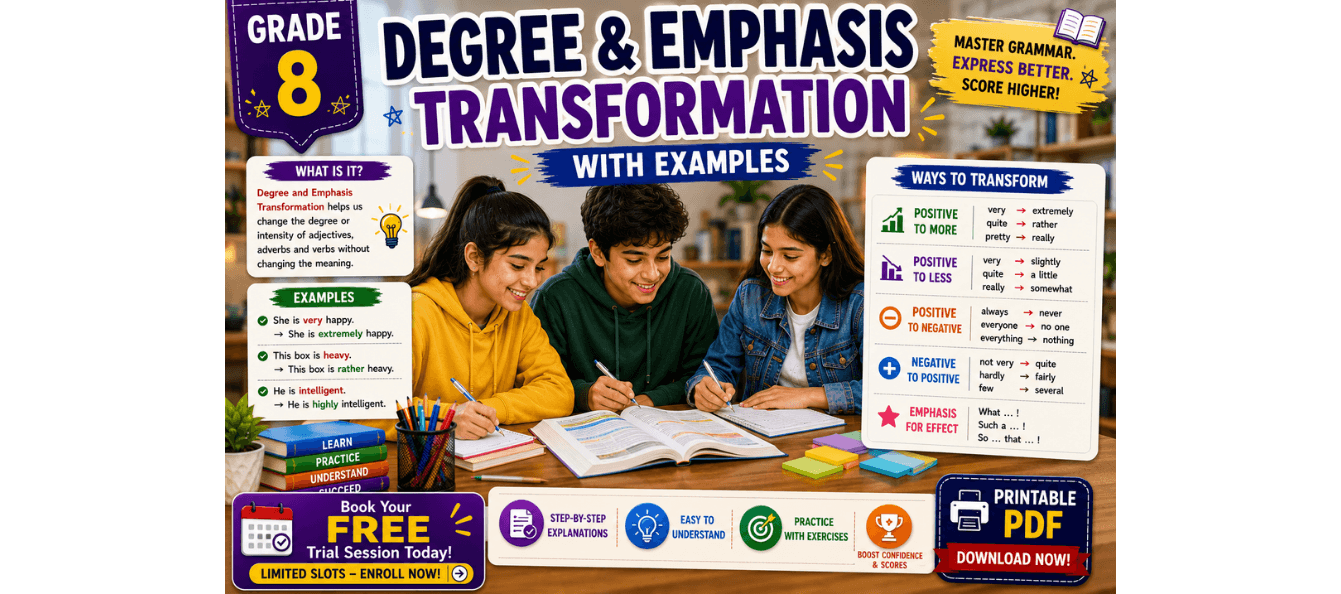
What Is Degree and Emphasis Transformation?
Degree transformation is the process of changing a sentence from one degree of comparison to another without changing its meaning. There are three degrees of comparison in English grammar. The positive degree is used without any comparison. It simply states a fact about a person or thing. For example, Aarav is tall. The comparative degree is used to determine two items and show which one has more or less of a quality. For example, Aarav is taller than Rahul. The superlative degree compares multiple items at once and shows which one has the highest or lowest quality. For example, Aarav is the tallest in the class.
Emphasis transformation is the process of adding emphasis to a sentence using adverbs of degree such as very, extremely, absolutely, and remarkably. These adverbs add emphasis to adjectives and make the sentence stronger. Changing degree must preserve the sentence perspective, and emphasis must not change the original meaning.
What's in This Worksheet?
This worksheet on degree and emphasis transformation for Grade 8 students includes five carefully designed exercises that test different aspects of this grammar topic. Here is what you will find inside:
1. Multiple Choice Questions: Ten questions that test your understanding of the three degrees of comparison, emphasis adverbs, degree markers, adjective form changes, and how degree transformation preserves meaning.
2. Fill in the Blanks: Ten sentences with a word bank containing adverbs like surprisingly, relatively, thoroughly, remarkably, perfectly, intensely, considerably, extremely, incredibly, and absolutely. Each blank must be filled with the correct adverb to complete the sentence.
3. True and False: Ten statements about positive degree, comparative degree, superlative degree, degree transformation rules, emphasis adverbs, form changes, and common degree patterns.
4. Underline the Words: Ten sentences where students must underline the adjective or adverb and circle the degree marker. This exercise tests the ability to identify the word being compared and the marker that shows the type of comparison.
5. Sentence Writing: Ten rewriting tasks that ask students to change sentences between different degrees of comparison, write comparative and superlative sentences, use emphatic degree, and apply emphasis structures on various topics like monuments, cricket, and school.
Definitions, Examples, Techniques, and Tips
Here are some important definitions and techniques related to degree and emphasis transformation based on the worksheet content:
1. The positive degree makes a simple statement without any comparison. For example, Pooja is tall. This is the most basic form of describing a quality.
2. The comparative degree is used to determine two items. It usually uses the suffix -er or the word more before the adjective, along with than. For example, This is easier than the last.
3. The superlative degree compares multiple items at once. It uses the suffix -est or the word most before the adjective, along with the. For example, This is the most fun to read.
4. As tall as is used in positive degree form. This pattern is used to show that two items are equal in a particular quality.
5. Taller than is an example of comparative degree. The word than is the degree marker that tells us a comparison is being made between two items.
6. The most beautiful is in superlative degree form. The word the and most are the degree markers for the superlative.
7. Changing degree requires adjusting the adjective form. The adjective must change from its base form to the comparative or superlative form depending on the type of transformation.
8. Degree transformation keeps the structure unchanged in terms of meaning. The sentence may look different, but the core message stays the same.
9. Adverbs of degree include very, more, extremely, absolutely, and many others. These adverbs add emphasis to adjectives and make descriptions stronger.
10. Better is the comparative form of good, and worst is the superlative of bad. These are irregular forms that students must memorize.
Why Is It Important to Learn Degree and Emphasis Transformation?
Learning degree and emphasis transformation is important for Grade 8 students for several key reasons. First, it helps you express comparisons clearly and accurately in your writing. Whether you are comparing two things or choosing the best among many, knowing how to use the correct degree makes your writing precise.
Second, degree transformation is frequently tested in school examinations. Students who can change sentences from positive to comparative to superlative score better in grammar tests. Third, emphasis transformation makes your writing more expressive. Using adverbs like incredibly and absolutely helps you paint a clearer picture for your readers.
Fourth, understanding degrees of comparison improves your reading comprehension. When you read texts that use comparative and superlative forms, you understand relationships between different items more easily. Fifth, mastering both degree and emphasis transformation together gives you a complete toolkit for writing powerful and effective sentences.
Where Will This Knowledge Help You?
The knowledge of degree and emphasis transformation will help you in many practical situations:
1. Academic writing: In essays and reports, you often need to compare different ideas, data, or viewpoints. Degree transformation helps you make these comparisons smoothly.
2. School grammar tests: Degree transformation is a regular feature in English grammar examinations across all boards and levels.
3. Story writing and descriptions: Emphasis adverbs help you create vivid and engaging descriptions for your readers.
4. Debates and speeches: Comparative and superlative degrees are essential tools of persuasion when arguing for one option over another.
5. Everyday conversation: We use degrees of comparison and emphasis all the time, whether talking about the weather, comparing prices, or describing experiences.
How to Use This Worksheet?
Follow these steps to make the most of this degree and emphasis transformation worksheet:
1. Read each question carefully before answering. Understand what type of transformation or identification is being asked.
2. For the multiple choice questions, read all three options before selecting the one that best completes the sentence.
3. For the fill in the blanks exercise, use the word bank provided and choose the adverb that fits the context of each sentence naturally.
4. For the true and false section, think about each statement and decide whether it correctly describes a grammar rule related to degree or emphasis.
5. For the underline activity, identify the adjective or adverb in each sentence and underline it, then find and circle the degree marker such as the, -er, -est, more, most, than, or as.
6. For the sentence writing section, read each instruction carefully and rewrite or create the sentence according to the specified degree or emphasis transformation.
7. After completing all exercises, check your answers using the complete answer key provided at the end. The solutions follow the worksheet order exactly.
8. Review any mistakes and understand why the correct answer is right.
9. Practice rewriting the same sentence in all three degrees to build confidence.
10. Try using emphasis adverbs in your own everyday writing.
Important Tips and Tricks
Here are some important tips and tricks to keep in mind while working on degree and emphasis transformation:
1. Always identify the adjective in the sentence before changing its degree. The adjective is the word whose form will change.
2. Degree transformation must not change the meaning of the sentence. The comparison should stay the same even when the form changes.
3. Remember that the positive degree uses as...as pattern, the comparative uses -er or more with than, and the superlative uses the with -est or most.
4. For short adjectives, use -er and -est. For longer adjectives, use more and most.
5. Memorize the irregular forms: good becomes better becomes best, and bad becomes worse becomes worst.
6. When using emphasis adverbs, choose the one that fits the intensity. Extremely is stronger than very.
7. The superlative always uses the before the adjective. Missing the is a common mistake.
8. Comparative degree compares two items, not three. If you are comparing three or more, use the superlative.
9. Emphasis always enhances the description but does not change the sentence meaning.
10. Always read your transformed sentence aloud to check that it sounds natural and grammatically correct.
Complete Answer Key
Below is the complete answer key for all five exercises in this worksheet. The answers follow the exact order of the worksheet.
Exercise 1: Multiple Choice Questions
Q1 = b) comparison
Q2 = a) determine
Q3 = c) multiple
Q4 = a) perspective
Q5 = b) emphasis
Q6 = c) positive
Q7 = a) comparative
Q8 = b) superlative
Q9 = c) adjective
Q10 = a) structure
Exercise 2: Fill in the Blanks
1. The weather was incredibly cold that day.
2. Pooja did remarkably well in the show.
3. The view was absolutely beautiful.
4. Aarav was extremely skilled for his age.
5. The book was relatively costly.
6. The test was surprisingly easy.
7. The house was thoroughly cleaned.
8. Rahul was perfectly sure of it.
9. The game was considerably close.
10. Diya was intensely calm in the drill.
Exercise 3: True and False
1. True
2. False
3. True
4. False
5. True
6. True
7. True
8. False
9. True
10. True
Exercise 4: Underline the Adjective or Adverb and Circle the Degree Marker
1. Aarav is the tallest in class. (Underline: tallest. Circle: the)
2. This is easier than the last. (Underline: easier. Circle: than)
3. Pooja runs as fast as Anjali. (Underline: fast. Circle: as...as)
4. Mumbai is among the busiest. (Underline: busiest. Circle: the)
5. Rahul is more hard than most. (Underline: hard. Circle: more...than)
6. This is the most fun to read. (Underline: fun. Circle: the most)
7. Nisha reads better than he. (Underline: better. Circle: than)
8. The red saree was prettiest. (Underline: prettiest. Circle: the)
9. Aryan is less bold than Rohan. (Underline: bold. Circle: less...than)
10. No one is as good as Diya. (Underline: good. Circle: as...as)
Exercise 5: Rewrite (Q1-Q10)
Answers may vary.
1 No other boy in the class is as tall as Rahul.
2 Mumbai is the biggest city in India.
3 Steel is stronger than iron.
4 Diamond is the hardest of all substances, so it is harder than any other mineral.
5 The Taj Mahal is indeed the most beautiful monument in the world.
6 No other gift is as precious as this one.
7 Cricket is the most popular game in India.
8 The Red Fort is larger than the Hawa Mahal.
9 No other river in India is as long as the Ganga.
10 It is the school that shaped my future.
Degree and emphasis transformation is a powerful grammar skill that every Grade 8 student should master. By learning to change sentences between positive, comparative, and superlative forms, you gain the ability to express comparisons clearly and precisely. By adding emphasis adverbs to your sentences, you make your descriptions more vivid and engaging. Both skills work together to make your writing stronger. Keep practicing with this worksheet, review the answer key, and watch your grammar confidence grow with every exercise you complete.