
Grade 8 Mixed Tense & Conditional Review [With Examples]
![Grade 8 Mixed Tense & Conditional Review [With Examples]](https://cdn5.planetspark.in/media/small_4_686ccf12d1.png)

Grade 8 English Grammar Worksheet on Mixed Tense and Conditional Review
Have you ever noticed how verbs change their form when we talk about the past, present, or future? In Grade 8, students learn about different tenses and conditional sentences that help them express ideas clearly. Mixed tense and conditional review is one of the most important topics in English grammar because it teaches you how to use the right verb forms in different situations. Whether you are talking about something that happened yesterday or something that might happen in the future, understanding tenses and conditionals helps you communicate with confidence. This worksheet gives you a complete practice set with multiple choice questions, fill in the blanks, true and false statements, underline activities, and sentence writing tasks to master this topic.
Download these English grammar worksheets and practice regularly to strengthen your language skills and build a strong foundation. You can also book a free trial to get expert guidance and improve your reading, writing, and comprehension abilities. The worksheets are designed in a simple and structured way to help K-8 students learn grammar concepts easily and use them confidently in everyday communication.
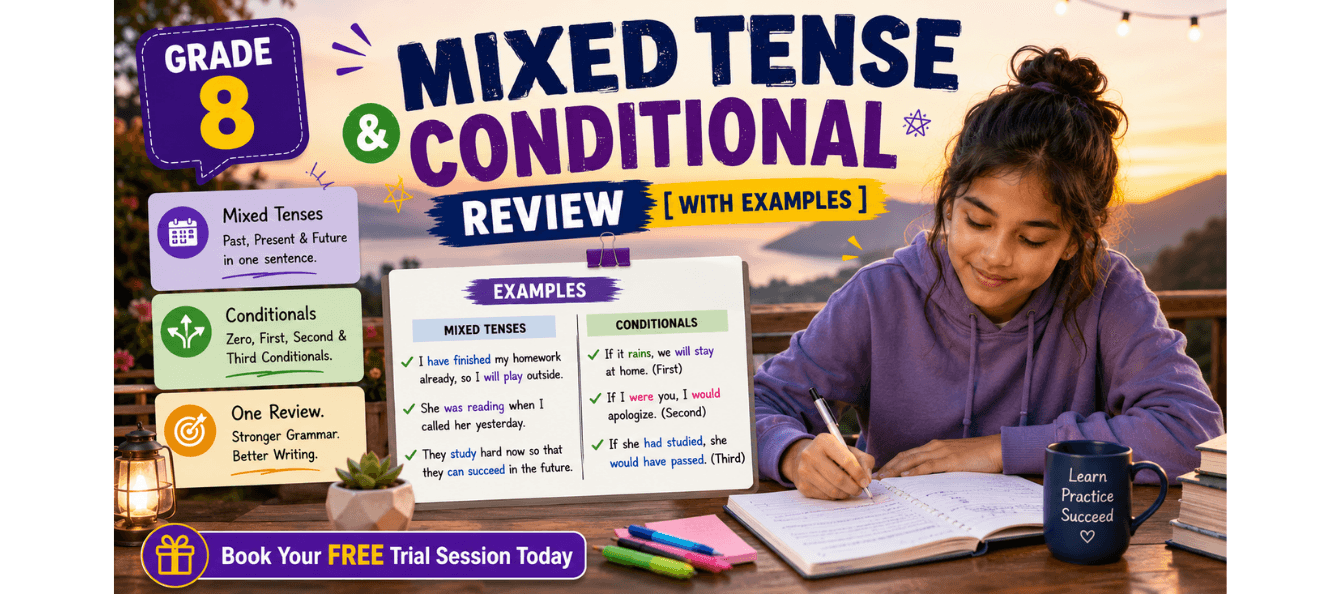
What Is Mixed Tense and Conditional Review?
Mixed tense review means practising different types of tenses together in one exercise. Instead of focusing on just one tense at a time, this topic asks you to identify and use the correct tense from a range of options. Tenses like simple past, past perfect, present perfect continuous, future perfect, and past continuous all appear together so you can build your understanding of how they work in different sentences.
Conditional review focuses on sentences that express a condition and its result. These sentences often use words like "if," "had," "should," and "unless." For example, when you say "If Aarav performed well, he would pass," you are using a conditional structure. Conditionals can talk about real situations, imaginary situations, or situations in the past that did not happen but could have.
Together, mixed tense and conditional review helps Grade 8 students understand how to choose the right verb form in any context. You learn to recognise patterns like past perfect ("She had already left when we arrived"), present perfect continuous ("Aarav has been residing in Delhi for ten years"), past continuous ("Pooja completed her homework when I called her"), and future perfect ("By next year, Rahul completed all his courses"). You also learn how to form conditional sentences where the condition and the result belong to different time frames, which is called a mixed conditional.
What's in This Worksheet?
This worksheet is created by Archita Srivastava and is designed for Grade 8 students who want to practise mixed tenses and conditional sentences. Here is what you will find inside:
1. Multiple choice questions that test your ability to choose the correct verb form or tense in a sentence with three options given for each question.
2. Fill in the blanks where you use a word bank with ten words including promised, remained, continued, conducted, completed, submitted, succeeded, performed, prepared, and insisted to complete conditional sentences.
3. True and false statements that check whether you can identify correct and incorrect tense and conditional structures in given sentences.
4. Underline the words activity where you underline the conditional clause and circle the main clause in each sentence.
5. Sentence writing tasks where you rewrite sentences as directed, including writing conditional sentences about rain, composing a sentence about a wish for the future, forming a sentence using mixed tenses, writing conditional sentences on exams, and using wish in a sentence about the past, among other tasks.
The worksheet has a total of five exercises with increasing levels of difficulty to help you build your skills step by step.
Definitions, Examples, Techniques, and Tips
Here are the key concepts covered in this worksheet along with examples and techniques:
Past perfect tense is used when one action in the past happened before another action in the past. For example, "She had already left when we arrived" shows that leaving happened before arriving. The worksheet uses verbs like completed, submitted, and possessed in past perfect contexts.
Present perfect continuous tense shows an action that started in the past and is still continuing. For example, "Aarav has been residing in Delhi for ten years" uses "has been" plus the verb with -ing.
Past continuous tense describes an action that was in progress when another action happened. For example, "Pooja completed her homework when I called her" shows an action happening at a specific moment.
Future perfect tense talks about an action that will be finished by a certain point in the future. For example, "By next year, Rahul completed all his courses" shows completion before a future time.
Conditional sentences express that something will happen only if a certain condition is met. The worksheet includes several types:
Real conditionals use "if" with present tense and future result: "If she studies hard, she will pass."
Unreal conditionals use "if" with past tense and would: "If I were a bird, I would fly away" and "If I were you, I appreciate the opportunity."
Past unreal conditionals use "had" with past participle: "If he practised harder, he would have passed" and "She wished she possessed more free time."
Conditional clauses can also start with "had," "should," or "unless" as seen in the worksheet: "Had she studied, she had passed," "Should you need help, call me," and "Unless you try, you fail."
A technique for solving fill in the blanks is to read the entire sentence first, then look at the word bank and think about which word makes sense with the conditional structure.
For the underline and circle activity, remember that the conditional clause contains the "if," "had," "should," or "unless" part, while the main clause contains the result. For example, in "If it rains, the match is off," the conditional clause is "If it rains" and the main clause is "the match is off."
Why Is It Important to Learn This?
Learning mixed tenses and conditional sentences is extremely important for Grade 8 students for several reasons. First, it helps you write clearly and accurately. When you know which tense to use, your writing becomes more precise and easier to understand. Second, conditional sentences appear frequently in both academic writing and everyday communication. You use them when you talk about possibilities, make plans, express wishes, or describe hypothetical situations.
Understanding tenses also improves your reading comprehension. When you read a passage, you need to follow the timeline of events. This worksheet prepares you for that kind of reading by giving you practice with sentences like "She had already left when we arrived" and "By the time he arrived, the train left." In exams, questions on tenses and conditionals are very common. Being able to quickly identify the correct verb form saves you time and helps you score better.
Where Will This Knowledge Help You?
Mixed tenses and conditional sentences are used everywhere in real life. Here are some places where this knowledge will help you:
1. Writing essays and stories in school where you need to describe events in the correct order.
2. Reading comprehension passages where authors use different tenses to show the sequence of events.
3. Everyday conversations when you talk about what happened, what is happening, and what might happen.
4. Grammar exams and competitive tests that include questions on verb tenses and conditional structures.
5. Formal writing like letters, emails, and reports where correct tense usage shows your language proficiency.
How to Use This Worksheet?
Follow these steps to get the most out of this worksheet:
1. Read each question carefully before answering. Do not rush through the questions.
2. For the multiple choice section, read the full sentence first and then look at the three options. Think about the tense or conditional structure that fits best.
3. For the fill in the blanks, go through the word bank first: promised, remained, continued, conducted, completed, submitted, succeeded, performed, prepared, and insisted. Then read each sentence and choose the word that completes the conditional meaning.
4. For the true and false section, read each sentence and decide if the tense and conditional structure is correct or incorrect.
5. For the underline activity, identify which part of the sentence is the condition (starts with if, had, should, or unless) and underline it. Then circle the main clause that shows the result.
6. For the sentence writing section, follow the direction given for each question. Write your sentence clearly and check that it follows the grammar rule being tested.
7. After completing all questions, check your answers using the answer key provided below. The solutions follow the worksheet order exactly so you can verify each answer easily.
8. Review any mistakes you made and try to understand why the correct answer is right.
Important Tips and Tricks
Here are some important tips to keep in mind while working on mixed tenses and conditional sentences:
1. Always read the full sentence before choosing an answer. The context of the sentence tells you which tense or conditional type is needed.
2. In conditional sentences, pay attention to whether the condition is real, unreal, or in the past. This tells you which verb form to use.
3. For past perfect, look for two actions in the past where one happened before the other. The earlier action uses past perfect.
4. Present perfect continuous uses "has been" or "have been" followed by a verb with -ing. Look for phrases like "for ten years" or "since morning."
5. In the fill in the blanks section, each word from the word bank is used only once. Cross out words as you use them.
6. When underlining conditional clauses, remember that "had," "should," and "unless" can also start conditional clauses, not just "if."
7. In true and false questions, look carefully at the verb form. A sentence can be false because the tense is wrong, not because the idea is wrong.
8. Examiners expect you to use the exact verb form required. Do not change the spelling or form of words from the word bank.
9. When writing conditional sentences, make sure both the condition and the result make sense together.
10. Practice regularly with similar worksheets to build speed and accuracy in identifying correct tenses and conditional structures.
Complete Answer Key
Multiple choice questions answers:
Q1 = b) completed
Q2 = a) surpassed
Q3 = c) completed
Q4 = a) appreciate
Q5 = b) residing
Q6 = c) completed
Q7 = a) developed
Q8 = b) submitted
Q9 = c) possessed
Q10 = a) practised
Fill in the blanks answers (in order):
1. prepared
2. conducted
3. completed
4. continued
5. remained
6. insisted
7. submitted
8. performed
9. promised
10. succeeded
True and false answers:
1. True
2. False
3. True
4. True
5. True
6. False
7. True
8. True
9. True
10. False
Underline the conditional clause and circle the main clause: For each sentence, underline the part that starts with "if," "had," "should," or "unless" and circle the remaining part that shows the result. This applies to all ten sentences in the exercise.
Sentence writing answers:
Answers may vary.
1 If it rains heavily tomorrow, the school will declare a holiday.
2 I wish I would become a doctor when I grow up.
3 Aarav had already finished his homework before Pooja arrived at his house.
4 If you study regularly, you will pass the exams with flying colours.
5 I wish I had not wasted my time playing video games last summer.
6 If the event is cancelled due to rain, the organisers will announce a new date.
7 Rahul had never visited the Taj Mahal before his school trip last month.
8 Diya is going to join a summer coding camp next week to improve her skills.
9 If we book the tickets early, we can travel to Jaipur during the winter break.
10 Anjali has lived in Mumbai since she was five years old and she loves the city.
Practising mixed tenses and conditional sentences regularly will help you feel more confident in your Grade 8 English grammar skills. This worksheet covers all the important areas you need to focus on, from choosing the right verb form in multiple choice questions to writing your own conditional sentences. The more you practise, the easier it becomes to use conditional structures accurately in your writing and speech. Keep working through exercises like this one and you will see a clear improvement in your understanding of mixed tenses and conditionals.