
Grade 8 Active–Passive Transformation (Advanced) [Grammar Practice]
![Grade 8 Active–Passive Transformation (Advanced) [Grammar Practice]](https://cdn5.planetspark.in/media/small_7_428ab98fd7.png)

Grade 8 English Grammar Worksheet on Active Passive Transformation Advanced
Have you ever noticed how the same idea can be expressed in two completely different ways? Sometimes the focus is on who is doing the action, and sometimes the focus shifts to what is being done. This is the beauty of voice transformation in English grammar. For Grade 8 students, learning how to change sentences from active voice to passive voice at an advanced level is an essential skill that improves both writing and comprehension. This worksheet on active-passive transformation advanced is designed to help you understand the rules, practice different sentence types, and gain the confidence to tackle even the trickiest voice change questions in your exams.
Download these English grammar worksheets and practice regularly to strengthen your language skills and build a strong foundation. You can also book a free trial to get expert guidance and improve your reading, writing, and comprehension abilities. The worksheets are designed in a simple and structured way to help K-8 students learn grammar concepts easily and use them confidently in everyday communication.
What Is Active-Passive Transformation?
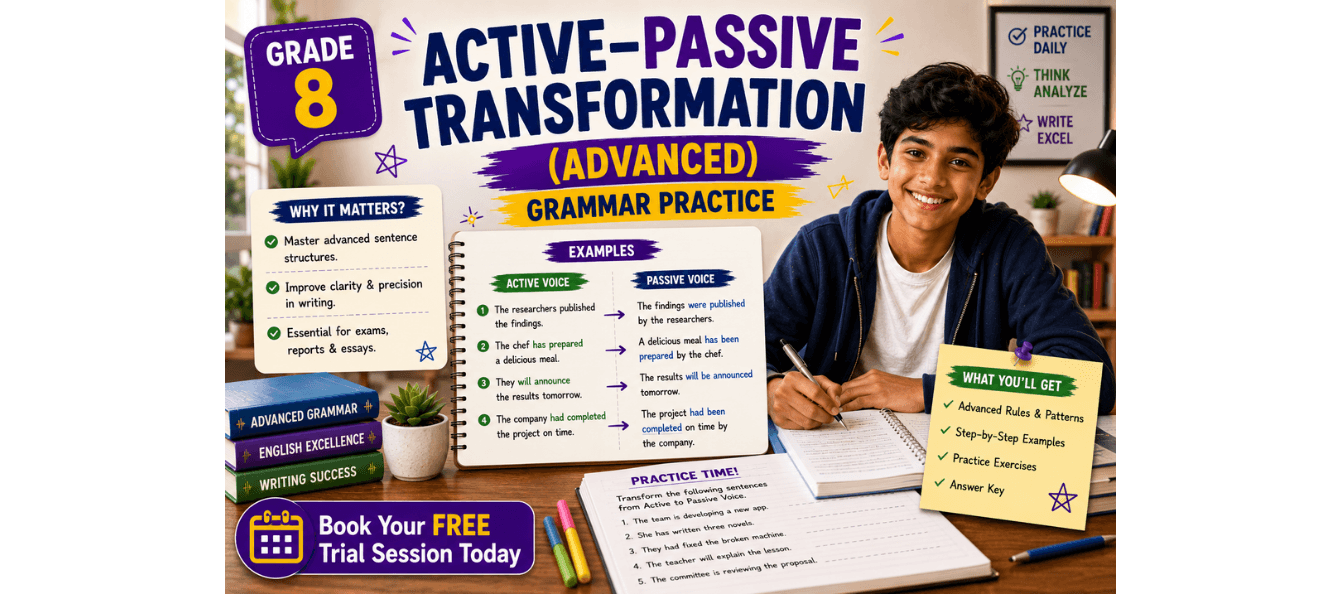
Active-passive transformation is the process of changing a sentence from active voice to passive voice. In active voice, the subject performs the action. In passive voice, the subject receives the action. The meaning of the sentence stays the same, but the structure changes.
For example, in the active sentence "Aarav plays cricket," Aarav is the subject and he performs the action. When we transform it to passive voice, it becomes "Cricket is played by Aarav." Here, cricket becomes the subject and receives the action.
When transforming to passive, the sentence structure is reversed. The object in active becomes the receiver in passive. The preposition by identifies the performer in passive voice. Transitive verbs can be transformed to passive voice, but changing intransitive verbs to passive is impossible.
Voice change needs careful attention to verb forms. Passive imperatives use be plus a participle form. A question can also be transformed into passive voice. The agent or performer can sometimes be dropped in passive voice when it is not important or not known.
What Is in This Worksheet?
This Grade 8 English grammar worksheet on active-passive transformation advanced contains five carefully designed exercises. Here is a breakdown of what you will find:
1. Multiple Choice Questions: Ten questions that test your understanding of voice transformation rules. Each question has three options, covering topics like the preposition by, transitive and intransitive verbs, tense consistency, and passive imperatives.
2. Fill in the Blanks: Ten sentences where you must choose the correct word from a word bank. The word bank includes reorganised, transformed, restructured, rephrased, recomposed, adjusted, reformulated, rewritten, converted, and modified. This exercise strengthens your vocabulary related to sentence transformation.
3. True and False: Ten statements about active and passive voice that you must mark as true or false. These statements test important rules such as whether every active sentence can become passive, whether intransitive verbs can form passive, and whether the word by is always needed.
4. Underline the Words: Ten passive voice sentences where you must underline the subject and circle the verb. This activity trains you to quickly identify the key grammatical components in a passive sentence.
5. Sentence Writing: Ten tasks where you must change sentences from active to passive voice, write passive sentences on given topics, and transform questions and imperatives into passive voice. Topics include village life, Diwali, market, school, and more.
Definitions, Examples, Techniques, and Tips
Here are the key definitions and concepts covered in this worksheet:
Active voice means the subject of the sentence performs the action. Passive voice means the subject of the sentence receives the action. When transforming to passive, the sentence structure is reversed.
The preposition by identifies the performer in passive voice. The object in active becomes the receiver in passive. The tense of the sentence remains identical on change, meaning the time of the action does not shift.
Transitive verbs can be transformed to passive voice. A transitive verb takes an object. Intransitive verbs cannot be changed to passive voice. Changing intransitive verbs to passive is impossible.
Passive imperatives use be plus a participle form. For example, the active imperative "Close the door" becomes "Let the door be closed" in passive voice.
A question can also be transformed into passive voice. For example, "Who taught you?" becomes "By whom were you taught?" in passive voice.
Voice change needs careful attention to verb forms. You must select the correct form of the be verb and the past participle based on the tense of the original sentence.
Here are some examples from the fill in the blanks exercise:
The line can be transformed into passive.
The line was rephrased for more clarity.
The clause should be restructured now.
The essay needs to be rewritten well.
The rule was adjusted to fit more.
The poem was recomposed from free verse.
The words were modified for the class.
The seats were reorganised for guests.
The plan has been reformulated this year.
The tune was converted with new beats.
Why Is It Important to Learn Active-Passive Transformation?
Learning active-passive transformation is important for many reasons. First, it gives you flexibility in writing. Sometimes you want to emphasise the doer of the action, and sometimes you want to focus on the action itself. Knowing both voices lets you choose the best structure for your sentence.
Second, passive voice is widely used in formal, academic, and scientific writing. When the performer of the action is unknown or unimportant, passive voice is the preferred choice.
Third, active-passive transformation is a common topic in school examinations. Questions on voice change appear in almost every English grammar test. Practicing with this worksheet prepares you to handle these questions quickly.
Fourth, understanding voice transformation helps you identify grammatical errors in your own writing and correct them.
Where Will This Knowledge Help You?
The knowledge of active-passive transformation is useful in many areas.
In essay and article writing, knowing when to use active and passive voice makes your writing more effective.
In science and research writing, passive voice is the standard. Research papers and lab reports frequently use passive voice to describe experiments.
In news reporting, passive voice is often used when the focus is on the event rather than the person responsible.
In grammar examinations, voice change questions test your understanding of verb forms, sentence structure, and tense consistency.
In reading comprehension, understanding passive voice helps you grasp the meaning of sentences quickly and improves your reading accuracy.
How to Use This Worksheet?
Follow these steps to make the most of this worksheet:
1. Read the worksheet title and instructions carefully. Understand that this worksheet focuses on advanced active-passive transformation.
2. Begin with Exercise 1, the multiple choice questions. Read each question and all three options before selecting your answer. Think about the rules of voice transformation as you choose.
3. Move to Exercise 2, the fill in the blanks section. Review the word bank and read each sentence carefully. Select the word that best fits the context of the sentence.
4. Attempt Exercise 3, the true and false section. Evaluate each statement based on your understanding of active and passive voice rules.
5. In Exercise 4, read each passive sentence and underline the subject. Then circle the verb. This helps you recognise the structure of passive sentences instantly.
6. In Exercise 5, carefully change each active sentence to passive voice. Pay attention to the tense, the verb form, and the placement of the subject and object.
7. After completing all exercises, check your answers using the complete answer key provided at the end of this blog. The solutions follow the worksheet order exactly, so you can verify each exercise step by step.
8. Note any mistakes and review the relevant rules. Understanding why an answer is wrong is just as important as knowing the correct answer.
Important Tips and Tricks
Here are some important tips to help you master active-passive transformation:
1. Identify whether the verb is transitive or intransitive before attempting a voice change. Only transitive verbs can be changed to passive voice. Intransitive verbs cannot form passive.
2. The tense always remains the same when you change from active to passive voice. If the original sentence is in the past tense, the passive sentence must also be in the past tense.
3. The subject and object swap places in passive voice. The object of the active sentence becomes the subject of the passive sentence.
4. Use the correct form of the be verb based on the tense. Present simple uses is, am, or are. Past simple uses was or were.
5. The main verb in passive voice always takes the past participle form. This is a common mistake that students make, so double-check your verb forms.
6. The preposition by is used to introduce the performer in passive voice, but it is not always needed. The agent can be dropped when it is not important or when it is unknown.
7. Questions can be changed to passive voice. The structure changes slightly, but the meaning remains the same.
8. Imperatives can also be changed to passive voice. Passive imperatives use be plus a participle form.
9. Changing voice does not alter the meaning of the sentence. The focus shifts, but the information stays the same.
10. Practice with different types of sentences, including statements, questions, and imperatives. The more variety you practice, the more confident you become.
Complete Answer Key
Exercise 1 - Multiple Choice Questions:
Q1 = b) reverses
Q2 = a) performer
Q3 = a) transformed
Q4 = a) identical
Q5 = b) receiver
Q6 = c) impossible
Q7 = a) participle
Q8 = a) reported
Q9 = c) attention
Q10 = a) transformed
Exercise 2 - Fill in the Blanks:
1. The line can be transformed into passive.
2. The line was rephrased for more clarity.
3. The clause should be restructured now.
4. The essay needs to be rewritten well.
5. The rule was adjusted to fit more.
6. The poem was recomposed from free verse.
7. The words were modified for the class.
8. The seats were reorganised for guests.
9. The plan has been reformulated this year.
10. The tune was converted with new beats.
Exercise 3 - True/False:
1. False
2. True
3. True
4. True
5. True
6. False
7. True
8. True
9. False
10. True
Exercise 4 - Underline the Subject and Circle the Verb:
1. The walls were painted by them.
2. The song was sung by Diya.
3. The cake had been eaten then.
4. The work is being checked now.
5. The match will be shown live.
6. The plants have been watered.
7. The lesson was taught well.
8. The letter had been posted.
9. The gifts are being given out.
10. The flag was raised today.
Underline the subject (the walls, the song, the cake, the work, the match, the plants, the lesson, the letter, the gifts, the flag) and circle the verb (were painted, was sung, had been eaten, is being checked, will be shown, have been watered, was taught, had been posted, are being given, was raised) in each sentence.
Exercise 5 - Rewrite:
Answers may vary.
1 Cricket is played by Aarav every evening.
2 A temple was built by them on the bank of the river.
3 By whom was the window broken?
4 A letter is being written by her at the moment.
5 You are ordered to leave the room immediately.
6 Farming is mainly done by the people in the village.
7 The homework was given to the students by the teacher.
8 Is the answer known to you?
9 Diwali is celebrated with great enthusiasm by people all over India.
10 Fresh vegetables are sold by the farmers at the market every morning.
Active-passive transformation is a valuable grammar skill that every Grade 8 student should practice regularly. It helps you write with greater flexibility and perform well in examinations. This worksheet on active-passive transformation advanced covers all the important concepts through carefully designed exercises. Keep working through the exercises, review the rules, and apply what you learn in your own writing. With regular practice, voice transformation will become one of your strongest grammar skills.