
Grade 8 Adjective Clauses (Relative Clauses) [With Examples]
![Grade 8 Adjective Clauses (Relative Clauses) [With Examples]](https://cdn5.planetspark.in/media/small_18_125d34a6ef.png)

Grade 8 English Grammar Worksheet on Adjective Clauses and Relative Clauses
Have you ever read a sentence that gives extra information about a person, place, or thing and wondered how it works? In Grade 8, students learn about adjective clauses, also called relative clauses, which do exactly that. An adjective clause is a group of words that describes or identifies a noun in a sentence, just like an adjective does. However, instead of a single word, an adjective clause gives you a full description using a relative pronoun like who, which, whose, whom, where, or that. This worksheet gives you a thorough practice set with multiple choice questions, fill in the blanks, true and false statements, underline activities, and sentence writing tasks to help you master this topic.
Download these English grammar worksheets and practice regularly to strengthen your language skills and build a strong foundation. You can also book a free trial to get expert guidance and improve your reading, writing, and comprehension abilities. The worksheets are designed in a simple and structured way to help K-8 students learn grammar concepts easily and use them confidently in everyday communication.
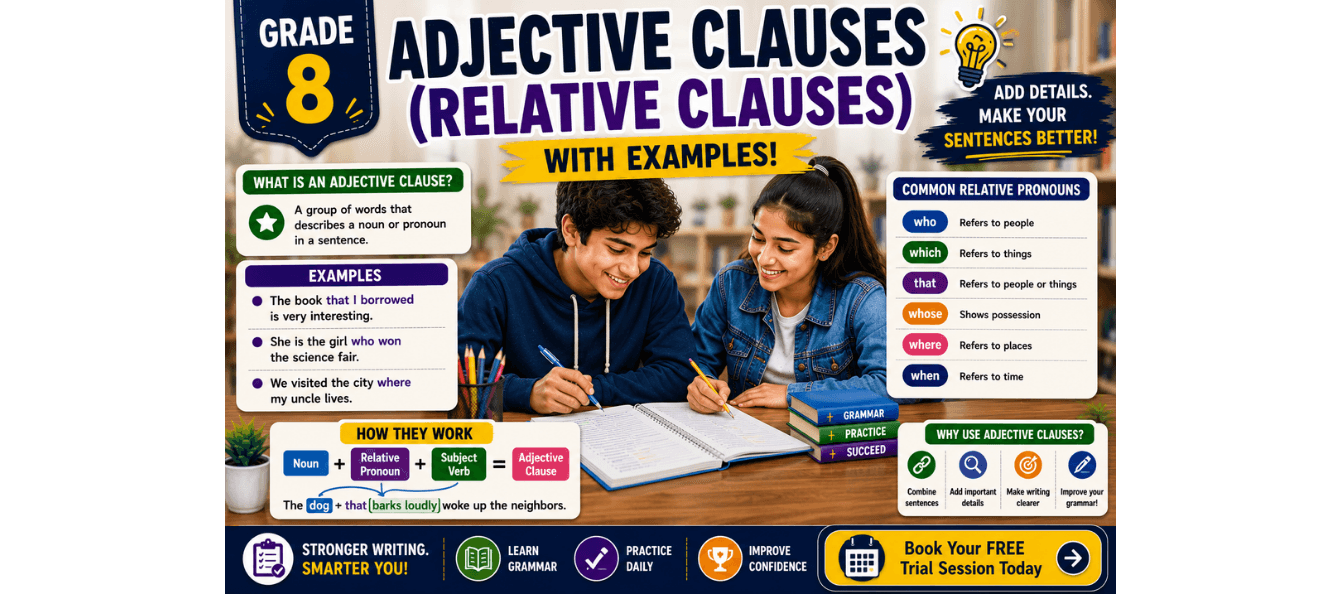
What Are Adjective Clauses and Relative Clauses?
An adjective clause is a type of dependent clause that describes or gives more information about a noun or pronoun in a sentence. It works like an adjective, but instead of a single word, it is a group of words that includes a subject and a verb. Because it is also called a relative clause, the two terms mean the same thing.
Relative clauses are introduced by relative pronouns such as who, which, whose, whom, where, that, and why. The pronoun "who" refers to individuals or people. The pronoun "which" refers to something or things. The pronoun "whose" indicates ownership or possession. The pronoun "where" is used for places. The pronoun "whom" is used for people in a formal way. The pronoun "that" can replace who or which in identifying clauses.
Relative clauses can be essential or nonessential. An essential relative clause gives information that is necessary to identify the noun, and it does not use commas. For example, in "The boy who won is Rahul," the clause "who won" is essential because it tells us which boy is being talked about. A nonessential relative clause gives extra information that is not necessary, and it is separated by commas. For example, in "The film which we saw was set," the clause "which we saw" adds additional information about the film.
This worksheet helps Grade 8 students learn how to identify, form, and use adjective clauses correctly in their writing and speech.
What's in This Worksheet?
This worksheet is created by Archita Srivastava and is designed for Grade 8 students who want to practise adjective clauses and relative clauses. Here is what you will find inside:
1. Multiple choice questions that test your understanding of relative pronouns, clause types, and how adjective clauses function in sentences with three options given for each question.
2. Fill in the blanks where you use a word bank with ten words including instructs, reviewed, celebrated, scientist, witnessed, discovered, encountered, scholarship, recommended, and performance to complete relative clauses.
3. True and false statements that check whether you can identify correct and incorrect rules and facts about adjective clauses and relative pronouns.
4. Underline the words activity where you underline the relative pronoun and circle the noun it describes in each sentence.
5. Sentence writing tasks where you rewrite sentences as directed, including writing a sentence with who in a relative clause, composing a sentence with which for things, forming a sentence using whose for ownership, writing a sentence with where, and creating a relative clause on a teacher, among other tasks.
The worksheet has a total of five exercises with increasing levels of difficulty to help you build your skills step by step.
Definitions, Examples, Techniques, and Tips
Here are the key concepts covered in this worksheet along with examples:
An adjective clause describes a noun or pronoun. The worksheet states that an adjective clause describes a noun or pronoun, meaning it gives more details about the person, place, or thing being mentioned.
"Who" refers to individuals in relative clauses. For example, "The boy who won is my friend" uses who to describe the boy.
"Which" refers to something in relative clauses. For example, "The film which we saw was set" uses which to describe the film.
"Whose" indicates ownership in a relative clause. For example, "The girl whose bag was lost spoke" uses whose to show the bag belongs to the girl.
"Where" can introduce a relative clause about place. For example, "The place where we met is near" uses where to describe the place.
"Whom" is used for people in a formal way. For example, "The man whom I met is a judge" uses whom to describe the man.
"That" can replace who or which in identifying clauses. For example, "The book that you gave is great" uses that instead of which.
Essential relative clauses give essential information about nouns. These clauses do not use commas. Nonessential relative clauses give additional information about nouns, and commas are used with nonessential relative clauses.
Omitting the relative pronoun is possible in identifying clauses. In some sentences, you can leave out the relative pronoun when it is the object of the clause.
A technique for fill in the blanks is to read the sentence carefully and think about what kind of word fits. For example, in "The girl who won the scholarship is from Delhi," the word scholarship fits because it is something a student wins.
Why Is It Important to Learn This?
Learning adjective clauses and relative clauses is very important for Grade 8 students. First, adjective clauses function like adjectives, which means they help you add detail and description to your writing. Instead of writing short and simple sentences, you can combine ideas using relative clauses to make your writing more interesting.
Second, relative clauses help you identify and distinguish between different nouns. When you say "The book that you gave is great," the clause helps the reader know exactly which book you are talking about.
Third, understanding relative pronouns improves your reading comprehension. In exams, questions on adjective clauses and relative pronouns are common, and knowing how they work helps you answer accurately and score better.
Where Will This Knowledge Help You?
Adjective clauses and relative clauses appear in many areas of language use. Here are some places where this knowledge will help you:
1. Writing descriptive essays and paragraphs in school where you need to give detailed information about people, places, and things.
2. Reading comprehension passages where authors use relative clauses to provide additional information about nouns.
3. Everyday conversations when you describe people, places, or events using extra details.
4. Grammar exams and competitive tests that include questions on relative pronouns and clause types.
5. Formal writing like reports, articles, and emails where correct use of clauses makes your writing clear and professional.
6. Creative writing where you want to add rich descriptions using adjective clauses to make your stories more engaging.
7. Understanding academic texts and textbooks where relative clauses are used frequently to explain concepts and define terms.
How to Use This Worksheet?
Follow these steps to get the most out of this worksheet:
1. Read each question carefully before answering. Do not rush through the questions.
2. For the multiple choice section, read the full sentence first and then look at the three options. Think about which relative pronoun or clause type fits best.
3. For the fill in the blanks, go through the word bank first: instructs, reviewed, celebrated, scientist, witnessed, discovered, encountered, scholarship, recommended, and performance. Then read each sentence and choose the word that completes the relative clause.
4. For the true and false section, read each statement and decide if it is correct or incorrect based on the rules of adjective clauses and relative pronouns.
5. For the underline activity, identify the relative pronoun in each sentence and underline it. Then circle the noun that the relative pronoun describes.
6. For the sentence writing section, follow the direction given for each question. Write your sentence clearly and check that it includes the correct relative pronoun or clause type.
7. After completing all questions, check your answers using the answer key provided below. The solutions follow the worksheet order exactly so you can verify each answer easily.
8. Review any mistakes you made and try to understand why the correct answer is right.
Important Tips and Tricks
Here are some important tips to keep in mind while working on adjective clauses and relative clauses:
1. Always read the full sentence before choosing an answer. The context tells you which relative pronoun is needed.
2. "Who" is used for people. If the clause describes a person, the answer is most likely who or whom.
3. "Which" is used for things and animals. If the clause describes a thing, use which or that.
4. "Whose" shows possession. If the sentence talks about something belonging to someone, use whose.
5. "Where" is used for places. If the clause describes a location, use where.
6. In the fill in the blanks section, each word from the word bank is used only once. Cross out words as you use them.
7. Commas are used with nonessential relative clauses. If the clause gives extra information that is not necessary, it should have commas.
8. "That" can replace who or which in identifying clauses but not in nonessential clauses.
9. A relative pronoun can be omitted in identifying clauses when it is the object of the clause, but it cannot be omitted when it is the subject.
10. Examiners expect you to use the exact relative pronoun required. Pay attention to whether the noun is a person, thing, or place before choosing the pronoun.
Complete Answer Key
Multiple choice questions answers:
Q1 = b) describes
Q2 = a) relative
Q3 = c) individuals
Q4 = a) something
Q5 = b) ownership
Q6 = c) additional
Q7 = a) relative
Q8 = b) identifying
Q9 = c) nonessential
Q10 = a) identifying
Fill in the blanks answers (in order):
1. scholarship
2. scientist
3. reviewed
4. discovered
5. encountered
6. witnessed
7. performance
8. celebrated
9. instructs
10. recommended
True and false answers:
1. True
2. False
3. True
4. False
5. True
6. True
7. True
8. True
9. True
10. False
Underline the relative pronoun and circle the noun it describes: For each sentence, underline the relative pronoun (who, which, that, whose, where, whom, why) and circle the noun that the pronoun describes. This applies to all ten sentences in the exercise.
Sentence writing answers:
Answers may vary.
1 The boy who stood first in the class was awarded a gold medal.
2 The book which I borrowed from the library has many interesting stories.
3 The girl whose father is a doctor won the science competition last week.
4 This is the park where we play cricket every evening after school.
5 Mrs Sharma, who teaches us Mathematics, is the kindest teacher in our school.
6 The Agra Fort, which was built by the Mughal emperor Akbar, attracts thousands of tourists every year.
7 My brother Aarav, who is an excellent swimmer, has won many medals at the state level.
8 The monsoon, which usually arrives in June, brings great relief from the scorching summer heat.
9 The principal, to whom I spoke yesterday, promised to look into the matter immediately.
10 The village where my grandmother lives is surrounded by green fields and tall coconut trees.
Practising adjective clauses and relative clauses regularly will help you feel more confident in your Grade 8 English grammar skills. This worksheet covers all the important areas you need to focus on, from choosing the correct relative pronoun in multiple choice questions to writing your own relative clauses. The more you practise, the easier it becomes to identify and use adjective clauses accurately in your writing and speech. Keep working through exercises like this one and you will see a clear improvement in your understanding of relative pronouns and how adjective clauses work.