
Grade 8 Noun Clauses (Advanced Usage) [Printable Grammar Worksheet]
![Grade 8 Noun Clauses (Advanced Usage) [Printable Grammar Worksheet]](https://cdn5.planetspark.in/media/small_17_356f0246a0.png)

Grade 8 English Grammar Worksheet on Noun Clauses (Advanced Usage)
Have you ever wondered how a single clause can act like a noun inside a sentence? Noun clauses are powerful grammatical structures that Grade 8 students often find challenging but incredibly useful. They can function as subjects, objects, and complements, giving your sentences depth and sophistication. This blog will walk you through the concept of noun clauses and share a complete Noun Clauses (Advanced Usage) worksheet designed by Archita Srivastava that covers everything from multiple choice questions to creative sentence writing.
You can download all our worksheets for free and book a free trial to get expert guidance on English grammar topics like this one.
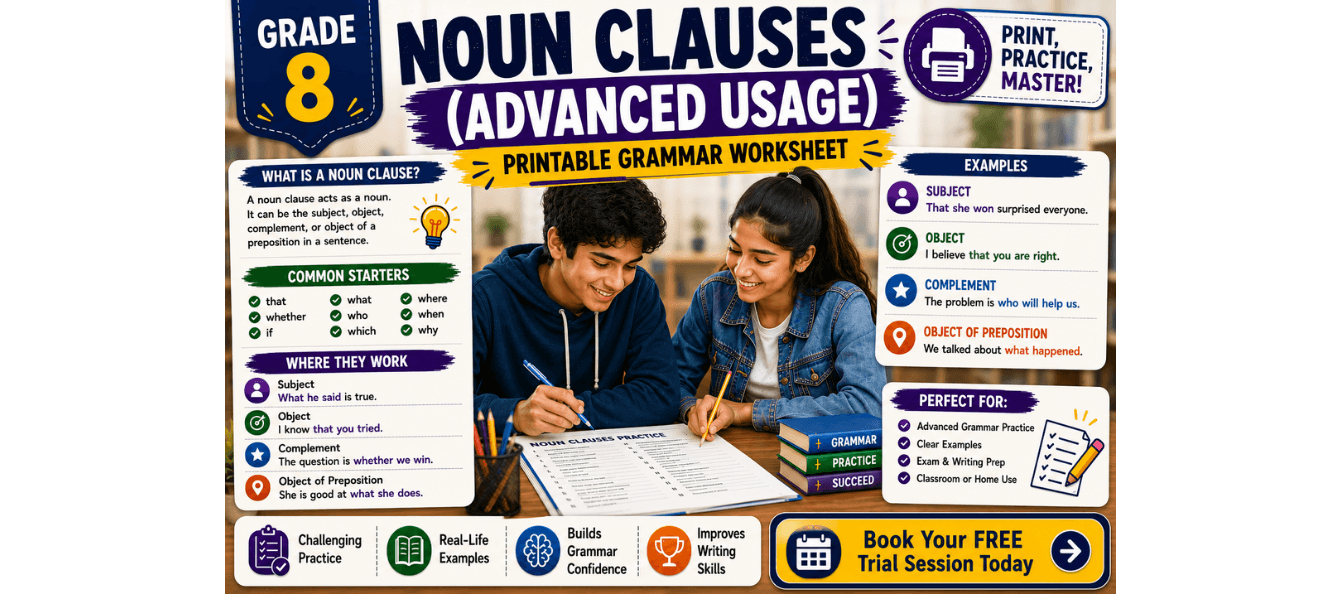
What Is Noun Clauses (Advanced Usage)?
A noun clause is a dependent clause that functions as a noun within a sentence. It can serve as the subject, object, or complement, just like a regular noun would. Noun clauses typically begin with words such as "that," "what," "whatever," "whichever," "wherever," "whenever," "whether," "who," "whoever," or "whomever." For example, in the sentence "I know that she is coming," the noun clause "that she is coming" acts as the object of the verb "know." Advanced usage involves recognising noun clauses in various sentence structures and understanding that they always contain both a subject and a predicate.
Noun clauses are always subordinate clauses in sentences. They cannot stand alone and depend on the main clause to convey a complete thought. They are frequently found in complex sentences and never modify nouns the way adjective clauses do. Instead, they function entirely as nouns, making them one of the most versatile tools in English grammar.
What's in This Worksheet?
This Grade 8 English grammar worksheet by Archita Srivastava includes five exercises that thoroughly test your understanding of noun clauses:
1. Multiple choice questions covering the fundamentals of noun clauses, including their functions, introductory words, and structural properties.
2. Fill in the blanks exercise that provides a word bank of reporting verbs and noun clause starters, testing your ability to choose the correct word for each sentence.
3. True and false statements that check your conceptual clarity about what noun clauses can and cannot do within sentences.
4. Underline the noun clause and circle the verb exercise that builds your analytical reading skills by asking you to identify clauses and their related verbs in context.
5. Sentence writing tasks where you compose your own sentences using different types of noun clauses such as "what" clauses, "whether" clauses, and "whoever" clauses.
Definitions, Examples, Techniques, and Tips
A noun clause always has a subject and a predicate. The subject is who or what the clause is about, and the predicate tells what the subject does or is. In "What she said shocked us," the noun clause "What she said" acts as the subject of the main sentence, with "she" as the subject and "said" as the predicate inside the clause.
A noun clause acts as the subject, object, or complement. When used as a subject, the entire clause occupies the subject position: "That he was late was excused." When used as an object, it follows the main verb: "I feel that truth is best." When used as a complement, it completes the meaning: "What he said shocked us."
Noun clauses often begin with "that," "what," or "whatever." They answer questions like "who" or "whomever." They are frequently found in complex sentences and are always subordinate. A noun clause can also be the object of a preposition, as in "I am interested in what she said," where "what she said" is the object of the preposition "in."
Noun clauses do not modify nouns like adjectives do. If a clause describes a noun, it is an adjective clause. Noun clauses function purely as nouns. Common noun clause starters include "that," "what," "whatever," "whichever," "wherever," "whenever," "whether," "who," "whoever," "whom," and "whomever." Memorising these words helps you spot noun clauses quickly in any sentence.
Why Is It Important to Learn This?
Learning noun clauses is important for several reasons. First, noun clauses appear frequently in exams and competitive tests. Questions about clause identification, sentence correction, and error detection often target noun clauses, and knowing how they work helps you score well.
Second, noun clauses allow you to write more sophisticated sentences. Instead of writing "She will come. I know this," you can write "I know that she will come," which flows much better and sounds more polished.
Third, understanding noun clauses builds a strong foundation for advanced grammar topics like reported speech, conditional sentences, and relative clauses. Each of these topics relies on your ability to identify and use dependent clauses correctly.
Fourth, noun clauses are everywhere in everyday English. From newspaper articles to novels, from formal emails to classroom discussions, noun clauses help pack complex ideas into single, well-structured sentences.
Where Will This Knowledge Help You?
This knowledge will help you in many areas of your academic and daily life. In school, you will use it in every English exam and in writing assignments across all subjects.
In reading comprehension passages, noun clauses often carry the key information. Being able to identify them helps you extract meaning faster and answer questions more accurately.
In competitive exams, grammar sections are a major component. Questions on error detection, sentence correction, and fill in the blanks frequently test your understanding of noun clauses and their functions.
In daily communication, using correct grammar shows attention to detail and makes your writing more credible. Whether you are writing a formal letter, an email to a teacher, or a social media post, knowing how to use noun clauses correctly always makes a strong impression.
How to Use This Worksheet?
Follow these simple steps to get the most out of this worksheet:
1. Read through the definitions and explanations above so that you understand the basic rules before you begin.
2. Start with the multiple choice questions in Exercise 1. Read each sentence carefully and choose the option that correctly completes it.
3. Move on to the fill in the blanks in Exercise 2. Use the word bank provided and think about whether each sentence needs a noun clause starter or a reporting verb.
4. Attempt the true and false exercise next. Read each statement and decide whether it is correct or incorrect based on your understanding of noun clause rules.
5. For Exercise 4, read each sentence, underline the noun clause, and circle the verb it follows. Take your time to analyse the sentence structure.
6. Finally, complete the sentence writing tasks in Exercise 5. Use your creativity and understanding of noun clauses to write meaningful sentences for each prompt.
7. After finishing all exercises, check your answers using the complete answer key provided at the end of this blog.
8. Review any mistakes you made and try to understand why the correct answer is right.
Important Tips and Tricks
Here are some tips and tricks to remember when working with noun clauses:
1. Always look for a subject and a verb inside the clause. If a group of words has both and functions as a noun, it is a noun clause.
2. Memorise the common noun clause starters: "that," "what," "whatever," "whichever," "wherever," "whenever," "whether," "who," "whoever," "whom," and "whomever."
3. Remember that noun clauses do not modify nouns. If a clause describes a noun, it is an adjective clause, not a noun clause.
4. Noun clauses can be objects of prepositions. Do not assume that only noun phrases can fill this role.
5. Noun clauses are always dependent. They can never stand alone as a complete sentence.
6. In true or false questions, pay close attention to words like "always" or "cannot." These absolutes often signal a false statement.
7. When writing noun clauses, start by forming a question in your mind. "What does she want?" becomes "I know what she wants." This technique makes it easier to form correct sentences.
8. Practice identifying noun clauses in your daily reading. The more you see them in context, the faster you will recognise them in exercises and exams.
Complete Answer Key
Exercise No. 1 - Multiple Choice Questions:
1. b) subordinate
2. a) complement
3. c) modifier
4. a) complement
5. b) whenever
6. c) whomever
7. a) correlative
8. b) sometimes
9. c) identical
10. a) predicate
Exercise No. 2 - Fill in the Blanks:
1. whatever
2. whichever
3. Wherever
4. Whenever
5. explained
6. suggested
7. believed
8. reported
9. demanded
10. discovered
Exercise No. 3 - True and False:
1. True
2. True
3. True
4. True
5. False
6. False
7. False
8. True
9. True
10. True
Exercise No. 4 - Underline the Noun Clause and Circle the Verb:
1. Noun clause: "that she is coming" - Verb it follows: "know"
2. Noun clause: "If she will come" - Verb it follows: "is"
3. Noun clause: "That he was late" - Verb it follows: "was"
4. Noun clause: "he would go to the museum" - Verb it follows: "said"
5. Noun clause: "that he passed" - Verb it follows: "was"
6. Noun clause: "What he said" - Verb it follows: "shocked"
7. Noun clause: "Whoever solves this" - Verb it follows: "wins"
8. Noun clause: "that truth is best" - Verb it follows: "feel"
9. Noun clause: "what time it was" - Verb it follows: "asked"
10. Noun clause: "where the book is" - Verb it follows: "Tell"
Exercise No. 5 - Sentence Writing:
Answers may vary.
1. What she said during the assembly surprised everyone in the school.
2. I know what you want to achieve in this examination.
3. The teacher explained that the earth revolves around the sun.
4. Whether she will attend the function or not is still uncertain.
5. He believes that hard work always leads to success in life.
6. That the school won the first prize in the debate competition is a matter of great pride.
7. How the cricket match ended surprised all the spectators at the stadium.
8. Whoever finishes the assignment first will receive a special reward from the teacher.
9. What makes Diwali special is the joy of celebrating it with family and friends.
10. The villagers believe that the old temple at the centre of the village is over five hundred years old.
Noun clauses may seem tricky at first, but with consistent practice and a solid understanding of their structure, they become one of the most useful tools in your grammar toolkit. This worksheet by Archita Srivastava is designed to give Grade 8 students a thorough workout in identifying, analysing, and writing noun clauses. By working through every exercise and reviewing the answer key, you will build the confidence to tackle any noun clause question that comes your way. Keep practising, stay curious, and watch your grammar skills grow stronger with every sentence you write.