
Grade 8 Adverb Clauses (Time, Cause, Condition, Contrast) [Free PDF]
![Grade 8 Adverb Clauses (Time, Cause, Condition, Contrast) [Free PDF]](https://cdn5.planetspark.in/media/small_19_7aa0006eee.png)

Grade 8 English Grammar Worksheet on Adverb Clauses (Time, Cause, Condition, Contrast)
Have you ever wondered why some sentences feel richer and more informative than others? The secret often lies in adverb clauses, those powerful groups of words that add meaning to verbs by telling us when something happened, why it happened, under what condition it happened, or how it contrasts with another fact. Sentences like "When the bell rang, we ran" or "Although she was tired, she finished her homework" appear everywhere in the books you read. Mastering adverb clauses is a crucial step in Grade 8 English grammar because it transforms simple sentences into complex, expressive ones.
This blog walks you through the concept of adverb clauses of time, cause, condition, and contrast, and shares a carefully designed worksheet by Archita Srivastava covering multiple choice questions, fill in the blanks, true and false, clause identification, and sentence writing.
Download these English grammar worksheets and practice regularly to strengthen your language skills and build a strong foundation. You can also book a free trial to get expert guidance and improve your reading, writing, and comprehension abilities. The worksheets are designed in a simple and structured way to help K–8 students learn grammar concepts easily and use them confidently in everyday communication.
What Is Adverb Clauses (Time, Cause, Condition, Contrast)?
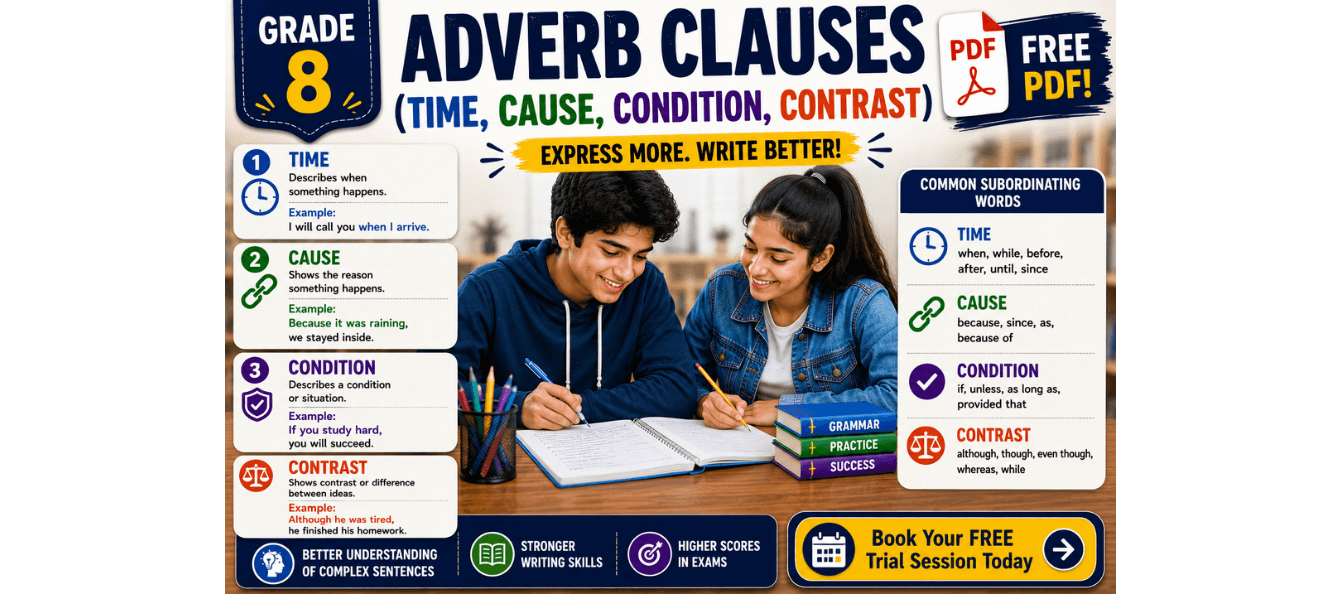
An adverb clause is a dependent clause that functions as an adverb in a sentence. Unlike a single adverb like "quickly" or "yesterday," an adverb clause includes a subject and a verb, and it modifies the main verb by answering questions such as when, why, under what condition, or how something contrasts with another fact.
Adverb clauses of time tell us when an action takes place, introduced by conjunctions such as when, while, before, after, since, until, and whenever. For example, "Before the train arrived, we bought the tickets" uses a time clause to show sequence.
Adverb clauses of cause tell us why something happens, introduced by conjunctions such as because, since, and as. For example, "Because it rained heavily, the match was cancelled" gives the reason for cancellation.
Adverb clauses of condition tell us under what circumstances something will happen, introduced by conjunctions such as if, unless, and provided that. For example, "If you study regularly, you will pass the exam" sets a condition for passing.
Adverb clauses of contrast tell us about something unexpected or opposite to the main clause, introduced by conjunctions such as although, though, whereas, and even though. For example, "Although Pooja practised hard, she lost the match" presents a contrasting fact.
Understanding these four types and their subordinating conjunctions is the key to writing sophisticated sentences.
What's in This Worksheet?
This Grade 8 English grammar worksheet by Archita Srivastava includes five exercises that test every aspect of your understanding of adverb clauses of time, cause, condition, and contrast:
1. Multiple choice questions that test your conceptual knowledge of adverb clauses, including their function, the type of relationship each subordinating conjunction introduces, the meaning of words like "unless," and punctuation rules for introductory adverb clauses.
2. Fill in the blanks with a word bank of verbs such as apologised, finished, practised, departed, travelled, explained, continues, attempts, fascinated, and prepared, challenging you to choose the correct verb for each sentence containing an adverb clause.
3. True and false statements that check your clarity about adverb clause rules, including what they modify, which conjunctions show contrast, cause, time, and condition, and comma rules.
4. Underline the adverb clause and circle the subordinating conjunction exercise that builds analytical reading skills by asking you to identify both the clause and the conjunction within complex sentences.
5. Sentence writing tasks where you create sentences using adverb clauses of time, condition, contrast, and cause on topics including sports, school, monsoon, Diwali, and cities.
Definitions, Examples, Techniques, and Tips
A subordinating conjunction introduces an adverb clause and connects it to the main clause. Common conjunctions for time include when, while, before, after, since, and until. For cause, they include because, since, and as. For condition, they include if, unless, and provided that. For contrast, they include although, though, whereas, and even though.
An adverb clause always contains a subject and a verb. In "When the bell rang, we ran," the clause "when the bell rang" has the subject "the bell" and the verb "rang," distinguishing it from a simple adverb or adverb phrase.
The word "unless" means "if not." In "Unless you try, you do not grow," the clause can be rewritten as "if you do not try" without changing the meaning.
"When" is used for a single moment or point in time, while "while" is used for a continuing or simultaneous action. Understanding this difference helps you use both conjunctions accurately.
A comma is required after an adverb clause at the beginning of a sentence: "If you study hard, you will pass." No comma is needed when the clause comes at the end: "You will pass if you study hard."
The word "since" can introduce both time and cause clauses depending on context. "Although" and "though" both introduce contrast clauses and can be used interchangeably in academic writing.
Why Is It Important to Learn This?
Learning adverb clauses is essential for several reasons. First, it is a frequently tested topic in Grade 8 English grammar examinations. Questions on identifying adverb clauses, choosing the correct conjunction, and punctuating complex sentences appear regularly, and a solid understanding helps you score well.
Second, adverb clauses let you write complex sentences that convey more information. Instead of writing "It rained. The match was cancelled," you can write "Because it rained, the match was cancelled." This makes your writing more concise and professional.
Third, understanding adverb clauses improves reading comprehension. Novels, newspapers, and textbooks contain complex sentences with adverb clauses, and recognising them helps you understand relationships between ideas.
Fourth, this knowledge prepares you for advanced grammar topics such as reduced adverb clauses, sentence transformation, and complex sentence structures in higher grades.
Where Will This Knowledge Help You?
This knowledge will help you across many areas of your academic life. In school, every English grammar exam includes questions on clauses, and this worksheet targets the types that appear most frequently in Grade 8 assessments.
In essay and story writing, adverb clauses of time help you narrate events in sequence, clauses of cause help you build logical arguments, and clauses of contrast allow you to present opposing viewpoints in persuasive writing.
In reading comprehension, understanding adverb clauses helps you identify why, when, and under what conditions something happened, leading to more accurate answers and better interpretation of passages.
In competitive exams such as Olympiads, clause-related questions including error detection, sentence completion, and sentence transformation are common.
How to Use This Worksheet?
Follow these simple steps to get the most out of this worksheet:
1. Read through the definitions and explanations above so that you understand the four types of adverb clauses, their subordinating conjunctions, and the basic punctuation rules before you begin.
2. Start with the multiple choice questions. Read each question carefully, think about the rules of adverb clauses, and choose the best option.
3. Move on to the fill in the blanks. Use the word bank and think about which verb fits the context of each sentence with an adverb clause.
4. Attempt the true and false exercise next. Read each statement and decide whether it is correct based on your understanding of adverb clause rules and punctuation.
5. For the clause identification exercise, read each sentence carefully, underline the complete adverb clause, and circle the subordinating conjunction. Pay attention to the boundary between the clause and the main clause.
6. Complete the sentence writing tasks last. Create sentences using adverb clauses on the given topics, focusing on the correct subordinating conjunction and proper sentence structure.
7. After finishing all exercises, check your answers using the complete answer key provided at the end of this blog.
8. Review any mistakes and try to understand why the correct answer is right. This is the most important step for long-term learning.
Important Tips and Tricks
Here are some tips and tricks to remember when working with adverb clauses:
1. Always identify the subordinating conjunction first. Words like when, because, if, although, since, unless, while, and whereas signal an adverb clause. Once you spot the conjunction, the clause usually follows until the next comma or the end of the sentence.
2. Remember that adverb clauses are dependent clauses. They cannot stand alone. "Because it rained" is not a complete sentence. It must be attached to a main clause such as "the match was cancelled" to form a complete thought.
3. Use a comma after an introductory adverb clause but not before a concluding one. "When the bell rang, we ran" is correct. "We ran when the bell rang" is also correct and does not need a comma.
4. Learn the specific meaning of each conjunction. "Although" always shows contrast, "because" always shows cause, "if" always shows condition, and "when" always shows time. Mixing these up can change your sentence meaning entirely.
5. Be careful with "since" and "while" because each can serve two functions. "Since" can show time or cause. "While" can show time or contrast. Always read the full sentence to determine which meaning applies.
6. When writing sentences, make sure your adverb clause has both a subject and a verb. Avoid fragments. "Although she was tired, she worked" is the full form with a complete clause.
7. In true and false questions, watch for absolute statements. If a statement says adverb clauses "always" need a comma, it is likely false because grammar rules usually have exceptions depending on sentence position.
8. Practice converting simple sentences into complex sentences by adding adverb clauses. For example, "She worked hard" can become "Although she was unwell, she worked hard." This improves both understanding and creative writing ability.
Complete Answer Key
Exercise 1 – Multiple Choice Questions
1. b) modifiers
2. a) subordinate
3. c) condition
4. c) whenever
5. b) contrast
6. c) sentence
7. a) drizzling
8. b) condition
9. c) contrast
10. a) whenever
Exercise 2 – Fill in the Blanks
1. attempts
2. practised
3. travelled
4. explained
5. prepared
6. finishes
7. fascinated
8. prepared
9. apologised
10. continues
Exercise 3 – True or False
1. True
2. False
3. True
4. False
5. True
6. True
7. True
8. True
9. False
10. True
Exercise 4 – Underline the Adverb Clause and Circle the Subordinating Conjunction
1. Underline: When the bell rang | Circle: When
2. Underline: Since it rained | Circle: Since
3. Underline: If you study | Circle: If
4. Underline: Though tired | Circle: Though
5. Underline: After the guests left | Circle: After
6. Underline: While Pooja read | Circle: While
7. Underline: Since he was out | Circle: Since
8. Underline: Unless you try | Circle: Unless
9. Underline: Before the train came | Circle: Before
10. Underline: Though nervous | Circle: Though
Exercise 5 – Sentence Writing
Answers may vary.
1. When the bell rang, all the students rushed to the playground for the sports period.
2. Because she was unwell, the teacher allowed her to leave the class early.
3. If you study regularly, you will definitely score good marks in the examination.
4. Although it was raining heavily, the children went out to play football in the mud.
5. After the match ended, the captain thanked the coach for his guidance throughout the tournament.
6. Unless you complete your homework, the teacher will not allow you to join the school picnic.
7. While the monsoon clouds gathered, the farmers happily prepared their fields for sowing seeds.
8. Before Diwali arrives, families start cleaning their homes and shopping for new clothes and gifts.
9. Since he was the tallest boy in the class, the teacher selected him for the basketball team.
10. Whereas the city is always noisy and crowded, the village remains peaceful and quiet throughout the day.
Mastering adverb clauses of time, cause, condition, and contrast is a skill that will serve you throughout your academic career. Whether you are writing a story with clear time sequences, building an argument with cause-and-effect reasoning, or presenting contrasting viewpoints, adverb clauses give you the tools to express complex ideas with confidence. This worksheet by Archita Srivastava provides a thorough practice session covering every dimension of adverb clauses, from recognising conjunctions in multiple choice format to identifying clauses within complex sentences and writing original sentences on diverse topics. Work through each exercise, review your answers using the answer key, and keep practising until using adverb clauses becomes a natural part of your writing. Strong grammar is the backbone of confident communication.